
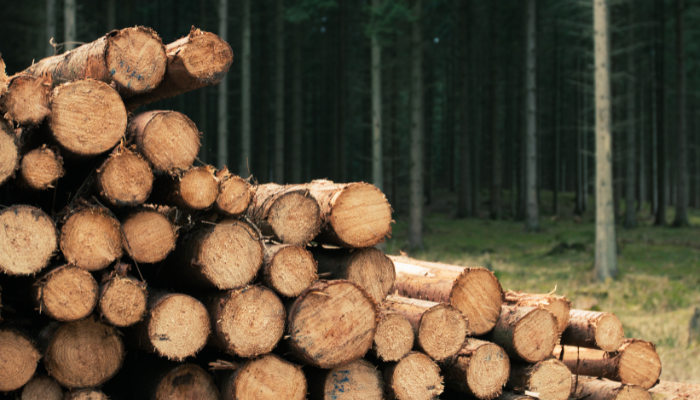
Accurate, real-time information on the volume and classification of timber being harvested is an essential tool for forest managers, contractors, and forest owners. In this, the sixth of eight articles in a series, Teagasc Forestry Advisors explain the role of the harvesting head.
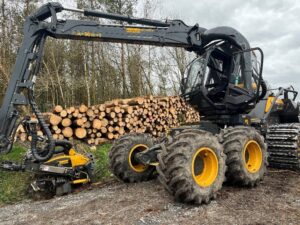
Modern mechanised harvesters are equipped with advanced onboard computers and measuring systems, that record data automatically as trees are processed in the forest. These systems measure each log’s length and diameter as it passes through the harvester head, allowing the machine to calculate the volume and assign the log to a specific product category (e.g. sawlog, pallet, pulp, or stake).
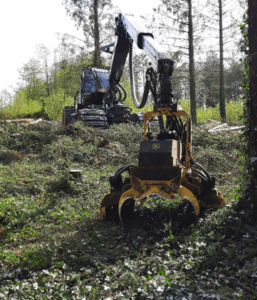
Data from a regularly calibrated harvesting head can be invaluable, not only for tracking productivity trends and optimising harvesting, but also for post-harvest analysis. It can be used to confirm whether the harvesting operation has met yield expectations, whether the correct sizes and categories of trees were cut, and whether any adjustments to future operations are needed.
Data available from the technology onboard modern timber harvesters plays a powerful role in managing forest operations. This data is also a valuable resource to forest owners; providing real-time information on the volume, percentage and number of different products cut on a specific site or in a particular period of time.
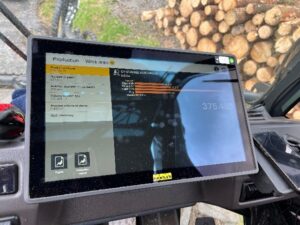
Example
The sample printouts from a timber harvester outlines the breakdown of harvested timber by species, log length class, volume (in cubic metres), and number of logs, giving a clear overview of the output from a specific forested area. This kind of data-driven insight supports efficient decision-making, improves communication between harvesting teams and landowners, and enhances the overall sustainability and profitability of forest operations.
Sample Printout 1
| Sample Printout | |||
| Spruce | Length Class | Vol m3 | No. of Logs |
| Commercial | 4.90 | 1635.58 | 4751 |
| 5.50 | 481.43 | 1111 | |
| Comm 2 | 3.70 | 842.40 | 3385 |
| Pallet | 2.50 | 419.52 | 4171 |
| 3.10 | 1039.86 | 8623 | |
| Pulp | 3.00 | 1607.01 | 23781 |
Sample Printout 2
| Sample Printout | |||
| Spruce | Length Class | Vol m3 | No. of Logs |
| Commercial | 4.90 | 42.42 | 126 |
| Comm 2 | 3.70 | 15.87 | 88 |
| Pallet | 2.50 | 21.03 | 237 |
This printout contains two datasets
- The first dataset (top section) is data from an area of 11 ha of clearfelled spruce forest.
- The second dataset (bottom section) represents a much smaller area of 4 ha of windblown spruce forest.
Each dataset categorises the harvested spruce timber into different classes; Commercial (Sawlog), Comm 2 (Stakewood), pallet and pulp.
For each timber class, the report provides the length (m), the volume (m³) and the number of logs processed.
Relevance to forest owners
This simplified example highlights the efficacy of modern harvesting equipment in assessing and processing trees as it harvests.
This data can easily be made available to the forest owner and represents another part of controlling and recording timber harvests, supporting transparency and traceability in selling timber.
Teagasc forestry advisors are available to provide objective guidance and support to forest owners. For further information, contact your local Teagasc forestry staff and visit the forestry section of the Teagasc website.
View the full series of fact sheets on controlling a conifer harvest here
Why not engage with your local forestry advisor by booking a free appointment at one of the current series of One-to-One Forestry Support Clincs with a focus of providing guidance for storm-impacted forests.