
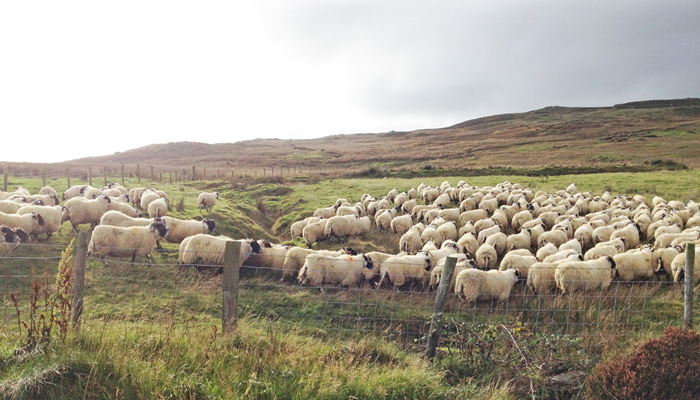
Joanne Masterson, Drystock Advisor, Teagasc Athenry, tells us about the Kerrigan family’s journey in developing an organic hill sheep system Co. Galway.
In recent years, Martin Joe and his son Martin have joined the Teagasc BETTER Farm Sheep Programme with their hill flock. They have also changed the farm system to an organic hill sheep system in recent years. The farm is situated in Glentrague, Clonbur, Co. Galway. Martin Joe and Martin manage 220 Connemara/Mayo Blackface ewes, 40 replacement ewe hoggets, and six stock rams on 133 hectares (329 acres) of good-quality, mineral-type enclosed hill grazing, along with an additional 10 hectares of semi-improved and improved grazing in the foothills. On 11 September, the Kerrigans will be holding a BETTER Farm Walk on their farm (details below). In this article, I will go through some of the work that has been taking place on the farm recently, as well as some of the plans going forward.
Weaning
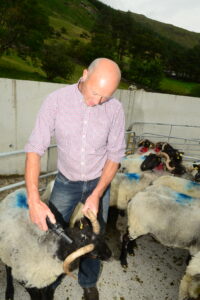
Weaning has taken place recently on the farm, with the Kerrigans happy with the performance of their Connemara/Mayo Blackface flock in 2025, with all lambs being weighed and recorded at 7 weeks of age and at weaning (14 weeks of age).
Flock management up to weaning
Single-rearing ewes and their lambs were turned out to the hill grazing almost immediately after lambing. This allowed the twin-rearing ewes to be run on the improved grassland up to the end of June. At this stage, twin-rearing ewes were also put to a separate area of the hill grazing for a month to build up grass on the improved ground for lambs post-weaning. The twin-reared lambs were weaned in early August to allow their dams more time to recover body condition before the next mating. The single-rearing ewes were gathered from the hill and weaned on 18 August. All lambs were treated with a white drench at around 7 weeks of age for Nematodirus. Only one subsequent treatment for stomach worms has been needed, which was based on checking faecal egg counts from dung samples.
Lamb performance 2025
As mentioned earlier, very good lamb performance was again achieved this year. The lamb performance to weaning (adjusted to lamb weights at 100 days of age) is summarised in Table 1.
Table 1: Lamb performance to weaning 2025
| Birth type | Birth weight (kg) | Weaning weight (kg) | ADG 0–14 weeks (g/day) |
|---|---|---|---|
| 1 | 4.2 | 23.2 | 194 |
| 2 | 3.3 | 20.4 | 174 |
Marketing of lambs
About 20 ram lambs suitable for breeding have been selected and genotyped. These will be sold as SIS-eligible ram lambs which, like last year, are expected to be in big demand. A further 50 ram lambs weighing between 25–30kg have been sold to Teagasc to join the lamb finishing trials. The remaining ram lambs will be sold as stores. The breeding policy of retaining homebred ewe lambs not only reduces the risk of buying in unwanted disease issues but also offers the opportunity to fully exploit genetic improvement. This important task took place at weaning, selecting replacements that are true to type, and by selecting well-grown lambs they are choosing progeny from the top-performing ewes in the flock. As parentage of these replacements has been recorded, inbreeding can be avoided when these lambs come of age to join the ram at 19 months old. Once replacements are taken out, the plan is to sell the remaining ewe lambs at special breeding sales held locally in Maam Cross and Ballinrobe.
Ewe management post-weaning
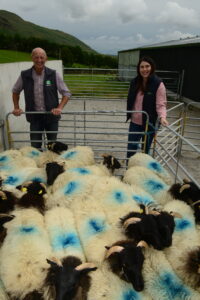
All ewes will go through their annual fitness-for-breeding health check after weaning, checking udders, teeth, body condition score, feet etc., with culls being identified for selling. Ewes that have had issues during the year, such as prolapse for example, have had this information recorded on the handheld device and can now also be identified for culling. It is anticipated that a small number of ewes in poor body condition at weaning will be kept on the low ground to help regain body condition, with the remaining ewes returning to the hill until near mating time. This allows the low ground to rest and build grass covers for the breeding season. In the coming weeks, two replacement rams, including at least one SIS-eligible ram, will be purchased for the upcoming breeding season. The plan is to turn out rams to around 200 ewes in mid-November. Ewes will have their body condition score recorded before they are divided into mating groups in the days running up to introducing the rams.
BETTER Hill Sheep Farm Walk
The BETTER Hill Sheep Farm Walk will be taking place on the farm of Martin Joe and Martin Kerrigan (Eircode F12 VH72) on Thursday 11 September at 6:30pm.
Topics discussed on the evening include:
- Overview of the farm system and flock performance
- Ewe and ram management pre-mating
- Hill grazing
- Sheep Ireland OviFlock update