
Rachel Holmes and Pablo Silva Boloña discuss the impact of different dry-off procedures and treatments on somatic cell count (SCC).
The mammary gland is more susceptible to intramammary infections (IMI) during the early and late dry periods. Many dairy farms, including those in Ireland, are moving away from widespread antibiotic dry cow therapy, opting instead for teat sealant (TS) alone for uninfected or low SCC cows.
Irish studies found that low SCC cows treated with TS alone had higher odds of increased SCC and IMI in the following lactation compared to those treated with antibiotics. This suggests that dry-off procedures or management during the dry and early lactation periods may make TS-treated cows more susceptible to infections.
An observational study reported that cows cleaned with surgical spirit swabs at dry-off had lower SCC, and a second study showed that partial insertion of the antibiotic tube at dry-off resulted in fewer new IMIs compared to full insertion. However, there is limited controlled research on dry-off procedures.
This study aimed to evaluate the impact of two dry-off procedures and two dry-off treatments on SCC during the following lactation.
Experimental design
This study was conducted between October 2023 and December 2024 at the Teagasc Moorepark research herd, which follows a pasture-based spring calving system with 326 cows. Weekly individual SCC recordings are conducted in this herd. During the dry period, cows were housed in cubicle sheds with daily cleaning and disinfecting. Cows with monthly SCC ≤100,000 cells/ml and no clinical mastitis during the lactation were eligible for the study.
Two dry-off procedures were explored:
- Guidelines-based dry-off (GDO)
- Common practice dry-off (CDO)
Two dry-off treatments were tested:
- Antibiotic plus internal teat sealant (AB+TS)
- TS alone
The GDO procedure followed strict hygiene, disinfection, and partial insertion of both the antibiotic and TS tube. The CDO procedure was the farms usual practice following simpler disinfection steps.
Sixty cows were randomly assigned to one of the four possible treatment combinations (GDO-AB+TS, GDO-TS, CDO-AB+TS, CDO-TS), resulting in 15 cows per group.
At dry-off, cleanliness and TS visibility from the outside after dry-off were assessed by an independent staff member.
The impact of the combination of dry-off technique and treatment on SCC during the first 30 days in milk (DIM) was evaluated.

Visible teat sealant at teat-end post-infusion, creating an effective barrier.
Dry-off procedures
Guidelines-based dry-off procedure (GDO)
- Clip udder and tail hair before dry-off
- New pair of gloves
- Teat disinfection (minimum 30 s contact) – dry teats
- Dry teats with paper towel
- Disinfect with cotton and methylated spirits
- Disinfect with 70% alcohol wipes
- Partially insert nozzle
- Massage antibiotic – never touching teat end
- Pinch base of teat for teat sealant infusion
- Teat sealant visible from outside teat (teat canal cover)
- Apply disinfectant (dip)
Common practice dry-off procedure (CDO)
- New pair of gloves
- Automatic spray – no minimum contact time
- Dry teats with paper towel
- Disinfect with cotton and methylated spirits
- Massage antibiotic – never touching teat end
- Pinch base of teat for teat sealant infusion
- Automatic spray of teat disinfectant
Results
Cows treated with TS alone and dried-off with the CDO procedure had significantly higher SCC in the first 30 days of the next lactation compared to the other groups.
61.7%, 56.3%, 60.4% and 30.6% of teats were deemed ‘Clean’ in the GDO-AB+TS, CDOAB+ TS, GDO-TS and CDOTS groups, respectively.
85%, 31.3%, 95.8% and 19.4% of TS was deemed ‘visible’ in the GDO-AB+TS, CDO-AB+TS, GDO-TS and CDO-TS groups, respectively.
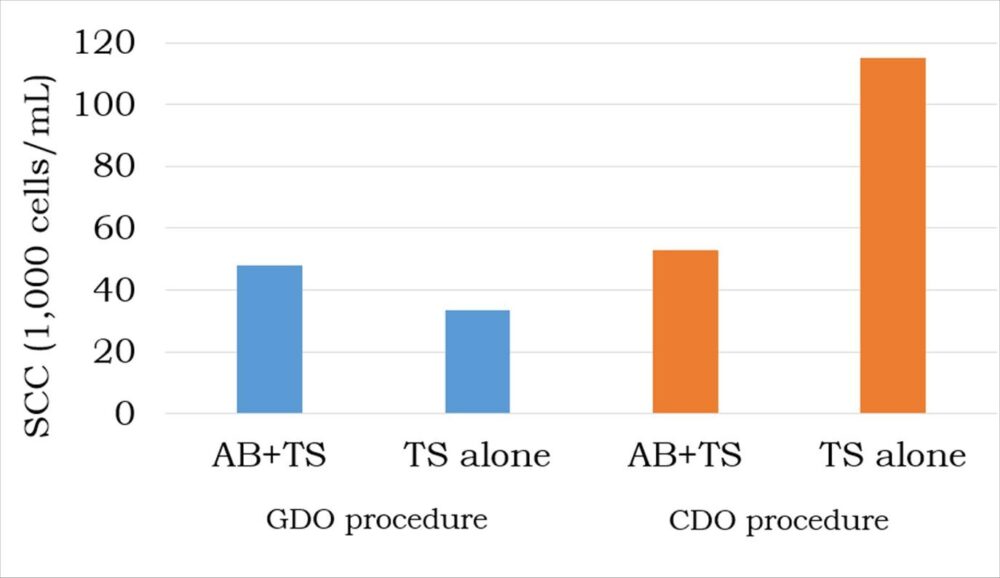
Average SCC in the first 30 days in milk for the dry-off procedure (GDO, CDO) and dry-off treatment (AB+TS, TS) combinations.
Conclusion
This study showed the importance of a clean and accurate technique for applying dry-off treatments, especially for cows being treated with TS only. In the context of widespread selective dry cow therapy, farmers should observe a high hygiene standard to dry-off cows.
The above article was first published Teagasc/Dairygold Milk Quality Farm Walk booklet. Read more about the Milk Quality Farm Walk at the Kennedy Farm in Tipperary, 28th August 2025