The recently released 2025 Beef Calving Statistics Report from the Irish Cattle Breeding Federation (ICBF) highlights opportunities for earlier and more compact calving in suckler herds. Catherine Egan, Beef Specialist at Teagasc, examines the findings and their implications for beef farmers.
Research from Teagasc and the experience of nearly one in five suckler beef farmers who calve their heifers at 24 months demonstrate clear financial and environmental benefits of earlier calving. Calving at 24 months significantly reduces the cost of replacement heifers, as older heifers incur higher rearing costs before calving. Furthermore, older heifers have a greater environmental footprint due to increased methane emissions per calf over their lifetime. Other benefits of calving at 24 months include reduced labour costs: there are simply fewer stock groups to manage.
According to the ICBF, the proportion of heifers calving at 24 months has remained stable for over a decade. In 2025, about 19% of heifers calved between 22 and 26 months of age. This figure rises significantly to 25.4% for farmers with herd sizes of 75 to 99 cows. For herds in this category participating in the Suckler Carbon Efficiency Programme (SCEP) and HerdPlus programmes, the percentage increases further to 29%.
Although the two-year old calving percentage has remained relatively stable, there are a number of actions that suckler farmers can take to improve this statistic.
Growth rates in early life are critical to ensuring heifers reach their target of 380-420kg at breeding time. Selecting heifers with a high Replacement Index reduces the age at first calving, as animals reach puberty sooner and are more fertile. Good management is important to ensure they could express their genetic potential.
Table 1: Percentage of heifers calving 22-26 months national average and averages for different herd sizes and scheme participation
| Herd size | All | SCEP | Non-SCEP | SCEP & HerdPlus |
| National average | 19 | 21 | 16 | 23 |
| 10-14 | 18.9 | 21 | 17 | 23 |
| 15-19 | 16.8 | 18 | 15 | 19 |
| 20-29 | 19.1 | 21 | 14 | 24 |
| 30-39 | 18.5 | 19 | 16 | 21 |
| 40-49 | 22 | 23 | 18 | 26 |
| 50-74 | 24.7 | 25 | 21 | 26 |
| 75-99 | 25.4 | 28 | 11 | 29 |
| 100+ | 22.6 | 24 | 12 | 25 |
Compact calving
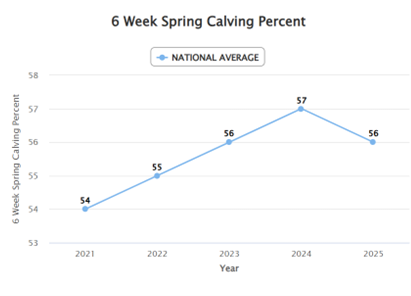
Compact calving is often discussed at Teagasc events. It’s a key focus area for farmers enrolled in the Teagasc Future Beef Programme, who are aiming for a shorter, more concentrated calving period. The target is to have 80% of the herd calved within the first six weeks. This approach improves efficiency and profitability by allowing farmers to focus their resources, increase the number of calvings per cow over her lifetime, and better manage resources and labour, ultimately leading to a more successful and profitable suckler herd. Currently, as seen in Figure 1, the national average for 2025 is 56%, which has increased only slightly since 2021.
Figure 1: 5 year trend for 6 week spring calving percent