
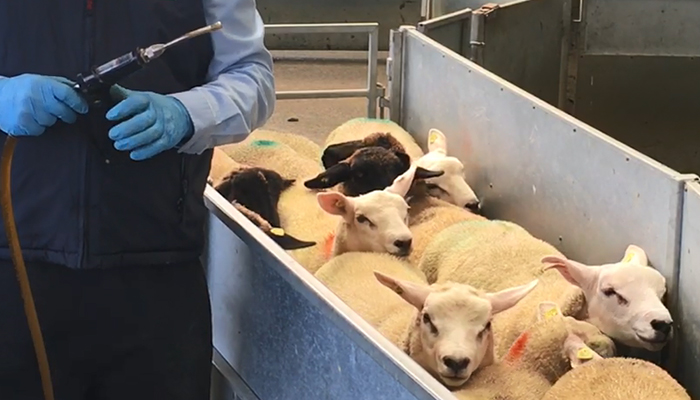
Orla Keane explains the importance of drench testing for anthelmintic effectiveness in sheep, and details how to conduct a drench test.
A drench test is a quick and simple test to assess if an anthelmintic treatment of a flock worked as it should.
Grazing lambs are continually picking up gastrointestinal nematodes (stomach worms) from the sward. These parasites cause appetite suppression and protein loss from the gut, resulting in ill-thrift. If the worm burden becomes high enough, it can lead to clinical disease and, in severe cases, even death.
Sheep develop immunity to stomach worms over time, and healthy animals usually have reasonable immunity by 1 year of age. However, immunity can wane during times of stress, such as lambing or nutritional or disease challenges.
Control of stomach worms is generally achieved by the administration of anthelmintics (wormers). Despite the large number of products on the market, there are only five classes of wormer for the control of stomach worms in sheep:
- White wormers – benzimidazoles
- Yellow wormers – levamisole
- Clear wormers – macrocyclic lactones
- Orange wormer – amino acetonitrile derivative (POM-V)
- Purple wormer – spiroindole (POM-V)
When first introduced, these wormers were highly effective (>99% kill). However, worms have now developed anthelmintic resistance.
Lambs should always be treated with a wormer that is fully effective on the farm to prevent disease and reduce resistant worm shedding.
The only way to know which wormers are working on your farm is by testing.
The gold-standard test for resistance is the Faecal egg Count Reduction Test (FECRT). If interested in this test speak to your vet or adviser.
A drench test is a simple test than can indicate if further investigation is necessary. This test involves collecting dung samples before treatment from a group of lambs and sending it to a lab to count the number of worm eggs. The lambs are then treated with the wormer to be tested. Dung samples are collected a set number of days after treatment and again sent to the lab for a worm egg count. If the wormer used was effective then the worms will be killed and there will be no (or very few) worm eggs in the sample after treatment. If some worms are resistant then there will be worm eggs in the dung sample after treatment.
Drench test procedure
- Select a group of 15 lambs at random and hold them in a clean pen. Place a mark or record the tag numbers to identify these lambs.
- Allow 1 to 2 hours for the lambs to dung. Then collect up to 10 separate fresh dung samples and place them in faecal sampling containers.
- Treat the lambs with the wormer to be tested according to the manufacturer’s instructions ensuring that the equipment is calibrated and the lambs are treated to the weight of the heaviest lamb in the group.
- Send the faecal samples to the lab as soon as possible, preferably on the day of collection. If there is a delay prior to posting place the samples in a fridge (do not freeze or leave in direct sunlight).
- Record the pre-treatment egg count (faecal egg count; FEC) when the results are returned from the lab.
- Gather the marked lambs in a clean pen a set number of days after treatment (see below). Allow 1 to 2 hours for the lambs to dung. Then collect up to 10 separate fresh dung samples and place in faecal sampling containers.
If testing a yellow wormer collect the second faecal sample 7 days after treatment
If testing a white or clear wormer collect the second faecal sample 14 days after treatment - Send the faecal samples to the lab as soon as possible, preferably on the day of collection. If there is a delay prior to posting place the samples in a fridge (do not freeze or leave in direct sunlight).
- Record the post-treatment egg count of the lambs when the results are returned from the lab.
- Calculate the reduction in egg count after treatment as described below
% Reduction = ((Pre-treatment FEC – Post-treatment FEC) / Pre-treatment FEC) x 100
If the reduction is <95% then this is an indication that the wormer is most likely not effective on the farm. In this case, contact your vet or adviser for further testing and advice on steps to take to slow the further development of resistance.
Worked example
Pre-treatment FEC: 800 eggs per gram (epg)
Post-treatment FEC: 400 eggs per gram (epg)
% Reduction = ((800-400)/800) x 100 = 50% reduction – drug likely not effective