
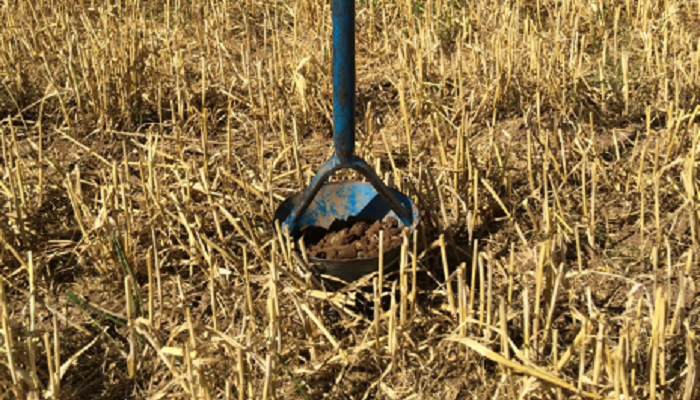
The post-harvest period is the ideal time to look at the health of your soils in tillage systems. With yield patterns still fresh in your mind, you can assess whether problems are linked to soil structure or fertility, Soil and Plant Nutrition Specialist, Dr. Veronica Nyhan tells us more.
To check for structural issues, use a Visual Evaluation of Soil Structure (VESS) – a simple “Double Spade” profile assessment. To identify fertility issues, take a soil sample. Together, these tests guide your decisions on key inputs such as organic manures, lime and the development of a Nutrient Management Plan (NMP).
Why Soil Sampling Matters
As the foundation of every NMP, the soil sample is critically important. For Irish tillage farmers, it is not just a compliance exercise but a vital step in maximising crop yield, reducing input costs and protecting the environment.
A reliable soil sample tells you what’s in your soil and what needs to be added – but only if it is taken correctly. Results must be accurate and representative of the field, as they remain valid for up to four years from the 15th September prior to sampling. These results determine your nutrient loading during that period.
More frequent sampling may be wise on very light soils, or where phosphorus (P) or potassium (K) fixation is known to occur. Poor technique, on the other hand, leads to misleading results, wasted money, and potentially harmful nutrient applications.
Good soil sampling practice
To ensure your soil samples provide the best information for managing your farm sustainably, follow these steps:
- Sample at the right time
- Take samples at least 3 months after fertiliser or slurry, and two years after lime.
- The best time is in autumn or early winter, before spring cultivations begin. Ideally resample at the same time each year.
- Use the correct depth and equipment
- For tillage soils, sample to a depth of 10 cm using a soil corer or auger.
- Ensure tools are clean and free from fertiliser or lime residues.
- Divide fields sensibly
- Each sample area should not exceed 5 ha, where soil type and cropping history are consistent. Ideally, take one sample per 2–4 ha for greater accuracy.
- Divide fields by soil type, slope, and management history – and sample them separately.
- Take a representative sample
- Walk the field in a W-shaped pattern and take at least 20 cores per sample area.
- Avoid usual spots where animals gather or where manure or lime has been heaped as it will impact the result
- Mix cores thoroughly in a clean plastic bucket before filling the sample bag.
- Keep accurate records
- Label samples clearly with farm name, field number, and date.
- Store results safely to guide fertiliser planning, liming, and crop rotations.
New Administrative Requirement (2025 Onwards)
From 14th September 2025, under SI 42 of 2025, a new rule applies to soil sample reports. Every soil analysis result must state the geo-reference (GPS co-ordinates) or the LPIS parcel number of the land represented by the sample. If this information is missing, the parcel will automatically default to P Index 4.
The LPIS number is the identifier shown on your BISS maps (a letter plus 10 digits). The most recent up-to-date parcel number must be used so it is important to only use current BISS maps when organising soil sampling. Geo-reference means GPS co-ordinates, presented as latitude and longitude, linked to a soil sample. The co-ordinates can be given as either Decimal degrees (DD), as Degrees, minutes, seconds (DMS), or as Degrees and decimal minutes (DMM). If one sample represents several small parcels, the printed report must include the LPIS number or geo-reference for each parcel.
Accurate soil sampling is the cornerstone of sustainable tillage farming in Ireland. With proper technique and compliance with the new reporting rules, farmers can cut input costs, boost yields, and meet regulatory requirements.
Get soil sampling wrong, and your nutrient management plan is undermined. Get it right, and you’ll make smarter decisions and grow healthier crops.
Soil Health Week
From Monday, 22 September to Friday, 26 September, Teagasc will host Soil Health Week, a dedicated weeklong initiative designed to support and inspire farmers, students and the general public with the latest insights, innovations, and practical guidance on soil health. From informative podcasts and live “Ask the Expert” webinar, to farm walks, expert-led lectures, and engaging talks, the week offers a packed schedule aimed at deepening understanding and sparking conversation around sustainable soil management.