
Soil is the foundation of farming, food security, and life itself. It sustains crops, supports biodiversity and stores carbon. In this article we explore how you can maintain and improve your soil structure.
For farmers, soil is their most valuable asset, shaping the productivity and profitability of their land. But soil can be fragile, its structure can be damaged by compaction or poor management. Once damaged, if rested a soil will naturally try to remediate itself but it is often difficult to restore. This article provides practical tips to understand, evaluate, and manage soil structure, ensuring that this important resource is maintained.
What Is soil structure?
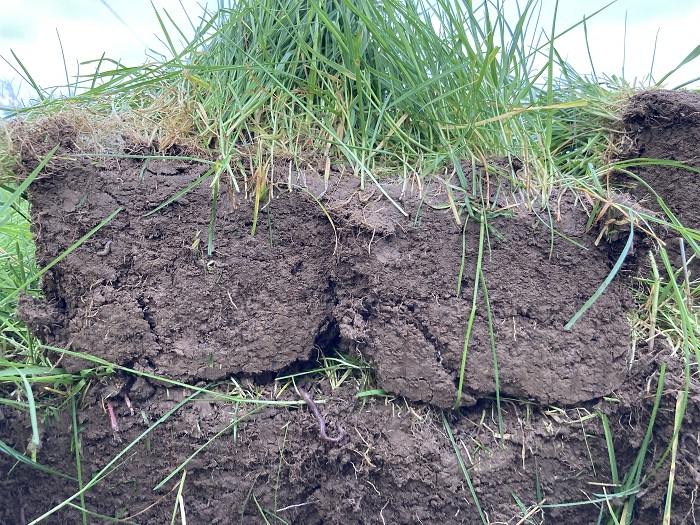
Soil structure refers to the arrangement of soil particles – sand, silt, and clay – into aggregates, natural clumps of soil. These aggregates form pores, cracks, and spaces, known as soil porosity, which control the movement of air, water, and nutrients. Within aggregate pore spaces are small and hold water for plants and soil organisms to use. Between aggregate pore spaces are larger, allowing excess water to drain away and holding air for plant use. Soil structure is not to be mistaken with soil texture. Texture refers to the proportions of sand, silt, and clay in the soil and gives the soil it’s characteristic feel- gritty, buttery, sticky. We can improve or destroy soil structure through management, but soil texture is fixed.
Key components of soil structure
- Form – the physical arrangement of soil aggregates.
- Stability – the ability of soil to resist breakdown under stress.
- Resilience – the capacity of soil to recover after damage.
Why soil structure matters
The structure of soil determines how it functions. Its arrangement affects:
- Water movement – pores drain excess water and store moisture.
- Air circulation – roots and soil organisms need oxygen.
- Temperature regulation – influencing microbial activity and crop growth.
- Crop yields – poor structure reduces nutrient uptake and productivity.
Impacts of poor soil structure
- Compaction squeezes aggregates together, reducing porosity.
- Waterlogging occurs when rain cannot drain, depriving roots of oxygen.
- Yield loss: Research showed a 12% drop in porosity and a 20% reduction in winter barley yields due to compaction.
- Biodiversity decline: Earthworms, insects, and microbes die off in poorly aerated soils.
- Nutrient loss: In waterlogged soils, nitrogen can be converted into harmful gases like nitrous oxide.
Healthy soil supports billions of microbes per gram, stores freshwater, locks away carbon, and provides the base for food, fuel, and fiber. Damaged soil undermines all these vital functions.
How to assess soil structure in the field
Unlike lab tests, soil structure can be visually assessed on-site. You can dig, break apart, and observe soil blocks to evaluate structure. provides a scoring system to rate soil quality.
Features to examine
- Aggregate size & shape: Smaller, rounded aggregates indicate better structure.
- Strength: Good soil crumbles easily, poor soil is hard to break.
- Porosity: Presence of pores and cracks inside aggregates.
- Root growth: Healthy soils allow unrestricted root penetration.
- Colour & smell: Earthy smell is good, foul smell or grey/blue colours indicate poor drainage.
Assessments take 15–20 minutes per site and require only a spade, tray, and score sheet.
Conserving and improving soil structure
Know your soil
- Use VESS regularly to identify structural problems.
- Record depth and severity of compaction.
- Tailor solutions to your particular issues.
Prevention is better than cure
- Avoid traffic on wet soils – livestock and heavy machinery can cause lasting compaction.
- Reduce axle loads – use lighter machinery, lower tyre pressures, and controlled traffic.
- Maintain organic matter – soil organic matter improves aggregate stability and resilience.
- Diversify management depth – rotate crops with different rooting depths.
Mechanical interventions in situations of extreme compaction
- Ploughing: Useful if damage is extreme and occurs above 25 cm.
- Subsoiling: For deep compaction (>25 cm). Subsoiling can only be conducted when the compaction layer depth is known consistently across the field and the soil is dry at this depth. Careful soil management is required after subsoiling to avoid re-compaction
- Drainage: Improves resilience in poorly drained soils but requires proper design.
Soil structure underpins food production, water management, biodiversity, and climate regulation. By routinely assessing soil structure, preventing damage, and applying interventions wisely, farmers can protect their soils and contribute to environmental sustainability.
Read more: The Soil Structure ABC – A practical guide to managing soil structure
Soil Health Week 2025
From Monday, 22 September to Friday, 26 September, Teagasc is hosting Soil Health Week, a dedicated weeklong initiative designed to support and inspire farmers, students and the general public with the latest insights, innovations, and practical guidance on soil health.