
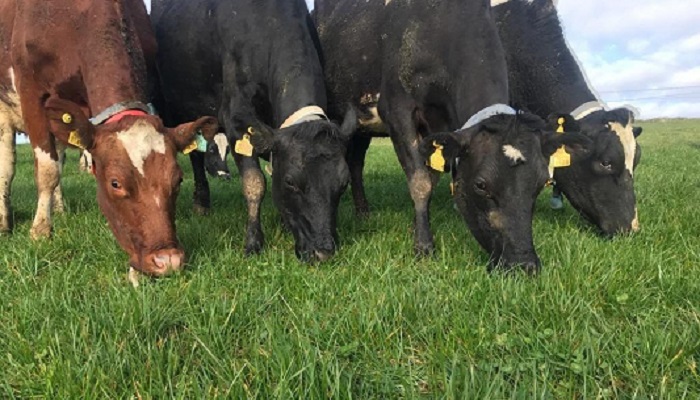
Updates to the Economic Breeding Index (EBI) are being rolled out this week, Kevin Downing of the Irish Cattle Breeding Federation (ICBF) fills us in on what these changes will mean on the ground.
Since its launch, the Economic Breeding Index has consistently proven itself to be the best predictor of on-farm profit. To ensure it continues to be as relevant to today’s farming environs, ICBF in partnership with Teagasc are updating the dairy evaluations this autumn.
Over the coming days and weeks farmers familiar with the EBI will notice changes to the EBI values published for their herd. These changes stem chiefly from the updating of the base cow population and the revision of the economic values to best reflect recent and future projections of market prices. Furthermore, there has been the inclusion of new models for health and management sub-indexes, which enhances the accuracy of the associated traits within each sub-index.
These changes aim to accelerate genetic gain, support better health and management decisions, and enhance the profitability and sustainability of the national dairy herd. Despite changes in EBI figures, most herds will experience minimal change in their overall ranking of animals within their herds; overall, farmers will see a reduction of approximately €83 per animal due to the combined impact of these changes.
Changing the base cow
On its own, changing the base cow population would actually mean no change at all to every animal’s position in the EBI ranking. Every animal is simply reduced by the exact same amount. This is because dairy evaluations require a reference point, or a base cow population, against which genetic progress is measured and thus providing a quantifiable scale of the improvements being made at national level. Within the current guise of the EBI, the base for milk and fertility were 2005-born cows milk recorded in 2007, 2008 and 2009. The latest evaluation run will see this move to a more recent cohort of animals, 2015-born cows, milk recorded in 2017, 2018 and 2019. The change makes the index more reflective of what’s happening at farm level and preventing over inflation of EBI values and keeps the EBI value aligned with the performance being witnessed at farm level.
Changing the base cow population will result in each animal’s EBI reducing by €97. This reduction actually reflects the amount of genetic progress achieved over the past 10 years, now that the base has been updated to a more recent cow cohort. Of this €97 adjustment, an average of €45 will be removed from the milk sub-index and €52 from the fertility sub-index. However, because the change is applied across all animals equally, it will not cause any re-ranking within herds.
Changes to economic values
The economic values underpinning the EBI are derived from the Moorepark Dairy Systems Model (MDSM). This model has recently been updated to better reflect the economics of milk production in Ireland, where significant shifts in input and output prices have taken place.
As a result, EBI figures published as part of the latest evaluation run will account for rising input costs – such as increased feed (€250/t to €370/t), fertiliser (€420/t to €550/t), energy (€0.15 to €0.25/kwh) and labour costs, along with higher output prices and future market projections. Additionally, to align the beef-sub index within the EBI with the Dairy Beef Index (DBI), carcass weight and cull cow valves have also been updated.
Table 1: Update economic weights in the EBI (Source: ICBF)
| Sub-Index | Trait | Official (May 2025)
€ |
New (September 2025)
€ |
| Milk | Protein kg | 5.88 | 6.83 |
| Fat kg | 2.08 | 2.16 | |
| Milk kg | -0.09 | -0.11 | |
| Fertility | Calving interval | -12.59 | -13.72 |
| Survival | 12.43 | 11.53 | |
| Calving | Gestation | -7.93 | -8.84 |
| Mortality | -2.58 | -2.58 | |
| Direct Calving Difficulty | Non-Linear | ||
| Maternal Calving Difficulty | Non-Linear | ||
| Beef | Age at finish | -1.01 | -1.27 |
| Carcass conformation | 13.18 | 13.18 | |
| Carcass weight | 2.29 | 3.01 | |
| Cull cow | 0.03 | 1.12 | |
| OPS Dairy | 0.75 | 0.75 | |
| Maintenance | Live Weight | -0.74 | -1.69 |
| Management | Milking Time | -0.31 | -0.35 |
| Temperament | 35.86 | 62.6 (scale change) | |
| Health | Lameness | -72.47 | -82.33 |
| Mastitis | -82.65 | -97.10 | |
| SCC | -43.49 | -43.49 | |
| TB | -3.45 | -3.45 | |
Changes to maintenance sub-index
Farmers examining their EBI reports will also notice adjustments to the beef and maintenance sub-indices for their herd. These changes reflect three key updates; the increase in the value of beef, higher feed costs (up by 40%), and the reallocation of heifer rearing costs from the cull cow element of the beef sub-index into the maintenance sub-index.
As a result, the economic value applied to the cost of maintaining each additional kilogram of cow live-weight has increased by 43%. This means the predicted live-weight (kg) of heifers based on the maintenance sub-index (table 2 below) will also be revised.
Similarly, due to the increase in the cull cow price and carcass weight, the beef sub-index for cows will see an average increase of €5, with the bigger cows being rewarded more and the smaller cows being penalised more.
Table 2: Predicted live weight of a mid-lactation 3rd parity Holstein-Friesian mature cow based on the old and new maintenance sub-index (Source: ICBF)
| Old Maintenance Sub-Index
(up to May ‘ 25) |
New Maintenance Sub-Index
(from Sept ’25) |
Predicted Live Weight (kg) |
| €23 | €44 | 525 |
| €16 | €29 | 550 |
| €10 | €15 | 575 |
| €4 | €0 | 600 |
| -€2 | -€14 | 625 |
| -€8 | -€28 | 650 |
| -€15 | -€43 | 675 |
New models for health and management traits
Additionally, both the health and management genetic evaluations have been recently revised. Some of the key changes include:
- Lameness and mastitis will now use records from multiple lactations, so cows with repeated cases are better reflected in the evaluations.
- Temperament: The scale has been simplified from 5 points to 3 points, making it quicker and easier to score.
- Locomotion scores: Linear locomotion scoring is now used to help predict overall health, giving a clearer picture of mobility issues.
- Better data checks and calculations: We have improved the way information is cleaned and analysed, so the results are more reliable.
- More accurate evaluations: We now use the latest international “single-step genomic” method, which combines pedigree and DNA data in one step for greater accuracy.
For more information on changes to the EBI, visit the ICBF website. Alternatively, speak to your local Teagasc dairy advisor.
More from Teagasc Daily: Aurivo Focus Farmers lead breeding gains out west