
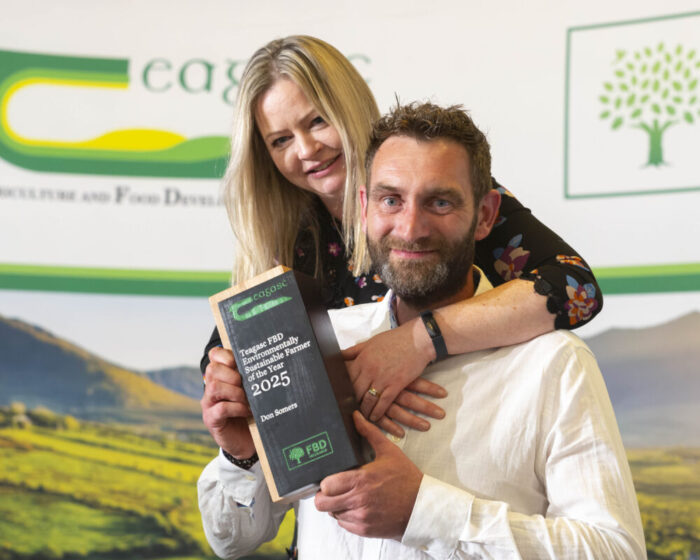
Don Somers, a tillage farmer from Oylgate, Co. Wexford has won the overall Teagasc FBD Environmental Sustainability Award 2025.
Don farms in partnership with his uncle Jim, sharing both machinery and labour resources. Farming 183ha, the main enterprise is winter and spring cereal production.
Although proud of his achievement, Don was quick to acknowledge the support and advice he has received over the years from other farmers, learning from their experiences – both good and bad. This willingness to share – including what works and what doesn’t – is something Don brings back to his own farming endeavours and any discussions he may have with other farmers looking to take a similar approach to his own.
Fertiliser Planning
Every year, Don plans his fertiliser programme on the basis of two things: what nutrients the crops remove from the soil when they grow, and how much is already in the ground. This way, nothing is wasted. Precision soil samples are taken every second year on this farm, based on varying soil types within fields, resulting in an average soil sample area of 2.1ha (lower than the 4ha allowance) for greater accuracy. Careful planning means his crops get what they need, but no more, protecting both the soil and the environment.
The Power of Organic Manure
Alongside fertiliser, Don makes good use of organic manures such as poultry litter, farmyard manure and dairy sludge. Getting hold of enough manure and transporting it can be tricky, but he sees big benefits through cost savings, adding valuable organic matter to the soils and thus making the whole system more sustainable.
He has a dedicated storage area in the yard, which allows him to transport during quitter times of the year and have it on hand for spreading the day he wants it.
Analysis is carried out to know exactly the nutrient content of what is being spread. Additionally, Don purchased his own spreader, so he is able to apply the organic manure at the optimum timing. The addition of weigh cells on the loader makes for accurate applications and knowing exactly what was spread.
Managing Soil Health
Soil health is at the heart of Don’s system. Don believes that the future of farming depends on keeping soils healthy, so crop rotation and soil care are always at the centre of what he does. He will regularly pull out the spade and check soil health – the structure of the soil, the presence of earthworms etc.
Between 2022 and 2023, more than half of the farm’s straw was recycled this way. Not always easy, as it can lead to slug problems and seedbed challenges, but Don fells the benefits are worth it.. Returning straw to the soil reduces fertiliser needs, keeps more nitrogen in the ground and builds up organic matter. In the long run, it leaves the soil healthier and more resilient.
Cover crops are another key part of Don’s system. They are grown on all of the farm’s spring crop land. Cover crops prevent leaching of nitrogen especially in the light sandy soils, improve soil structure, make it easier to prepare seedbeds in spring, and even help the land absorb water more effectively, reducing the risk to water quality.
For further insights from Don Somers, view the below video:
Using Precision Technology
Nitrogen is a vital plant nutrient, but it’s also one that farmers need to manage carefully to avoid waste and pollution. To get it right, Don has been trialling a special N sensor on his winter wheat crops.
On the final field application, the sensor measures crop growth as he drives through the crop and directs the spreader to apply a precise amount of nitrogen to the variable growth. On average, his fields received 50 kg of nitrogen per hectare in the final split, but this varied between 42 and 65kg – depending on growth conditions and predicted requirements. The result is increased efficiency, healthier crops and less nitrogen lost to the environment.
For the past six years, Don has been using yield maps to see exactly how crops are performing across different parts of his fields With this knowledge, he can target soil tests more accurately, vary fertiliser applications and spot issues like poor drainage or compaction – all on the basis of how previous crops have performed. Instead of treating a whole field the same, he can give each part exactly what it needs.
Reducing the risk to the river Slaney
Don is taking action to reduce the impact of his farm on the local river, the Slaney. He has reduced chemical N use by 20% through better soil management, careful nutrient planning, optimising the use of organic manure as well as using precision tools like GPS and yield mapping. After crops are removed at harvest, Don establishes catch crops in ground destined for spring cropping to ensure there is no bare ground on the farm overwinter.
Riparian buffer zones have also been installed, allowing for the protection of water quality along with the enhancement of biodiversity along watercourses.
Managing Biodiversity
Don has a clear understanding of the importance of both above and below ground biodiversity. His approach is practical and balanced. Hedges are very well-maintained and thoughtfully managed with most being escaped hedges, side trimmed to limit impact on the fields. There is clear evidence of working with nature, including the use of Integrated Pest Management (IPM) and an emphasis on encouraging natural predators, reducing reliance on chemical inputs and supporting ecological balance.
The above are just some of the reasons why Don Somers was crowned the overall winner of the Teagasc FBD Environmental Sustainability Award 2025. Find out more about the awards and meet the other finalists here.