
Autumn residual herbicides remain effective against meadow grasses and help reduce ALS-resistance risk, but this strategy is increasingly under threat, writes Teagasc's Vijaya Bhaskar.
Problem
Spring is a crucial time for managing bromes or wild oats in winter wheat crops. However, some farms rely solely on spring-applied ALS herbicides (eg. Pacifica) for broad-spectrum weed control, instead of using autumn-applied residual herbicides to take care of easy-to-control weeds like annual or rough-stalk meadow grass. If meadow grasses aren’t controlled early in the season, that is, before ALS herbicide use, resistance is likely to develop.
So far, we have confirmed ALS resistance in 14 out of 16 annual meadow grass populations and in four rough-stalk meadow grass populations suspected of resistance.
Solution
The correct selection and application timing of residual-type autumn-applied herbicides is a key part of the solution.
Annual and rough-stalk meadow grass populations with different ALS resistance statuses were used to evaluate residual products in glasshouse trials during winter 2024/25.
Six common residual products were tested at label recommended rates: 1) Diflanil 500 SC containing diflufenican (DFF), 2) Avadex Factor containing tri-allate, 3) Stomp Aqua containing pendimethalin, 4) Firebird containing flufenacet + DFF, 5) Defy containing prosulfocarb and 6) Tower containing pendimethalin + chlorotoluron + DFF.
The herbicides were applied at different growth stages (Figures 1 and 2). To ensure all seeds got the same exposure to herbicide the pre-emergence treatment applied the herbicide directly onto the seeds placed on moist soil (9% organic matter) and covered immediately with soil. In other treatments, residual herbicides were applied at the 1-leaf (GS 11), 2-4 leaf (GS 12-14) or tillering stage (>GS 21). Assessments were carried out 30 days post-treatment.
Residual herbicides provide broad-spectrum weed control but the results below are specific to meadow grasses, and cannot be used to predict the response with other weeds.
- Our results clearly demonstrate that residual herbicides, which are less prone to rapid resistance development, by controlling meadow grass early, play a crucial role in delaying herbicide resistance evolution.
- The response of both species to residual products was similar and the individual sensitivity status to ALS herbicides did not affect the efficacy of the residual products.
- pre-emergence timing is best, but in these glasshouse conditions, later application still checked/supressed growth.
- Weed control differences between Tower, Defy or Firebird were small when applied at either true pre-emergence timing (ie. before germination), 1-leaf or 2-4 leaf stages (Figures 1 and 2 A-C). But there were visible differences in product performance when applied on stronger plants at early tillering (Figures 1 and 2 D).
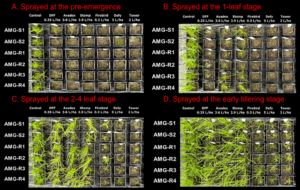
Figure 1: Effects of different residual herbicides on ALS-sensitive (AMG-S1 and AMG-S2) and ALS-resistant (AMG-R1 to AMG-R4) populations of annual meadow grass 30 days post-treatment, applied at the recommended label rate across different application timings (A to D).
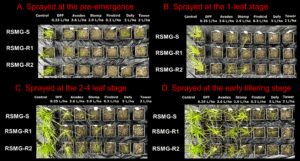
Figure 2: Effects of different residual herbicides on sensitive (RSMG-S) and ALS-resistant (RSMG-R1 and RSMG-R2) populations of rough-stalk meadow grass 30 days post-treatment, applied at the recommended label rate across different application timings (A to D).
- Tower with multiple actives delivered the greatest efficacy on meadow grass when applied at a true pre-emergence and 1-leaf stages (100% mortality) followed by Defy and Firebird (>90%). These products also delivered control or suppression when applied at 2-4 leaves. All of these products had growth checking effects when applied during early tillering with Tower having the most significant effect.
- There were variations within and between the meadow grass populations in response to other residual herbicides. Early application of DFF alone or Stomp or Avadex may result in some control, but their performance drops significantly when applied late or after weed emergence (GS >11).
- Pendimethalin when used as a co-formulation (eg. Tower) was more effective than stand-alone pendimenthalin (such as Stomp Aqua).
- DFF mainly provides broadleaf weed control with some meadow grass activity; so it must be used in combination with other actives to get a significant effect on meadow grass.
Overall, while weed dormancy, appropriate application and soil conditions influence the actual field performance of residual herbicides, our glasshouse trials reiterate that the use of residual herbicides (based on flufenacet, prosulfocarb or pendimethalin), especially products containing actives from multiple modes of action (eg. Tower), at the recommended label rate is critical for meadow grass control, including those of ALS-resistant populations. The best efficacy would come from pre-emergence timing (ie. 24-48 hours after drilling). However, if pre-emergence is not possible or missed, products like Tower can still have an impact at later application timings.
This approach will face serious challenges due to the expiration of metribuzin-based products (Firebird-Met) at the end of 2025 and the impending removal of flufenacet from the market in 2026. Other key actives, such as pendimethalin, chlortoluron, and DFF are also listed as candidates for substitution under EU regulations, threatening the continued availability of crucial residual herbicides. As these options diminish, there will be increased reliance on post-emergence ACCase/ALS and glyphosate herbicides. This added pressure could hasten resistance development, making grass-weed control even more challenging.