The starting point in nutrient management planning on farms, Anthony Dineen, Climate Action & Sustainability Advisor, Macroom, Co. Cork, looks at the many benefits that soil sampling brings.
Soil sampling is an essential practice for reducing greenhouse gas (GHG) emissions. It enables better management of nutrients and soil health, while also improving farm productivity.
Having an up-to-date fertiliser plan, based on accurate soil tests, ensures that the right nutrient is applied at the right rate and at the right time. This reduces the risk of over-fertilisation, which in turn lowers nitrous oxide (N₂O) emissions.
Maintaining optimum soil pH through liming improves nutrient availability and supports grass growth. Liming can also release up to 70 kg N/ha, reducing the need for chemical nitrogen and helping to further cut GHG emissions.
Soil test results provide the basis for lime, fertiliser and manure applications. The best time to take soil samples is between now and early March, before any slurry or fertiliser is applied.
Benefits of soil sampling:
Up-to-date soil results allow you to:
- Apply nutrients (fertiliser, slurry, FYM) where they are most needed.
- Decide where lime, phosphorus (P) and potassium (K) should be applied.
- Avoid wasting nutrients in areas where they are not required.
- Achieve maximum growth rates by ensuring correct soil fertility for lime, P and K.
Legal requirements
- Derogation farmers must test their soils every four years.
- Farmers with a stocking rate greater than 130 kg organic nitrogen/ha are legally required to have soil samples.
- Without soil samples, phosphorus is automatically assumed to be at Index 4, meaning:
- No chemical phosphorus can be applied.
- No slurry imports are permitted.
How to take a representative soil sample
Accurate results depend on correct sampling. Follow these key steps:
- Wait at least 3 months after the last P or K application (chemical or organic) and two years after the last lime application.
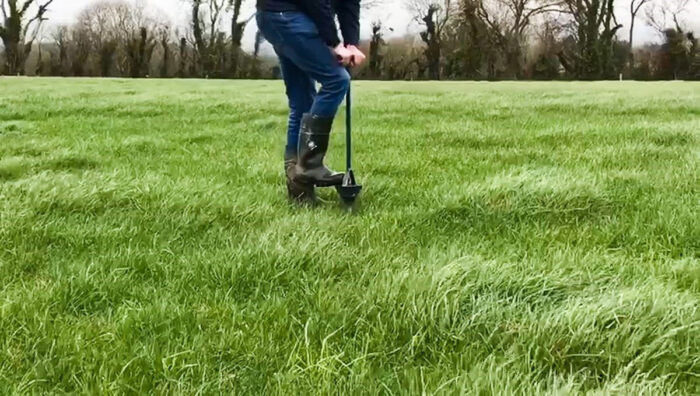
- Use a soil corer to sample at a depth of 10 cm (4″).
- Take one sample for every 2–4 ha, walking in a W-shaped pattern to ensure representation.
- Collect at least 20 cores per sample, ensuring the sample box is full.
- Avoid unrepresentative areas such as gateways, troughs, and old fence lines.
- Do not sample in extreme conditions (waterlogged or very dry soils).
- Label sample boxes clearly with field name and number for accurate future reference.
New soil sample identification requirement
Under S.I. No. 42 of 2025, all soil sample reports issued after 14th September 2025 must include the georeference or LPIS (Land Parcel Identification System) parcel number of the sampled area. Failure to provide this information will result in the sample being defaulted to P Index 4.
Support from Teagasc
Teagasc provides a nutrient management planning service to help farmers make the most of their soil sample results. Speak to your advisor for guidance. There is also an excellent video to watch below on the importance of soil sampling and the best way to do it:
The Teagasc Signpost Advisory Programme
Anthony Dineen is a Climate Advisor in Cork West region and is working on the Teagasc Signpost Advisory Programme. The Teagasc Signpost Advisory Programme provides enhanced advisory and training support to farmers to help them to select and implement climate and sustainability actions that are appropriate and impactful on their farms.
Sign up to the free Signpost Advisory Programme by clicking here. Alternatively, scan the below QR code: