
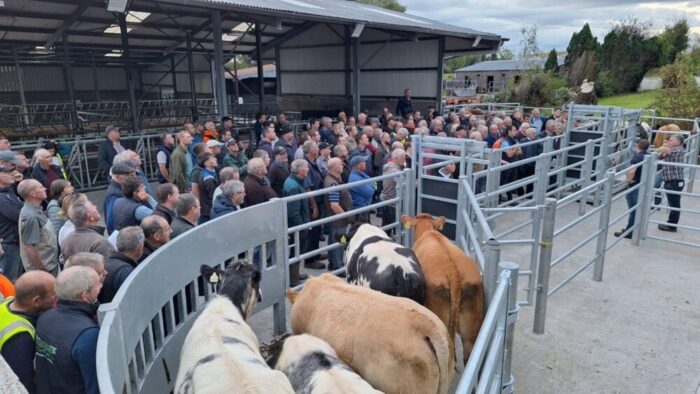
Padraig Glynn fills us in on a Teagasc cattle handling event, which took place recently on the farm of John Flynn and his family in Co. Galway.
Some of the topics covered on the evening included: key performance indicators for the farm, the old cattle handling facilities, a bale slice demonstration, the new cattle handling unit demonstration & TAMS 3 grant aid available.
John and his family have a 24 cow suckler to weanling store enterprise and all work full time off farm. His daughter Sarah has a dairy-beef enterprise on the farm also. She buys 10 dairy bred calves each year and rears them. John currently has a 374-day calving interval and 0.98 calves per cow figure which is very impressive. He carefully selects the sires used for his cows to ensure a low mortality rate. Zero calf mortality was recorded at birth and at 28 days. John calves 75% of his first time calvers between the ages of 22 – 26 months which compares to 19% for the national average.
Livestock and machinery incidents account for a high share of farm fatalities. Investments in better handling systems, lighting, slurry safety, and secure infrastructure reduce high-risk activities and improve control over animal behaviour. The main aim of this event was to showcase the improvements John has made to his farms facilities by purchasing this new equipment. Over 170 farmers attended this event where farmers got a chance to see the demos up close and ask any questions they had.
Good cattle handling facilities are essential for routine tasks like dosing, vaccinating, AI, herd testing, weighing and loading. Well-designed systems reduce labour, improve animal welfare, and reduce the risk of injuries. John explained on the evening how the new cattle handling facility has improved the labour efficiency and safety when handling stock on their farm. The new cattle handling facility has some handy design features such as a mobile cattle handling unit, curved holding pen, forcing gate, walkway along race & sliding backing gates.
As the cattle crush unit is mobile it allows John to use it on land away from the yard at different times throughout the year. This is essential due to the fragmented nature of his land. A well-planned handling facility, built around animal behaviour, operator safety, and efficient flow, pays back in fewer injuries, lower labour needs, and better animal performance.
Seamus Nolan, Teagasc Schemes Support Unit Specialist was in attendance at the event and he explained all about the TAMS 3, Farm Safety Capital Investment Scheme (FSCIS) 60% grant aid available to all farmers. He went through the application process and gave tips farmers should keep in mind when applying for TAMS grants. He explained the difference between fixed vs mobile equipment and the minimum specifications that handling facilities must be to avail of the grants available. Many farmers had technical queries in relation to their own yard layout which were all answered by Seamus on the evening.
The bale slice demonstration was done to show how it improves winter feeding safety. It avoids the farmers having to get out of the tractor to take off the plastic and net. This is key to get the grant on this machine as it must be able to retain the plastic from the bales to be eligible.
John availed of the TAMS 60% grant aid on the following items: Mobile cattle handling unit, mobile penning gates, a double-sided race, head scoop, cattle weighing scales, leg hoist lifter, & yard lights. This September DAFM have released new reference costs for all TAMS 3 items, the full list of these updated reference cost can be found here.
Launched in 2023, TAMS 3 – FSCIS has attracted a lot of farmer interest since due to a lot of the available equipment being applicable and needed on many farms. Some key points to note about the scheme include:
- The minimum amount of investment which is eligible for approval under this Scheme is €2,000 per application.
- All these items reference costs are excluding VAT figures.
- All applications and follow-up claim for payment must be made online via Agfood, either by the farmer themselves or through an agricultural agent or advisor.
- Farmers get one year to complete the investments and get their claim submitted from the date their approval letter is dated.
- All TAMS claims require an up-to-date tax clearance certificate, and a farm safety Code of Practice (COP) training certificate must be submitted as part of the TAMS payment claim.
- Teagasc provides a half-day course on the farm safety risk assessment.
- More information on TAMS FSCIS can be found here.
More from Teagasc Daily: Webinar offers key insights on TAMS 3 grants for drystock farmers