
Shorter days, the clocks due to turn back and last weekend’s heavy rain have reminded farmers that the winter housing period is fast approaching.
A yearly challenge on beef farms – both suckler and dairy-beef – is achieving the desired levels of weight gain over the winter months, whether that be for growing weanlings, stores or finishing stock.
To aid farmers overcome this challenge, the Beef Edge podcast, led by Teagasc Beef Specialist, Catherine Egan, is tackling the key causes of underperformance.
In the first of the three-part series, Beef Specialist, Niall Kerins covered the topic of housing, discussing the importance of space allowances, feed allowances and ventilation.
Before housing commences, Niall Kerins encouraged farmers to measure both the floor areas and the feed space available to cattle.
“It is important to take out the measuring tape and measure your pens to bring your attention to how much lying space you have available. The space allowance will vary depending on the categories of stock you plan to carry in the pen,” the Teagasc Beef Specialist explained.
As to its importance, Niall Kerins referred to recent research carried out in Teagasc Grange which showed that the performance of finishing cattle is severely hampered when offered insufficient lying space.
“In situations where you offer animals less that 2m2 lying space during the finishing period, it can significantly increase the length of time it takes animals to finish as animals don’t have enough lying space and are maybe standing more than they should,” he explained.
To ensure performance, Niall Kerins noted that 300-350kg weanlings require 2m2 of lying space on slatted accommodation, whereas finishing stock and suckler cows typically require 2.5-3m2 of lying space on slatted accommodation.
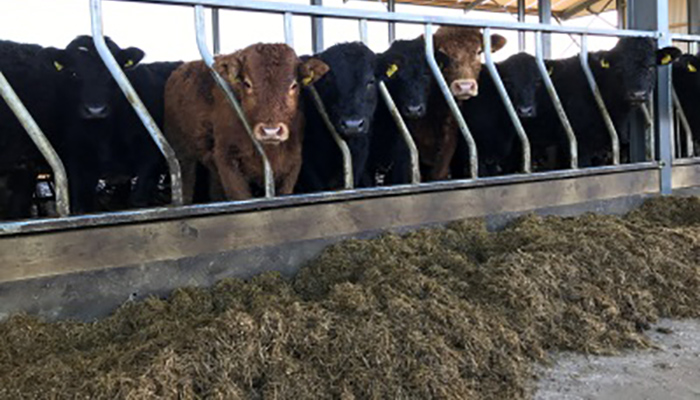
Another area often overlooked at farm level is the feed space available. When insufficient space is provided, less dominant animals tend to underperform, thus making it harder to achieve the desired levels of winter performance.
“The race to achieving the 0.6kg/head/day target [for weanlings] can be won or lost by having enough feed space for animals when foraging at any one time,” Niall Kerins said, before adding that 300-350kg weanlings require a minimum of 50cm of feed space, while finishing cattle – depending on their size – require 60-65cm of feed space when consuming concentrates.
For more insights, listen to the full episode of the Beef Edge podcast on winter housing below: