
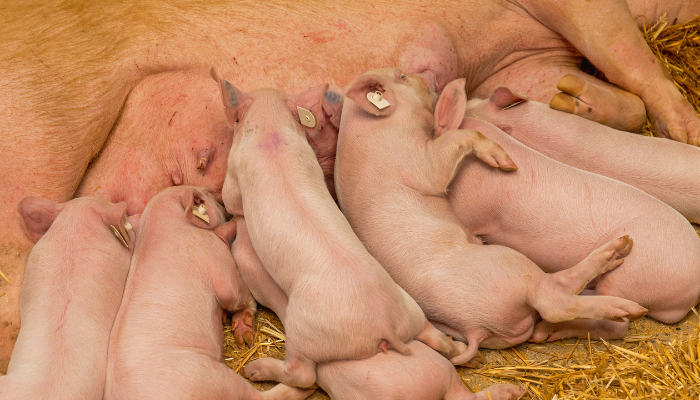
As part of the Teagasc Pig Farmers’ Conference, Dr. Peadar Lawlor discussed why optimising nutrition during lactation has become even more important given the rise in born alive rate.
Born alive on Irish pig farms has increased by ~4.4 pigs/litter in the last 25 years and by 2.6 pigs/litter in the past 10 years, alone. This will increase further in the years to come, with Denmark reporting an average born alive of 18.5 piglets in 2024. Therefore, it’s not surprising that optimising nutrition during lactation has become even more essential than ever. The physical intake of our sows must be high and there may also be a case for increasing the energy and nutrient density in lactation diets to help rear these large litters to respectable weaning weights, while at the same time avoiding excessive weight loss in sows during lactation, with all of its negative implications.
What are the energy requirements of a sow during lactation?
The energy and nutrient requirements of lactating sows are calculated from the body weight of the sow (Maintenance component), milk yield (Production) and loss in body weight (mobilisation of body tissue) during lactation.
Maintenance requirement
Maintenance requirement is quite modest. For a sow with an empty body weight of 220 kg, this is 28.1 MJ digestible energy (DE) per day. For a gilt with an empty body weight of 180 kg, this is 24.2 MJ DE per day.
Milk production
Milk production is the big determinant of the energy and nutrient requirements of lactating sows. Milk production is estimated indirectly from the weight gain of the litter during lactation. This in turn is influenced by the number of pigs weaned by the sow and their average weaning weight. Lactation length will also influence the energy and nutrient requirement of a sow on a daily basis during lactation.
As a rule of thumb, every 0.5 kg increase in the average pig weight at weaning increases the sow’s energy requirement for milk production by ~ 7 to 8 MJ DE/day (increases with higher litter size per sow). Likewise, every extra pig weaned per litter increases the energy requirement for milk production by ~6 to 8 MJ DE/day (increases with higher average piglet weaning weight).
Loss in body weight
Each 1 kg of body weight loss during lactation contributes 12.5 MJ DE to the energy requirements of the sow over an entire lactation. Therefore, for every 10 kg weight loss in a sow during lactation there is a reduction in the sow feed energy requirement of ~4.5 MJ DE/day where lactation length is 28 days and ~3.9 MJ DE/day when lactation length is 32 days. Although an important source of energy for the sow during lactation, it is important that weight loss during lactation should not be greater than 5 % (~10 kg) for first parity sows and 10 % (~22 kg) for older parities if early returns to oestrus, high farrowing rate and a high subsequent litter size are to be achieved.
Total Energy Requirement
Total lactation Energy Requirement = Maintenance energy + Milk production energy – Energy from loss in body weight.
Table 1 shows the total average daily energy requirement (MJ DE/day) of sows for a 28-day lactation and how it changes with increasing average piglet weaning weight and increasing number of pigs weaned per litter.
Table 1. Daily Energy Requirement (MJ DE/day) of sows during a 28-day lactation depending on number of pigs weaned per sow and average piglet weaning weight*
| Average piglet weaning weight (kg) | |||||
| 7.0 | 7.5 | 8.0 | 8.5 | ||
| Average number of pigs weaned per litter | 13.0 | 107.1 | 114.2 | 121.3 | 128.3 |
| 13.5 | 110.2 | 117.5 | 124.8 | 132.2 | |
| 14.0 | 113.2 | 120.8 | 128.4 | 136.0 | |
| 14.5 | 116.3 | 124.1 | 132.0 | 139.9 | |
* Every 10 kg weight loss in sow weight during lactation reduces the sow’s feed energy requirement by ~4.5 MJ DE/day. But sow weight loss during lactation should not exceed 10 % for sows and 5 % for gilts
If feeding a standard diet containing 14.2 MJ DE/kg, then this sow would need to have an average daily feed intake of >8.3 kg. However, if feeding a higher energy diet of 15 MJ DE/kg, then an average daily feed intake of 7.9 kg will achieve the same energy intake from feed. Failure to achieve these feed intakes means that sows will lose excessive weight during lactation and/or milk yield will be depressed. The follow on from this is reduced reproductive performance in sows for the next parity and/or reduced piglet weaning weight.
In Moorepark, we have been feeding a lactation diet containing ~15 MJ DE/kg for the past ~8 years now. Our lactation feeding curve provides a potential average daily feed intake of 8.8 kg (132 MJ DE) /day during a 28-day lactation. The average weaning weight of pigs on the unit is currently 8.6 kg.
What’s more, our average piglet birth weight is >1.4 kg which we believe is also a result of the high energy intakes achieved during the previous lactation. Had we still been feeding a 14.2 MJ DE/kg lactation diet, with our current number weaned per litter of 13.5, then an average daily lactation feed intake of 9.3 kg would have been necessary (to prevent no lactation weight loss in sows), whereas because we feed a 15.0 MJ DE/kg lactation diet, less physical intake (8.8 kg/day) is necessary to achieve the same energy intake. It is also important to note that weight loss (off an empty farrowing weight) in sows during lactation is minimal currently in Moorepark, meaning that sows are weaned in exceptionally good condition.
Decision on diet to use
Maximising lactation feed intake should always be the first course of action.
If you can achieve an average lactation feed intake of 8 kg per day then feeding a 14.2 MJ DE diet is sufficient to achieve an average piglet weaning weight of 8 kg with a weaning age of 32 days. However, if the number weaned per litter exceeds 13.5 and weaning is at 28 days then it will be necessary to either increase feed intake (above 8 kg/day) or feed a more energy dense diet (e.g. 15 MJ DE/kg) to prevent excessive sow weight loss or reduced average weaning weight in piglets.
Feeding a 15 MJ DE/kg lactation diet means that you can achieve a target energy intake with ~0.5 kg/ day less physical intake of feed. This certainly helps in achieving high target daily energy intakes during lactation; however, achieving higher physical feed intakes during lactation is the cheaper option and should always be the primary goal.
The following are pointers on how to encourage increased feed intake in lactating sows:
- Don’t overfeed during gestation,
- Maintain farrowing room temperature at 18-20 degrees C,
- Intakes will be higher with wet compared to dry feed,
- Use lactation feed curve to match/exceed desired intake of sows,
- Don’t let curve or trough capacity restrict intake,
- Use a water:meal ratio of 3:1,
- First 2 weeks of lactation is critical, and it is important to have high intake during this period,
- Feed 3 times per day; with larger splits in morning and evening particularly in Summer months,
- Ad-libitum wet dry feeding is a good alternative,
- Pellets better than meal with dry feeding,
- Keep feed fresh,
- Provide supplementary water,
- Remember the curve is your target but valves can be plussed and minused. Therefore, you must monitor the actual intake of each sow by zeroing valves at the start of lactation and recording feed intake at weaning.
Summary
Litter size in sows has increased greatly in recent years and this increase will continue for some years to come. As born alive increases, additional pigs will be weaned per litter, and we should aim to wean these pigs at 8 kg or more. These demands mean that the energy requirement of sows is increased. To meet this high requirement for energy, the emphasis should first be to maximise physical feed intake in sows. If productivity (number weaned per litter and average weaning weight of pigs) is so high that the sow’s energy demand cannot be met with a 14.2 MJ DE diet, then feeding an increased energy density diet (e.g. 15 MJ DE/kg) should be considered to prevent excessive weight loss in sows.
For more from the Teagasc Pig Farmers’ Conference, access the full event proceedings (PDF) here.