Hybrid beef burgers blend traditional meat with a portion of plant protein, providing options and choice for those who wish to increase the proportion of plant-based nutrients in their diet, without compromising on eating experience.
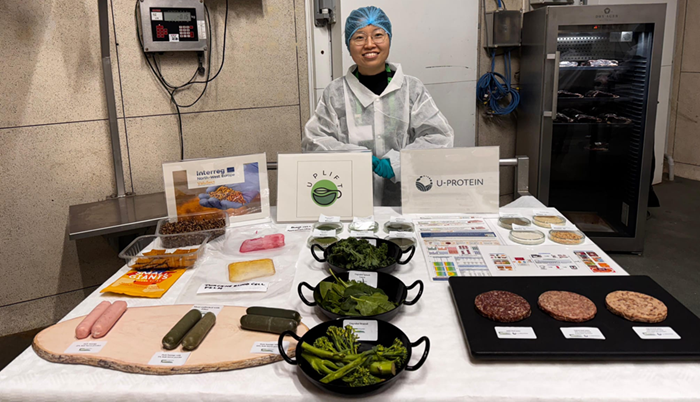
The challenge, as with any mix, is getting the balance right. That is where Teagasc Walsh Scholar Zuo Song (featured image above) and her colleagues at Teagasc and University College Cork step in, working to fine-tune these next-generation patties so they cook, bite and taste just like the burgers people know and love, but with a plant-enriched twist. Science Communication and Engagement Officer, Eimear Ferguson caught up with the team to find out more.
In this latest research, the team looked at how three different plant proteins; faba bean, pea and rice protein, performed when mixed into beef patties at a 12.5% substitution rate. They also examined how the level of water added to the plant protein before mixing (known as pre-hydration) affected cooking performance, moisture and fat retention, colour, and texture.
So why does this matter? When plant proteins are used in meat products, they can behave very differently depending on how they are handled during preparation. Some proteins absorb more water, some affect texture, and others change the way the patty looks or cooks.
Let’s explain. The patties made with faba bean protein stood out for retaining the most moisture and fat during cooking. This is likely because faba beans naturally contain high levels of starch and fibre, which help lock moisture into the meat. As a result, these patties lost less weight during cooking than pure beef patties, making them more economical. Faba bean patties also came out much softer than the control sample. For some products, that soft texture could be a benefit, especially in foods aimed at older adults or for certain types of ready meals.
Pea protein, on the other hand, gave patties that were texturally closest to 100% beef, especially in terms of chewiness. This means pea protein might be the most promising option for hybrid products designed to match the bite and feel of traditional burgers. It didn’t perform quite as well as faba bean when it came to holding moisture, but the trade-off is a more familiar mouthfeel.
Rice protein led to the firmest patties overall, with very high hardness values. That firmness could be useful in some cases, but it may be too tough for typical burger applications. Still, in processed meat products where firmness is valued, it might find a use. However, rice protein patties lost more moisture and fat during cooking, meaning more shrinkage and less yield.
“An interesting twist in the results was the role of hydration level,” explained Zuo Song.
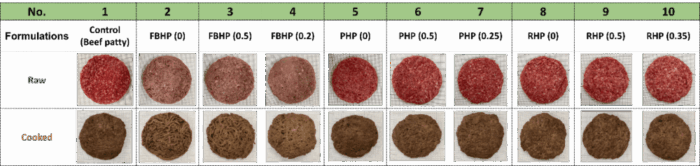
“Each plant protein was assessed both dry and at varying hydration levels. In general, the more water added to the plant protein beforehand, the softer the final patty became (Image 1).
“This makes sense; more water means a looser structure, but it also highlights how careful manufacturers need to be when preparing their ingredients. More hydration also meant more cooking loss in some cases, showing that it’s not just the protein source that matters, but how it’s handled.”
Image 1: Hybrid patties with increasing levels of pea and rice protein
According to Principal Research Officer and Zuo Song’s Teagasc supervisor on the project, Ruth Hamill, this work shows that there is no one-size-fits-all approach to making hybrid beef patties. Each plant protein behaves differently, and minor changes in preparation, especially how much water is used, can dramatically affect the product. For food producers and processors, this means plant proteins offer exciting opportunities to tailor products for different markets and consumer needs.
This research is conducted under the U-Protein project, a multi-institutional collaboration with ten industry partners, funded by the Department of Agriculture, Food and the Marine.