

Home to numerous species of bats, College Teacher at Kildalton College, Brian Clancy provides an update on the ongoing bat project with SETU and what it aims to achieve.
Researchers from SETU Waterford, PhD student, Evan Hickey and his supervisor, Dr. Andrew Harrington, put up seven bat boxes around the grounds of Kildalton College in early June 2025 as part of a study about Irish bat species on farmland in the south-east of Ireland.
Ireland has nine native bat species and those recorded at Kildalton College include: Soprano pipistrelle, Common pipistrelle, Leisler’s bat, Nathusius’ pipistrelle, brown long-eared bat, Daubenton’s bat and Natterer’s bat
Ireland’s most common bats are the common pipistrelle and the soprano pipistrelle. These pipistrelle bats have a body about the same length as your thumb and weigh around the same as a €2 coin. Each bat can eat thousands of insects, such as midges and other flying insects every night during the summer months, when they are most active. They are very common across most of Ireland, including on farmland, woodland and in towns and villages.
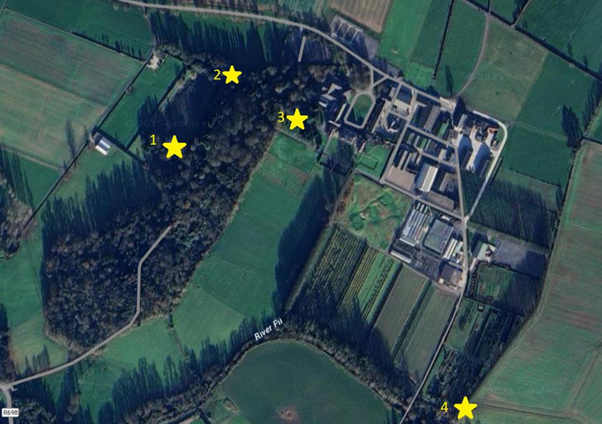
Locations of newly installed bat boxes at Kildalton College, June 2025 as part of a study about Irish bat species on farmland in the south-east of Ireland. (SETU Waterford & Teagasc Kildalton College)
The project ongoing at Kildalton aims to look at how effective bat boxes are as a tool for increasing the number of pipistrelle bats on Irish farmland, as they are often included as measures in Agri-environment schemes. The project is also interested in looking at the insect species which pipistrelle bats feed on, and in particular to what extent they feed on pests of crops and livestock systems.
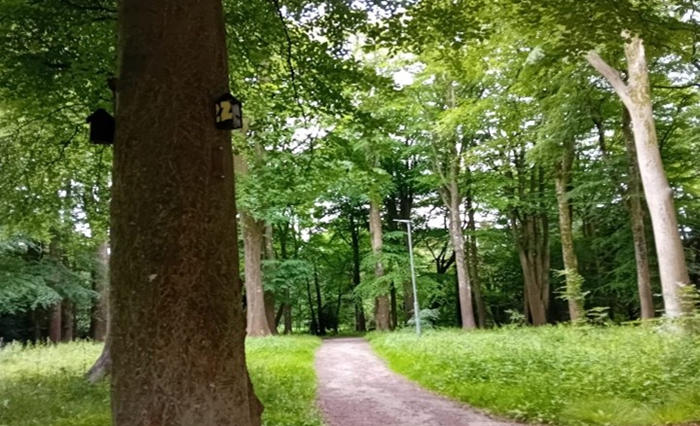
Over the coming four years, bat droppings will be collected from bat boxes at several sites over the summer months and used for DNA testing to understand more about the bat populations in these areas and the insects they feed on. Like Kildalton College, monitoring of bat boxes will take place at SETU Waterford’s Carriganore Campus and in Lismore, Co. Waterford.
More from Teagasc Daily: Bats at Kildalton – nature on the farm and in the classroom