
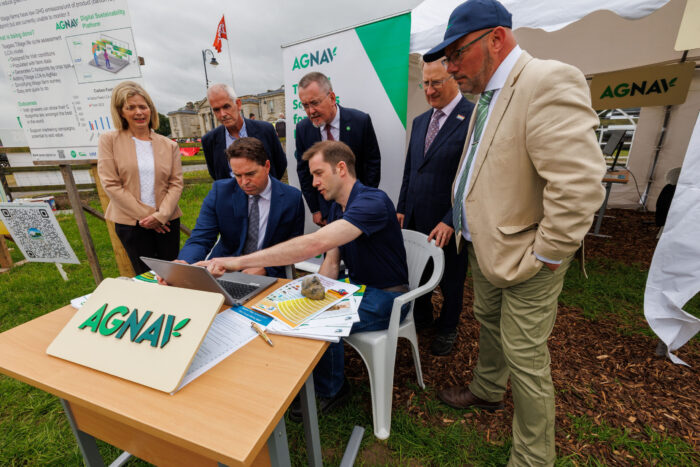
As part of the recent Farming for a Better Climate 2025: Practical and Emerging Solutions Conference, organised by the Teagasc Climate Centre and Teagasc Signpost Programme, Natasha Browne discussed some of the progress that’s been achieved since the launch of AgNav in 2023.
AgNav is a free, digital sustainability platform for the agri-food sector developed by Teagasc, Bord Bia, and the Irish Cattle Breeding Federation (ICBF). It supports Ireland’s national climate targets by providing farmers with science-based assessments, forecasting, decision support and planning tools to measure and improve environmental performance, driving measurable impact across Irish farms. To date, more than 17,000 farmers have registered, over 11,000 sustainability action plans have been created, and it is included in 13 processor sustainability programmes.
AgNav has received national and international awards, including recognition by the Food and Agriculture Organisation of the United Nations for its contribution to sustainable livestock transformation. The platform demonstrates Ireland’s leadership in data-driven sustainability and continues to grow as a trusted resource for farmers, advisors, and industry partners.
Siobhán Kavanagh, Signpost Programme Communications and Engagement Specialist, spoke to Natasha Browne at the conference. Watch the interview on Instagram below:
View this post on Instagram
New developments in 2025
National Rollout to Dairy and Beef Farmers
In 2025, AgNav became open to all Bord Bia and ICBF registered dairy and beef farmers through self-registration, marking a major milestone in national rollout. This expansion allows for over 49,000 farmers across Ireland to access the platform directly, view their sustainability data, and create tailored action plans without needing to enrol through programmes. By integrating data already held within national databases, AgNav reduces paperwork and provides a single, trusted source of truth.
Expansion to Tillage Farms
A major 2025 development was extending AgNav to tillage farms. It uses a Life Cycle Assessment (LCA) model designed by Teagasc, with collaboration from Tirlán, specifically for Irish conditions. Farmers input their data through a survey on AgNav, including details on fertiliser, lime, organic manures, tractor passes, crop yields, and straw or cover crop practices. The platform then calculates the gross and net greenhouse gas (GHG) emissions per tonne of produce; net GHG emissions include extra carbon stored in soils. Early results indicate that Irish tillage farmers’ carbon footprints are low. Growers can now quantify the carbon footprints of their crops, review emission profiles to identify hotspots and potential areas of improvements and communicate the low-emissions profile of Irish grain.
Soil Carbon
From the beginning of 2025, AgNav has included soil carbon functionality. By switching on the carbon capture toggle in AgNav, farmers can view a more complete picture of their farm’s overall carbon balance. To access this feature, farmers must complete the soil survey, providing information on land use, soil type, and management. This functionality highlights the climate benefits of well-managed soils, showing how land use and management decisions can reduce net emissions and contribute positively to GHG reduction targets. It also highlights that some soils are sources of emissions and not sinks. The soil carbon approach included is a simple Tier 1 approach with more complex approaches expected in the future.
Future directions and innovations
Upcoming enterprises
Sheep will be the next enterprise added to AgNav. Developed by Teagasc, the sheep LCA and is now being implemented by ICBF into AgNav. Farmers will complete a sheep survey on AgNav that will capture key information on flock size, performance and management practices. This will enable AgNav to calculate GHG emissions and other sustainability indicators. Further expansions are planned for pigs, poultry, horticulture and forestry. Together, these developments will increase the diversity of farmers who can use AgNav to access their sustainability indicators and identify areas for improvement.
Expanding the indicators
AgNav continues to evolve beyond its original focus on GHG emissions, with new and enhanced sustainability indicators being introduced. The nutrient balance indicator, introduced for dairy farmers in 2024, assesses nitrogen and phosphorus balance on farm. This functionality for specialised beef enterprises has been released and is being used in Waters of LIFE EU LIFE Integrated Project. Further work is underway to integrate additional measures covering biodiversity, economic, and social dimensions of sustainability, which will give farmers a more comprehensive view of their farm’s sustainability status.
Private advisors
Work is ongoing to make AgNav accessible to private agricultural advisors, extending its reach beyond Teagasc advisory services. Expanding access to private advisors will improve AgNav’s advisory reach, increasing support to farmers using consistent, science-based tools and strengthening AgNav’s advisory capacity.
Conclusions and practical takeaways
AgNav helps farmers and advisors turn farm data into practical actions. Ongoing functionality development and collaboration across the agricultural sector will ensure AgNav remains as a trusted, science-based tool that supports measurable environmental improvement on Irish farms.
By expanding access and widening sustainability indicators, AgNav is strengthening capacity to meet climate and environmental targets. To sign up, visit www.agnav.ie.
Dairy and beef farmers can click ‘Login’ and use their ICBF username and password to access AgNav. Tillage farmers select ‘Tillage Registration’ to create an account and begin using the platform.
The above paper was presented, Farming for a Better Climate 2025: Practical and Emerging Solutions Conference, was authored by Natasha Browne, Laurence Shalloo, Siobhán Jordan, Donal O’Brien, Sarah McPherson, Linda Omodara, Oyinlola Ogunpaimo, and Jonathan Herron.
The authors acknowledge the support provided by the Department of Agriculture, Food and the Marine, through the 2023 Research Call (AgNav – 2023RP956), the AgNav development programme, and the 2022 Policy & Strategic Studies Research Call (GHGBovine – 2022PSS130), and from Teagasc through the Sustainability Platform research project.