
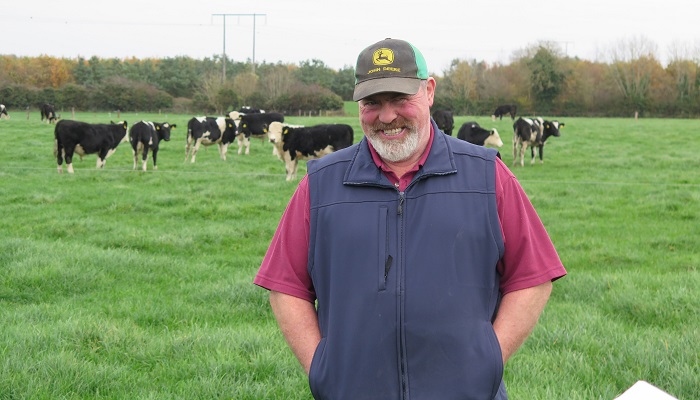
As part of the recent Farming for a Better Climate 2025: Practical and Emerging Solutions Conference, organised by the Teagasc Climate Centre and Teagasc Signpost Programme, a case study from Aidan Maguire’s farm in Navan, Co. Meath was presented, showing how a forestry enterprise is helping off-set farm emissions.
Aidan Maguire is a progressive dairy beef Signpost farmer in the DairyBeef 500 Programme, who currently farms in partnership with his son Luke on 46 hectares of grassland, operating a dairy calf-to-beef enterprise in Navan, Co. Meath.
Aidan has worked closely with his DairyBeef 500 advisor, Fergal Maguire, and local Teagasc advisor, Aine Gaffney, in developing his farming system in recent years. In 2005, Aidan planted 14.25 ha of forests on a mineral soil, consisting of the following species mix:
- Sitka spruce/larch (4.49 ha) – this is a fast-growing conifer stand with an estimated yield class (productivity indicator) of 24 (cubic metres/ha/year)
- Oak/Scots pine (2.97 ha) – this broadleaf/conifer mix has been previously thinned in 2017, removing the pine and is ready for a further thinning for which Department of Agriculture, Food and the Marine (DAFM) scheme supports are available
- Alder (1.69 ha) – this broadleaf species is growing productively and is due a thinning to favour the future potential crop trees, again with DAFM schemes supports available
- Ash (5.1 ha) – The ash has been impacted by Ash Dieback disease. DAFM supports are available to remove existing ash trees and replace with an alternative species/species mix.
Table 1 presents the mean sequestration rates and mean cumulative sequestration (CAP) values for three of the forest categories in Aidan’s farm forest. Productive conifer species such as spruce can return high sequestration rates, especially when their harvested wood products are taken in account. Broadleaf forests (e.g. alder, oak), have a lower mean annual rate of carbon capture due to their relative growth rates but cumulatively remove large amounts of CO2 over their lifetime. The ash plot was not included in the current analysis due to its disease status and its impending clearance and reconstitution with an alternative forest type(s).
Table 1: Indictive sequestration rates over 2 forest rotations
| Plot | Species / Mix | Rotation | Mean sequestration rate (t CO2e/ha/year) | CAP Value (t CO2e/ha) |
| 1 | Sitka spruce / larch | 37 | 16.05 | 516.9 |
| 2 | Oak / pine | 120 | 3.83 | 535.2 |
| 3 | Alder | 75 | 5.9 | 554.9 |
Table 2 presents indicative current forest sequestration rates for 2024 for three productive forest categories within Aidan’s farm forest enterprise. Gross plot area is adjusted to include the productive area for each plot, taking into account unplanted, access and biodiversity areas Overall of the productive area in Aidan’s forest of 8.4 ha, is estimated to have captured and stored over 200 tonnes of carbon dioxide equivalents during 2024. This rate of capture and storage changes over time according to factors such as tree species, soil types, forest age, productivity and management approach.
Table 2: Indictive current sequestration rates for 2024
| Plot | Species / mix | Gross plot area (ha) | Yield class* (m3/ha/year) | Productive plot area (ha) | Indicative current sequestration rate (t CO2e/ha/year) | Indicative current sequestration per plot (t CO2e/ha) |
| 1 | Sitka spruce / larch | 4.49 | 22-24 | 4.0 | 30.4 | 121.6 |
| 2 | Oak / pine | 2.97 | 6-8 | 2.8 | 16.1 | 45.1 |
| 3 | Alder | 1.69 | 8-10 | 1.6 | 21.5 | 34.4 |
| Total | 9.15 | 8.4 | 201.1 |
*Yield class is a measure of a forest’s productivity. For example, a spruce forest with a Yield Class of 24 can potentially produce an average annual timber volume of 24 cubic metres (m3) over its lifetime or cycle.
Siobhán Kavanagh, Signpost Programme Communications and Engagement Specialist, spoke to Aidan Maguire at the conference. Watch the interview on Instagram below:
View this post on Instagram
Aidan Maguire’s total greenhouse gas emissions for 2024 were 522t CO2e (NFS). The net emissions from this farm for 2024 were 321t CO2e, allowing for the indicative sequestration of the forestry on the farm of 201 t CO2e or 38% of the emissions from the farm offset by forestry on the farm.