December 2025 Future Beef Newsletter
Eamon & Donnchadh McCarthy, Youghal, Co. Waterford
Ruairi Cummins – Farm Update | Technical Update: Future Beef Labour-Saving Series | Technical Update: Ventilation | Technical Update: Key points for pre-calving mineral feeding | Technical Update: Why BS matters for suckler herds | Upcoming Events | Top Tips for December | The Beef Edge Podcast
Happy Christmas from The Future Beef Team!
2025 has been a brilliant year for the industry — great weather, strong prices, and a positive outlook heading into 2026. Enjoy the good times, stay safe, and have a wonderful Christmas. We’re looking forward to an exciting new year ahead!
Upcoming Events
Join us online on Wednesday, 3 December at 7pm for a Beef Farming Insights 2025-2026 webinar which will reflect on the beef farming sector for 2025 and what to prepare for in 2026.
Hosted by Catherine Egan, Teagasc Beef Specialist and featuring Pearse Kelly, Head of Drystock, Teagasc; Paul Crosson, Beef Enterprise Leader, Teagasc and Future Beef Programme participant, John Pringle, Suckler Beef farmer.
Click here to register: Webinar Registration – Zoom

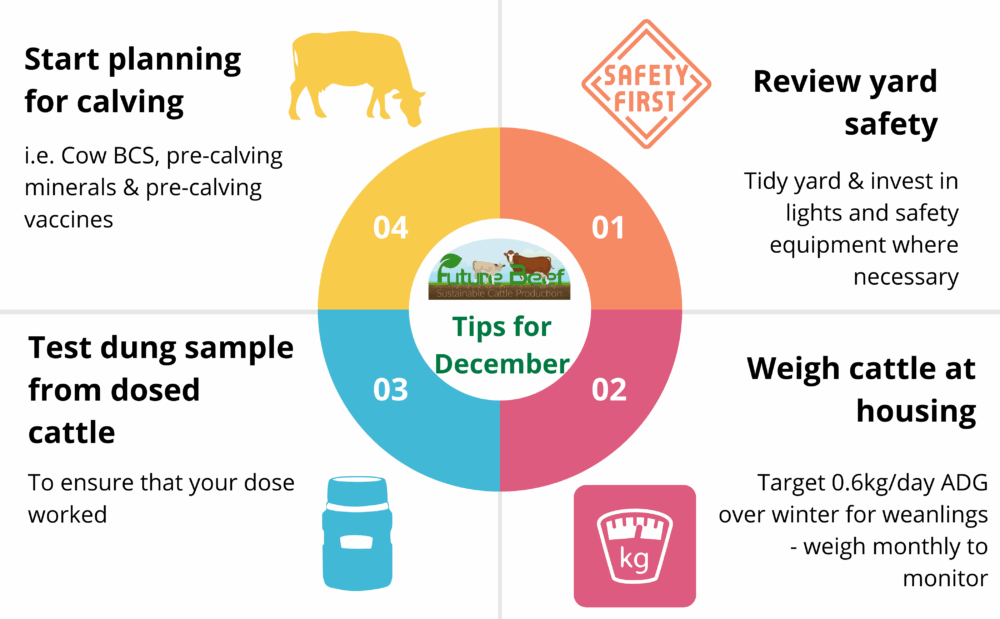
Top Tips for December
Farm Update: Eamon & Donnchadh McCarthy
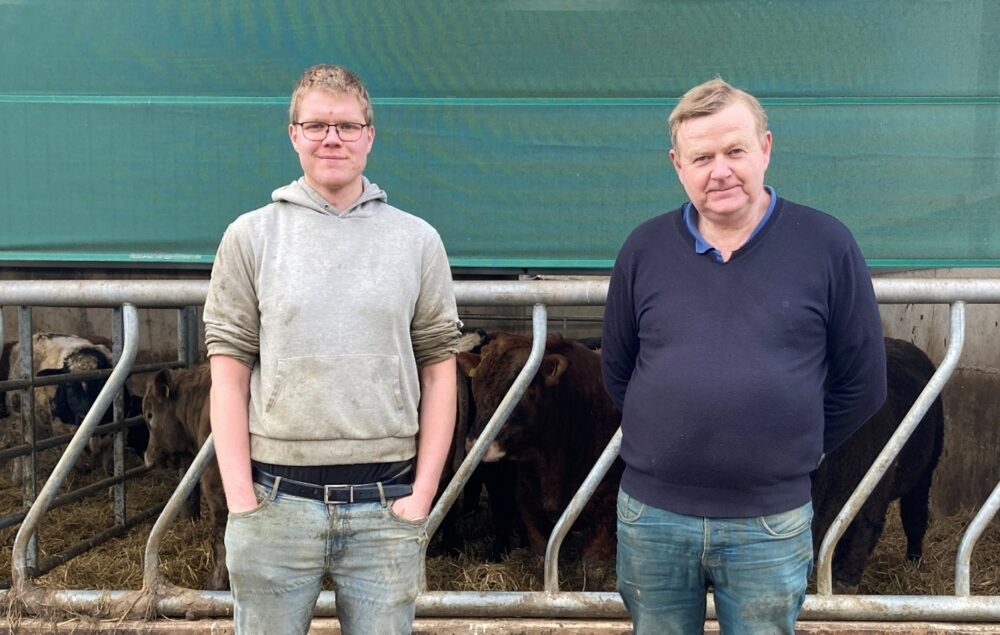
Donnchadh and Eamon McCarthy
Eamon McCarthy and his son Donnchadh run a highly efficient 40ha suckler beef farm in Glendine, Youghal, Co. Waterford. The McCarthys operate a suckling-to-beef system with a 60% spring-calving and 40% autumn-calving herd made up of 55 suckler cows.
Their male calves are finished as under-16-month bull beef, a system that requires excellent nutrition, housing, and herd health. The heifers that are not kept for breeding are finished at 18-20 months, while the best home-bred replacements are retained to maintain a strong maternal herd.
At this time of year, the McCarthy farm is focused on several key management tasks aimed at boosting herd performance, fertility, and beef output:
- Formulating winter diets based on silage test results to ensure cows, weanlings, and finishing bulls meet their performance targets
- Implementing a winter herd health plan, supporting thrive, fertility, and immunity during housing
- Grouping cows by body condition score (BCS) to ensure cows calve down in the ideal condition for both spring and autumn
- Completing construction work on a new animal housing facility and cattle handling unit, improving labour efficiency and safety
- Selecting high-beef-value sires for the autumn-calving herd to drive genetics and carcass quality
- Synchronising non-cycling cows to tighten autumn calving and boost herd fertility
- Maintaining weight gains and staying on target for the under-16-month bull beef finishing system
You can read more about their activities here.
Watch the video below where they discuss how they are managing their finishing stock this winter.
Farm Update: Ruairi Cummins
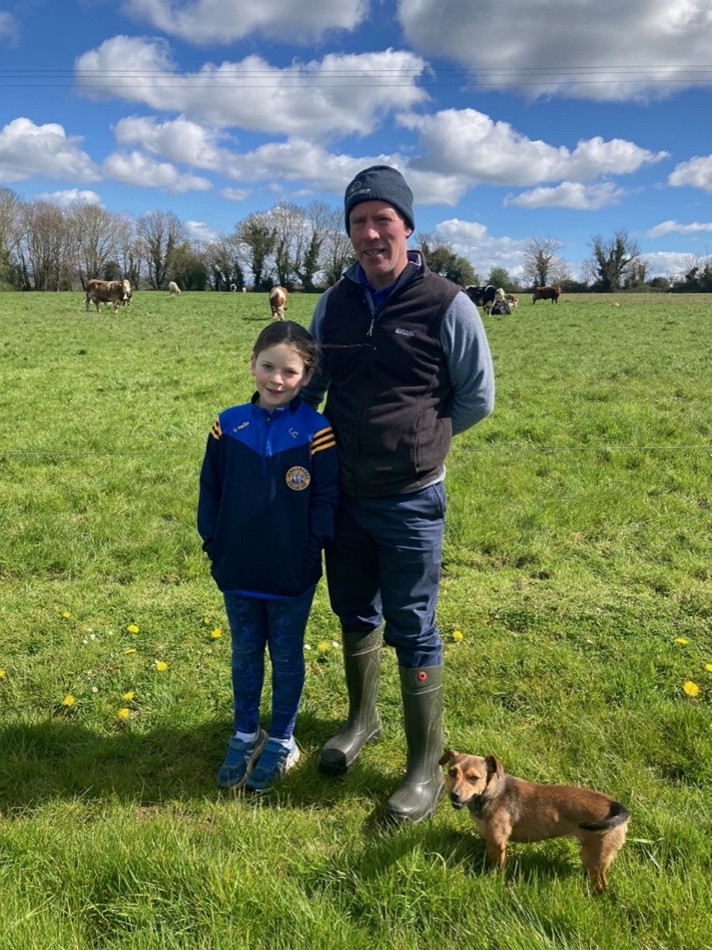
Ruairi with his daughter Laura and their dog Jess
Ruairi Cummins is farming 35ha in Kilmoganny, Co. Kilkenny. He operates a 45 cow suckler to store/beef system with a spring calving herd. Focus areas for him this month include:
- Performance
- Bulls gained 59 kg/day and heifers 1.26 kg/day, even while being weaned and housed.
- Strong performance comes from doing the basics right on Ruairi’s farm: low-stress weaning, a solid health plan and good nutrition.
- Bulls averaged 409 kg at 8 months, proving Ruairi’s system works.
- Winter Nutrition
- Cows are fed 65–66 DMD silage to keep condition right for calving.
-
- Weanling bulls get >70 DMD silage + 3.5–4 kg meal/day to drive 1.3–1.5 kg/day gains, rising to ad-lib meal at 500 kg.
- Heifers and steers are stored over winter, aiming for 0.6 kg/day to hit 400–420 kg for breeding next May. They are on 2 kg meal and 70 DMD silage
- Preparing for Calving
- Cows are grouped and fed to target BCS 2.75 for calving.
-
- All cows receive 100 g/day of a high-spec pre-calving mineral, starting six weeks before calving.
- Cows are vaccinated for Rota/Corona (4–5 weeks pre-calving) and IBR, based on their expected calving dates.
For more detail, click here.
Technical Update: Future Beef Labour-Saving Series
The Future Beef Programme has launched a new video series featuring practical labour-saving ideas and technologies from beef farmers nationwide. Each short video highlights simple ways to boost efficiency, cut workload, and improve safety on farms. Watch the series on the Teagasc YouTube channel, with new videos released weekly on social media. See some of them below from:
- Eamon McCarthy in Co. Waterford with his fertiliser dispensing stand,
- Olivia Hynes in Co. Roscommon with her new farm roadway,
- Michael McGuigan in Co. Meath with his automated heat detection & health monitoring system
- Ken Gill in Co. Offaly with his calf crate
Technical Update: Ventilation
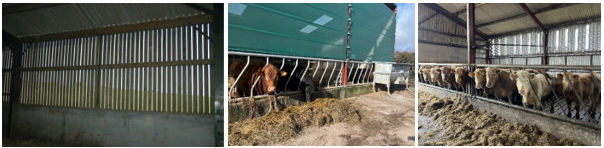
Space boarding, gale breakers & slits in sheeting can all help to improve air inlets
Good ventilation in cattle housing is one of the most important factors influencing animal health, performance, and weight gain on Irish beef farms. During the winter housing period, providing fresh, clean air helps cattle thrive, reduces the risk of respiratory disease, and supports efficient beef production. Poorly ventilated sheds allow gases, moisture, dust, and bacteria to build up, creating warm, damp, and stuffy conditions that can quickly undermine herd performance. In contrast, fresh air acts as a natural disinfectant — while viruses can survive for up to 20 hours indoors, they are deactivated outdoors in as little as 20 minutes.
Farmers should inspect their housing before and during the winter to identify signs of poor airflow. Cobwebs, condensation, damp walls, rusting steel, or a strong ammonia smell are key indicators that a shed is not “breathing” properly.
Natural ventilation is the most effective and widely recommended system for beef housing in Ireland. It relies on correctly sized inlets and outlets that allow warm air to rise and escape through the roof ridge, drawing in fresh air through the eaves. If either opening is too small or obstructed, airflow is restricted, increasing the risk of respiratory issues in housed cattle.
Ventilation performance is influenced by inlet and outlet size, roof pitch, eave height, shed orientation, and proximity to other buildings. A simple smoke bomb test can help farmers assess whether air is rising correctly or lingering at animal level.
If ventilation is poor, improving air inlets should be the first step. Options include angled cladding, removing blocks, or adding vented sheeting, Yorkshire boarding, or windbreak mesh. Outlets can be improved by modifying ridge caps or installing raised sheeting.
Good ventilation reduces disease pressure, avoids draughts at animal level, and supports better weight gain — making it a key priority for all Irish beef farmers during winter housing.
You can read more here.
Technical Update – Key Points for Pre-Calving Mineral Feeding
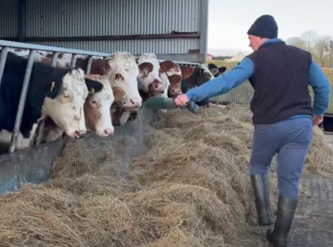
Dusting pre-calving minerals on silage is effective
- 1. Start Supplementation Early
- Begin feeding pre-calving minerals 6–8 weeks before calving (minimum 60 days).
- This allows enough time to correct deficiencies and build cow reserves.
- Choose the Right Mineral Specification
- Use a high-quality pre-calver mineral designed for suckler cows.
- Ensure correct levels of:
- Magnesium (Mg) – essential for calcium mobilisation and prevention of milk fever.
- Iodine, Selenium, Copper, Cobalt, Zinc – key for calf vitality, immunity, and cow metabolic health.
- Vitamins A, D₃, E – support calf vigour and reduce calving issues.
- Match Minerals to Silage Analysis
- Silage often varies in mineral content.
- High potash (K) silage can block magnesium and calcium absorption.
- Use a mineral tailored to your forage test for best results.
- Ensure Daily Intake Is Consistent
- Target 100–150 g/head/day depending on product specification.
- Avoid relying on lick buckets alone — intake can be highly variable.
- Boluses Are Not a Complete Solution
- Mineral boluses do not supply macro-minerals (e.g., Mg, Ca, P) needed in gram quantities.
- They are only useful for trace minerals, not a full pre-calver programme.
- Avoid High-Calcium Minerals Pre-Calving
- Feeding extra calcium before calving increases milk fever risk.
- The pre-calver mineral should be low calcium and high magnesium.
- Provide Adequate Feeding Space
- Ensure all cows have access: 60 cm/head at the feed rail for consistent mineral intake.
- Watch Body Condition Score (BCS)
- Aim for a BCS of 2.5–3.0 at calving.
- Thin or fat cows have higher calving and metabolic risks.
You can read more here.
Technical Update – Why Body Condition Scoring (BCS) Matters for Suckler Herds
Body condition scoring (BCS) is a simple but critical tool for managing your suckler herd, helping ensure your cows are in the right fat cover at key times of the production cycle. On well-managed Irish suckler farms, knowing and targeting the correct BCS for each stage (housing, calving, turnout, breeding) helps optimise cow health, fertility, calf performance and overall system profitability.
Target BCS for Spring & Autumn Calving Suckler Cows
Target BCS values for Ireland are:
- At housing: Spring calvers approx. 3.0-3.5; Autumn calvers approx. 2.5-3.0.
- At calving: Spring calvers ~2.5; Autumn calvers ~3.0.
- At turnout & at breeding: ~2.0+ and ~2.5 respectively.
How to Score Your Suckler Cows
BCS involves palpating three key sites on the cow: over the ribs, over the short ribs (transverse processes) and the tail head above the pin bones. Use a 5-point scale: For example, a cow at score 1 is very thin (bones prominent), while at score 5 the cow is over-fat and “blocky”.
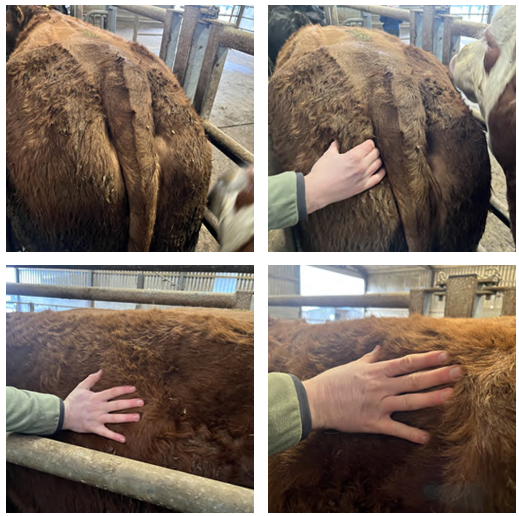
Score 3: Transverse processes can only be felt with firm pressure. Areas either side of tail head have fat cover that is felt easily
Why This Matters for Herd Performance
Cows in the correct condition at calving are much more likely to return to service early (within the first 42 days) and maintain good fertility. Over-fat cows may suffer calving difficulty, excessive BCS loss and reduced appetite. Thin cows face higher calf mortality and weaker calves.
Practical Steps for Irish Suckler Beef Farms
- Score all cows at housing, separate first and second calvers from mature cows (they still grow and have different needs).
- Feed thin cows with higher DMD silage or concentrates; restrict over-fat cows with lower quality silage.
- Regularly monitor BCS and adjust diets accordingly to hit target for calving and breeding.
You can read more on how to score your cows here.
The Beef Edge Podcast
Keep up to date on all things beef on The Beef Edge Podcast weekly.