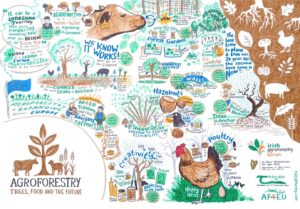
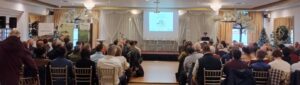
The National Agroforestry Conference held in Athenry recently explored how integrating trees into Irish farming systems can address multiple challenges facing agriculture today. Dr. Ian Short tells us more.
The event, organised by the Irish Agroforestry Form and Teagasc showcased practical examples of agroforestry from across Ireland, while highlighting the environmental, economic, social and animal welfare benefits that trees can bring to farm enterprises.
The conference was opened by Minister of State Michael Healy-Rae who defined agroforestry as “Trees, food and farming together”, a description well illustrated by the presentations given on the day.
Understanding the potential
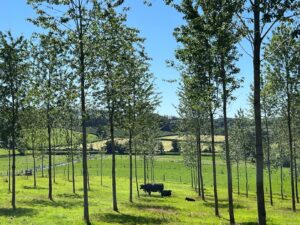
Prof. Jim McAdam from AFBI and Queen’s University Belfast opened discussions by emphasising that agroforestry offers solutions to several pressing issues: biodiversity loss, climate change, water quality problems, soil degradation and greenhouse gas emissions from farming. Drawing on 35 years of research at the Loughgall silvopasture site in Northern Ireland, Jim presented evidence that integrating trees with livestock production can maintain agricultural output while delivering substantial environmental benefits.
The Loughgall research has demonstrated that silvopasture systems can extend the grazing season considerably. Under 25-year-old trees, soil moisture analysis showed approximately 17 weeks longer grazing potential compared to open pasture, five weeks in spring and twelve in autumn. This extended trafficability is hugely important for Irish conditions, allowing farmers to keep animals outdoors longer according to soil and local conditions and reducing housing costs and emissions.
Jim stressed that grass is shade-tolerant, and for the first decade after tree establishment, there is no significant effect on livestock carrying capacity. Preliminary research from year one of a new study at Loughgall showed early season production was similar in both a 33-year-old silvopasture and open grassland, with peak-season production approximately 28 percent lower in silvopasture, less than predicted. Critically, late-season growth showed more similarity, with the lower soil moisture in silvopasture benefiting grass utilisation when open pastures may become poached.
The soil health benefits are remarkable. Research found twice as many earthworms in silvopasture compared to grassland, with earthworms being a key biological indicator of overall soil health. The systems also showed improved organic matter levels, enhanced biodiversity including fungi and insects, and better soil physical structure with improved porosity. These healthy soils are inherently more climate resilient.
Practical tree management
Dr Ian Short from Teagasc provided guidance on establishing and managing trees in agricultural settings. He outlined various planting configurations suitable for different objectives: windbreaks and alleys for shelter, scattered trees for shade, riparian buffers for water quality protection, and groups for multiple benefits, whilst also having potential for producing high quality timber.
For shelter, Ian described shelterbelts consisting of tree rows 7.5 metres wide with one line of trees and four lines of shrubs, and alley systems with 3.5-metre-wide tree rows spaced 20 metres apart (fence to fence), occupying approximately 15 percent of land area. For in-pasture shade, he recommended groups of four trees at 10-by-10-metre spacing with individual tree protection, which provides shade as the canopy matures.
Tree establishment requires careful attention to several factors. Protection from livestock, rabbits, and other animals is essential, along with vegetation control. Formative shaping during years two to four is crucial for developing quality trees. This involves removing large branches, forks, and co-dominant stems on selected trees. The timing of this work matters: oak should be shaped in December or June to July, while ash, beech, and sycamore are best pruned June to August or mid-winter.
Subsequent management depends on objectives. For timber production, pruning to six metres height should be done in stages to maintain tree health while providing access beneath the canopy and allowing light penetration for grass growth. In silvoarable systems, root pruning through ploughing or deep-ripping may be necessary to manage below-ground competition. The systems can produce diverse products including fruit and nuts, tree fodder, basketry materials, woodchip and firewood, and eventually high-value timber.
Commercial application – free-range egg production
Peter Lynch from Greenfield Foods demonstrated how agroforestry principles are being applied in commercial free-range egg production. With 1.7 million laying hens across 80 family farms, Greenfield Foods faces regulatory requirements for providing shelter and shade on ranges. Bord Bia requires at least five percent effective cover from hedgerow or tree cover, while RSPCA Assured standards mandate ten percent coverage by May 2027.
Peter acknowledged farmer concerns including regulations, control issues, avian influenza concerns, and potential shelter for predators like buzzards and pine martens. However, the benefits are substantial: improved ranging behaviour by hens, reduced feather pecking, lower parasite loads, and better eggshell quality. Environmental advantages include ammonia emission and dust capture, carbon sequestration, water quality protection, and wildlife benefits.
The tree species selected for free-range systems include red oak, improved birch, cherry, walnut, guelder rose, rowan, alder, and hazel. Peter emphasised that when planted correctly, trees work well on free-range farms while enhancing long-term farm viability through potential diversification opportunities.
Farm-scale innovation
Several farmers shared their experiences integrating trees into diverse farming systems. Ailbhe Gerrard from Brookfield Farm in County Tipperary described managing a forestry plantation established around 1997, predominantly oak and sycamore with minor species including ash, cherry, beech, birch, and European larch. Following selective thinning and horse logging extraction in 2011 and 2016, the stand now contains approximately 100 cubic metres of timber volume with 140 high quality potential crop trees per hectare.
Ailbhe’s farm demonstrates the broader potential of creative agriculture, combining organic crops, sheep, beekeeping, agritourism, and educational activities alongside forestry. Her work has received multiple awards including recognition for sustainable agriculture and social innovation.
Thomas O’Connor from Manna Organic Store outlined how trees contribute to his mixed farming systems through carbon fixation, water management, nutrient cycling, biodiversity improvement, microclimate creation, biomass generation, and on-farm energy production. His farm incorporates different zones including conventional fields, permaculture areas, agroforestry zones, and native woodland, demonstrating a transition toward natural and biologically-based farming systems.
Donal Chambers from Cork College of FET Kinsale Campus presented syntropic agroforestry approaches using forest garden designs with approximately 400 trees per hectare, 40 percent fruit and 60 percent timber species. His systems incorporate nut canopy trees like heartnut, tree fruits such as medlar and Nepal pepper, timber and native trees, shrubs including Chilean guava, and medicinal plants like alder buckthorn, guelder rose, and hawthorn.
Una Wycherley shared her journey designing an agroforestry system for her 100-acre farm near Lough Derg, where increasingly cold, wet winters and east winds scorch young plants. Inspired by her attendance at the first Irish Agroforestry Forum conference in Bantry in 2023, she is designing a living system that brings together food, timber, biodiversity, and in time the broader community. Fruits and nuts will create diverse income streams from silvopasture and agroforestry alleys that also incorporate timber trees and benefits to market gardening enterprises. The aim is for the system to enhance biodiversity, produce timber for local and on-farm users, and create community through pick-your-own days, workshops and farm walks. Una noted that, what we call agroforestry today is a continuation of the intelligent traditional understanding that farming and ecology have always been one and the same, and that proximity creates resilience.
European context and support
John Casey from Teagasc presented findings from the AF4EU project, which aims to promote European agroforestry through knowledge sharing, research dissemination, and development of cost-effective practices and business models. The project has produced extensive resources including 120 practice abstracts, 33 factsheets, 33 technical articles, 33 tutorials, and 12 policy briefs, all available through a knowledge platform.
John highlighted that advisory training is critical for agroforestry adoption. Advisors need competencies in project management, handling change, supporting groups, strategic business advice, and shaping innovation processes. The project developed training modules addressing these gaps, empowering advisors to lead projects and support long-term agroforestry adoption.
Terry Thomas from Wales provided international perspective through their experience at Coed Hendre Ddu, discussing how policy evolution has shaped woodland farming. He emphasised that agroforestry systems operate over decades and require long-term policy clarity, legal stability, and financial support. While agricultural components may adapt to policy changes, farmers need consistent understanding of support mechanisms. His experience showed how inconsistent policy instruments over 20 years shaped development more by chance than design, though current policy direction in Wales is positive.
Key messages for Irish farmers
The conference delivered several important messages for farmers considering agroforestry:
First, the evidence base is strong. Thirty-five years of research demonstrates that silvopasture maintains significant livestock production within conventional farm management while delivering environmental benefits. The systems can extend the grazing season, increase biodiversity and carbon sequestration, reduce water runoff and nutrient loss, and enhance animal health and welfare.
Second, design matters. Farmers should take a whole-farm approach, fitting tree integration into existing operations while maximising interaction between trees and understorey. Objectives should be clear from the start – whether for grazing, cutting, shelter, shade, or timber production, as this affects spacing and design. Using mixtures where possible and considering options like riparian buffers, hedge expansion, and in-field trees provides flexibility.
Third, management is crucial. Good establishment practices including protection, vegetation control, and formative shaping set the foundation for success. Ongoing management through pruning, thinning, and harvesting ensures trees deliver intended benefits without overly compromising agricultural productivity.
Fourth, the economics can work. While establishment requires investment, trees provide diverse income streams through timber, fruit, nuts, and environmental payments, while reducing input costs through improved soil health, extended grazing, and better animal welfare. Commercial operations like free-range egg production are already implementing these systems successfully.
Finally, support is growing. Teagasc and the Irish Agroforestry Forum provide education, research dissemination, practitioner training, and policy advice. European projects like AF4EU and EELAP offer extensive knowledge resources and advisory training. And international networks such as the European Agroforestry Federation (EURAF) are a font of international expertise.
The National Agroforestry Conference made clear that integrating trees into Irish farming systems offers practical solutions to environmental challenges while maintaining and potentially enhancing farm productivity and profitability. For farmers willing to think long-term and plan carefully, agroforestry presents an opportunity to build more resilient, diverse, and sustainable farming enterprises for the future.