
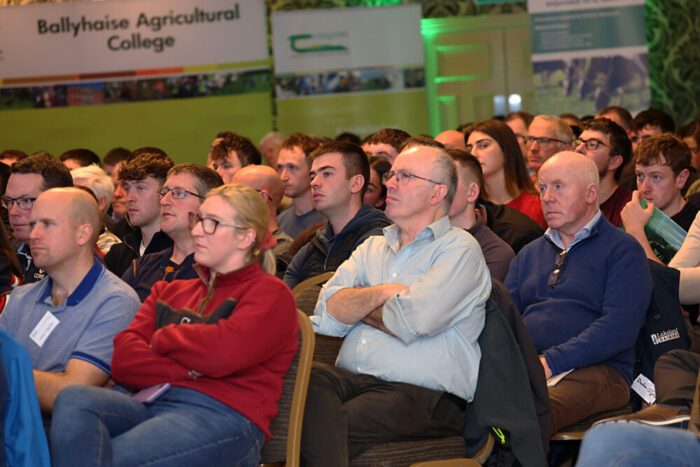
Dairy Specialist at Teagasc, Mark Treacy shares some of his key takeaways from the Teagasc National Dairy Conference.
The Teagasc National Dairy Conference, entitled ‘Pathways to Progress’, was held last week with many important messages delivered.
Markets
Dairy Market Analyst, Chris Walkland outlined the current situation in dairy markets and predicts that 2026 will be a challenging year for prices due to high supply levels of dairy produce across the world. While markets are difficult now, Chris was hopeful that market prices will improve in 2026 but doesn’t see this happening until late summer.
Focus on key performance indicators
While the market prices are largely outside of a farmer’s control, it was clear that inside the farm gate there is still scope to influence profitability by focusing on key performance indicators such as cost of production and grass utilised.
Joe Patton, Head of Dairy Knowledge Transfer at Teagasc, outlined how the cost of production per kg of milk solids has increased by over 43% between 2020 and 2024, with concentrate costs showing the largest increase.
Much of this increase has been driven by an increase in the amount of concentrate being fed on farm, however Joe questioned is this extra concentrate actually delivering more output and profit on farm and clearly showed that there is a very weak relationship between cow output and profitability. Indeed, the strongest relationship with profitability was shown to be the amount of grass utilised, with about 40% of the variability in margin explained by grass utilised. For 2026, farmers should focus on better aligning stocking rate to the grass production potential of their farm.
The EBI’s contribution
Donagh Berry outlined how the Economic Breeding Index (EBI) has developed over the last 25 years, and the contribution it has made to dairy profitability.
In this time, the EBI of the national dairy herd has risen by €191, with the cumulative improvement worth an estimated €5.46 billon to the Irish dairy industry. He outlined the importance of getting breeding decisions right on the ground as the results are long lasting and cumulative, as well as the challenge of future proofing the Irish dairy sector by ensuring AI bulls being bred today have suitable genetics for our industry in future years. The inclusion of a Carbon sub-index within the EBI is an example of such futureproofing.
Water quality
The importance of everyone in the industry doing their bit to maintain and improve water quality was discussed with 5 practical steps farmers can take outlined:
- Ensure there is no direct runoff from farm roadways to watercourses.
- Keep silage pits, aprons and feeding areas clean to minimise soiled water.
- Monitor water ingress to slurry stores and put solutions in place to minimise clean water entering these stores.
- Break direct connections between yards and surface water drains.
- Use the NMP online water quality pack to familiarise yourself with the potential nutrient loss pathways on your farm.
Succession and collaborative farming
Finally, there was much interest in the areas of succession and collaborative farming, with a range of options outlined by Ruth Fennell and Conor Hogan. Several farmers discussed how they have benefitted from collaboration with Michael Dunphy and John Gilvarry describing how they have collaborated to farm together in Co. Mayo, Conor Wynn described his experience of starting out farming on a leased farm, while Tony McCormack outlined how his registered farm partnership with Chris Cahill has allowed him to step back from farming while still remaining involved.
For further details, see the conference proceedings and presentations here.