
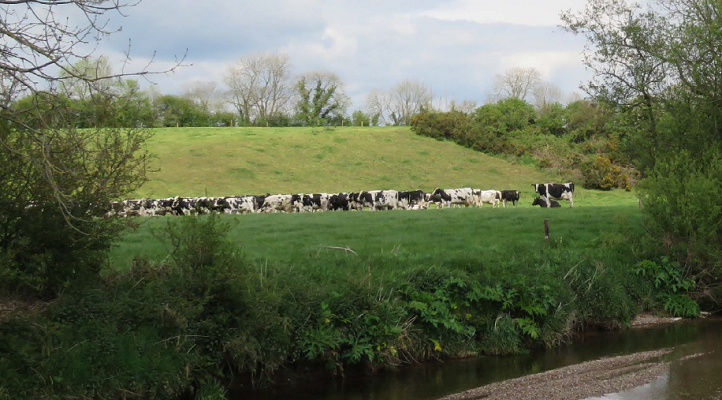
Cathal Somers, Manager of the Agricultural Sustainability Support and Advisory Programme (ASSAP), examined some practical steps dairy farmers can take to improve water quality as part of the Teagasc National Dairy Conference.
Water quality remains one of the most pressing environmental challenges facing Irish agriculture. Under the EU Water Framework Directive, Ireland must achieve good or high ecological status in its waterbodies. Agriculture can play a significant role in this effort and the solution lies in compliance with GAP regulations and tailored advice for farmers in their local area. This advice must be led by research and catchment science, with a focus on putting the right measure in the right place. Farmers have put in a lot of work to date on farms across the country, implementing measures to improve water quality. This needs to continue into the future and the volume of farms implementing measures must increase also to meet out targets.
The EPA Water Quality in Ireland (2019-2024) report shows that over half (52%) of our surface waters are in satisfactory ecological health being in either good or high ecological status. This means that 48% of the surface water bodies in Ireland are not where they should be. This is a decline from the previous assessment when 54% were satisfactory (EPA, 2025). On a more positive note, the report has identified some improvements in nitrate (39% of sites) when compared to the 2016-2021 report, however concentrations are too high at 44% of rivers sites, predominantly located in the east, southeast and south of the country (EPA, 2025). There is evidence that phosphorus concentrations have improved in priority areas for action, where the Agricultural Sustainability Support & Advisory Programme (ASSAP) advisors work and support farmers.
Why local matters
Teagasc’s research shows that water quality issues vary greatly between catchments. A one size fits all approach simply doesn’t work. Instead, advisors must use local data and catchment science to identify the right measure for the right place. This ensures that every measure delivers maximum impact on improving water quality and this is a core principle of Teagasc led Better Farming for Water campaign.
The Better Farming for Water Campaign
- Teagasc’s Better Farming for Water campaign highlights eight practical actions that farmers can take to reduce nutrient, sediment and pesticide losses.
- Reduce nutrient surplus: match nitrogen (N) and phosphorus (P) inputs to crop and grass demand
- Optimise soil fertility: maintain correct lime, P, and K levels for efficient nutrient use
- Apply fertilisers and slurry wisely: avoid high risk periods and wet conditions • Improve slurry storage: ensure adequate capacity to prevent winter spreading
- Protect farmyards and roadways: stop nutrient rich runoff entering drains
- Fence watercourses: keep livestock out of streams and rivers
- Install buffer zones and riparian margins: trap sediment and nutrients before they reach water
- Maintain green cover on tillage soils: reduce soil erosion during winter
By combining science-based advice with local knowledge, farmers can protect water quality while maintain profitable farms. This is not just compliance; it’s about safeguarding Ireland’s natural resources for future generations.
Main nutrients of concern
Diffuse nitrogen losses
Nitrogen (N) loss typically occurs on soils that have high permeability. These are ‘light’ free draining soils and water can quickly permeate through these soils. Where excess Nitrogen fertiliser is applied above crop requirement, this N is not utilised by the grass and is left in the soil. N does not bind tightly to soil and therefore when there is heavy rainfall, the water leaches N away to groundwater, streams and rivers. The natural biological processes in the soil increase the N available particularly in autumn. This requires careful management to minimise N losses at that time of the year.
Diffuse Phosphorus and Sediment losses
Phosphorus (P) loss typically occurs on soils that have low permeability. These are poorly draining soils and get quickly saturated with rainfall. When there is heavy rainfall on these saturated soils this leads to overland flow of water, particularly on fields with slopes.
The overland flow of water across fields can carry P in soluble form. It can also wash away soil clay particles that have P attached to them, P binds tightly to soil clay particles. The soluble P and soil clay particles can then be washed into the drainage network and streams located in the farm and end up impacting water quality.
Three Areas dairy farmers can target to reduce losses
The first thing a farmer should look at is their local water quality; this will help to focus in on areas of concern and associated issues.
- Nutrient management
- Farmyard
- Land management
Nutrient management
- Balanced fertility on moderate to heavily stocked farms is hugely important to ensure nitrogen is used efficiently by the grass.
- Ensure appropriate fertility (p/k) and liming for the intensity of the farm
- Sulphur can reduce nitrate leaching
- Reduce chemical N & P applications through improved use of slurry
- Good grassland management and reseeding practices can help reduce nitrogen applications
- Focus on reducing nitrogen surplus on the farm through improved nitrogen use efficiency, this can be achieved through reducing chemical N application with good slurry and clover management
Farmyard
- The yard is an important area on any farm and needs to be managed correctly. Slurry storage, silage effluent, FYM, soiled water, effluent, clean water and clean yard areas must comply with regulations.
- Slurry and soiled water storage is a priority; for slurry, it is advised to have a buffer beyond regulatory requirements for years where the housing period increases due to poor land conditions for grazing
- It is important to ensure all rainwater from roofs is managed correctly and collected through working gutters and downpipes to avoid clean water becoming soiled
- Identify the areas of the yard that need to be collected and reduce traffic on clean yard areas as much as possible, always keep areas in the yard defined as clean brushed or scraped and in clean condition
- Ensure all silage and FYM effluent is collected
- Farm roads must be sloped away from any waters and directed towards fields or appropriate mitigation measures as advised by ASSAP advisors
Land management
Pollution Impact Potential (PIP) maps found on catchment.ie can be used to identify areas on a farm susceptible to nitrogen and phosphorus loss, this tool can also be used to identify critical source areas (CSA’s) on the farm. CSAs are areas that are at highest risk of impacting a water body through overland flow. These are often low-lying parts of farms where runoff accumulates in high concentration. Runoff from CSA’s carries sediment and nutrients to waterways. Once the potential issue is identified, a plan can be put in place for addressing the issue.
Nitrogen balance & mitigation measures
Nitrogen Balance is a farm level metric that measures the difference between nitrogen inputs (such as chemical fertiliser, slurry, concentrates and purchased feed) and nitrogen outputs (mainly in the form of milk, meat, or crops sold off the farm). A high nitrogen balance means more nitrogen is remaining on the farm, which can increase the risk of losses to water and air, a lower nitrogen balance indicates more efficient use of nitrogen and reduced environmental impact.
Know your nitrogen balance number which can be accessed through AgNav and aim to reduce it through improved management, as this will help to reduce your N surplus and reduce potential N leaching.
- Reduce chemical N applications through use of clover
- Only apply nitrogen to meet crop requirement, grass measuring and good management is important in knowing crop requirement
- Appropriate fertility and liming will improve nitrogen use efficiency
- Use slurry to reduce chemical N application
- Reduce application during droughts and periods of poor growth, soil temperature, soil moisture deficit and grass growth rate data can be useful in making decisions
Phosphorus
- Aim for index 3 soils, index 4 soils have the potential for increased loss
- Avoid nutrient applications in critical source areas in the shoulders of the year
- Bare soil can be prone to losses in an area susceptible to overland flow, such as maize ground. Ensure carful placement of this type of crop and avoid locating in land connected to rivers and drains
- Remove animal access points to rivers
- Good use of riparian margins, buffer zones, trees, hedgerows and nature-based solutions to break the pathway of overland flow, these measures also slow down the movement of water across land during heavy rainfall events
- Avoid poaching and machinery damage, good infrastructure on the farm is important
Conclusion
The key to improving water quality is identifying the problem by using the tools and data available and finding the correct solution for your farm. Measures must be adopted across the areas of farmyard, land and nutrient management to reduce nitrogen, phosphorus, sediment and effluent loss. Using up to date science, research, advisory, TAMS and services like ASSAP if it’s available in your area, can help to improve water quality across the country if adopted widely.
For more insights from the Teagasc National Dairy Conference, visit here.