
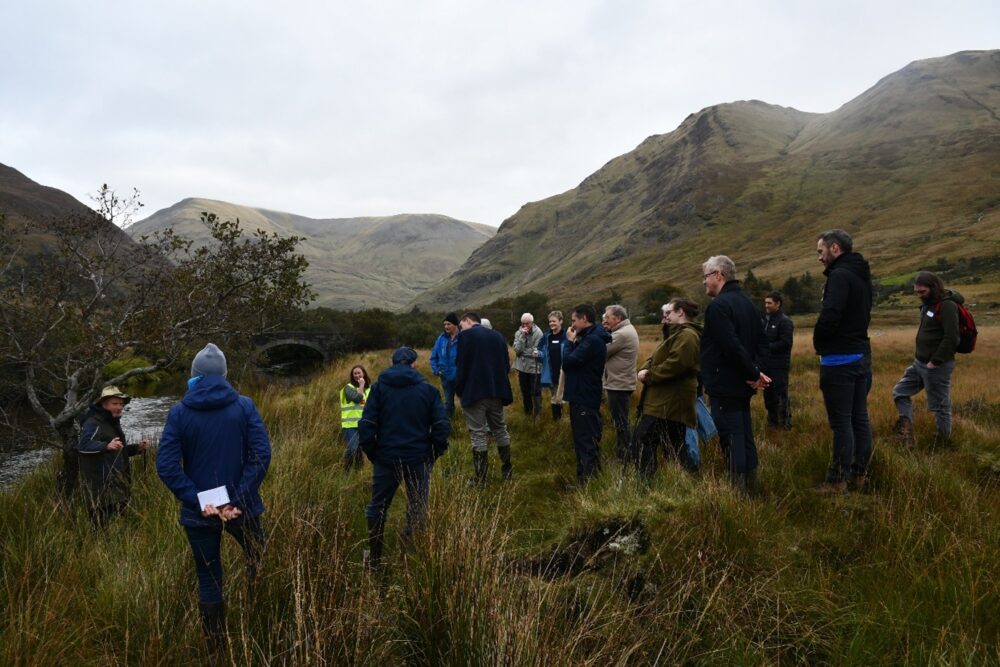
The second Farmer-Focused Biodiversity and Agricultural Knowledge Network (FarmBioNet) workshop brought together farmers, advisors, researchers and policy makers to explore knowledge gaps in biodiversity-friendly farming (BFF) practices and to better understand the needs of farmers implementing these practices.
The workshop was followed by a farm walk led by Colm Gavin on the Bundorragha river catchment, Delphi valley, Co. Mayo. Niall Walshe, FarmBioNet Research Officer; Meritxell Grau, FarmBioNet Project Manager; Saorla Kavanagh, FarmBioNet Project Coordinator & Research Officer; Claudia Barry, Biodiversity Research Technician; and Gary Goggins, NPWS, share key insights from the FarmBioNet event.
The project team (Dr. Saorla Kavanagh, Niall Walshe, Claudia Barry and Meritxell Grau Butinyac, Teagasc and Gary Goggins, NPWS) welcomed participants and presented an overview of the project’s aims and the results from FarmBioNet’s first workshop.
The workshop was centred around a discussion on biodiversity-friendly farming practices rated in terms of advantages to biodiversity and economic benefits to the farmer during our fist workshop.
The session began with attendees revisiting the BFF practices that had been discarded as not relevant to Ireland. Participants discussed why these practices were considered unsuitable, whether they had any direct experience with them, and how regional conditions influenced their relevance.
Participants then moved on to the BFF practices rated as having both high biodiversity value and high long-term economic benefit. For each practice, they explored why it had scored highly in both areas, shared whether they had implemented it, and outlined the motivations or barriers influencing adoption. Farmers and advisors also discussed the feasibility of these practices on their own farms, considered any additional co-benefits, and reflected on the time required for biodiversity and economic returns to become evident.
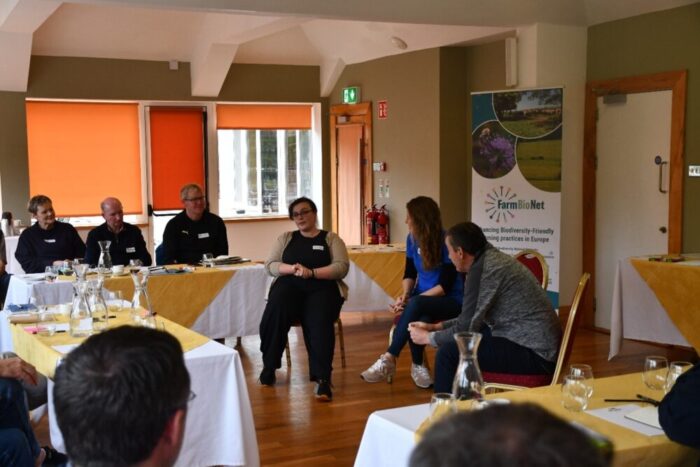
FarmBioNet Project Coordinator, Dr. Saorla Kavanagh conducts a fishbowl discussion with workshop participants (Photo: Claudia Barry).
The group then examined practices that were judged to provide high biodiversity benefits but low economic gain. They explored why these practices were attractive from a biodiversity perspective yet less appealing economically. Participants shared experiences of implementing these actions, considered feasibility at farm and regional levels, and identified co-benefits that might help justify their use.
Next, attendees turned to the practices rated low for both biodiversity and economic benefits. They discussed the reasons behind these low scores, whether any of the practices were used, and under what circumstances, if any, they might still be adopted. Farmers also highlighted practical and feasibility challenges associated with these actions.
Participants then considered the practices viewed as economically beneficial but offering limited biodiversity benefit. They shared any implementation experiences, discussed feasibility, and reflected on why these practices tended to deliver financial returns without corresponding ecological gains.
To close, attendees took part in a knowledge-needs fishbowl discussion. They identified the resources and supports required to adopt new BFF practices, highlighted knowledge gaps relating to BFF practices, and discussed needs around information exchange and advisory services. The conversation surfaced issues, including farm abandonment, policy constraints, research gaps in upland farming, the importance of farmer-to-farmer communication, and the value of better recognising ecosystem services.
Biodiversity-friendly farming practices in action
The second half of the day featured a guided farm walk led by Colm Gavin, an organic sheep farmer actively implementing BFF practices to enhance the vitality and biodiversity of his farm’s natural habitats. Colm farms 90-100 Mayo blackface ewes on a mosaic of peatland and wet grasslands spread across private and commonage lands. His land runs along the Bundorragha River and up to an altitude of 700m, nestled within the breathtaking Mweelrea mountain range.
One of the major challenges for Colm, and many landowners in Connemara, is managing invasive Rhododendron (Rhododendron ponticum). Colm explained the process of safely and effectively removing the plant, a technique he and other local farmers have received specialised training to carry out. Through collective efforts, significant progress has been made in clearing Rhododendron from farms across the area.
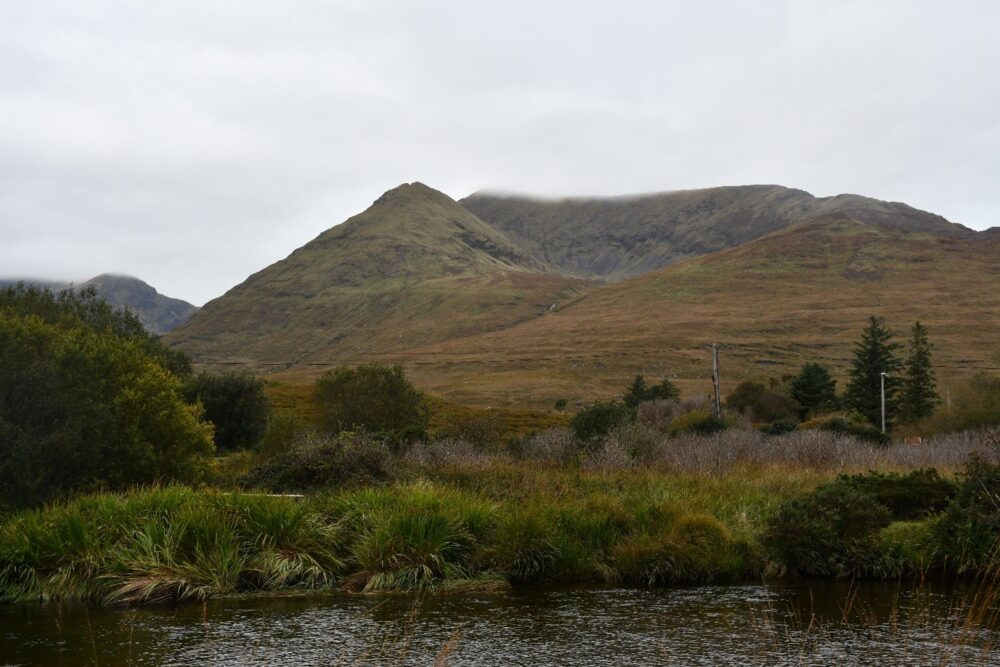
Bundorragha river catchment, recognised as one of the top pearl mussel habitats in Europe (Photo: Claudia Barry).
Flowing through Colm’s farm is one of Europe’s most important habitats for the endangered Freshwater Pearl Mussel. The Bundorragha catchment is recognised as one of the top pearl mussel habitats in Europe, and Colm’s BFF practices help nurture the waters these mussels rely on. One challenge identified is the sediment runoff from the sandstone mountains, which accumulates in the Bundorragha river. To address this, Colm has introduced drain management measures to reduce sediment entering the river.
Colm has previously participated in the Pearl Mussel Project EIP, which concluded in 2023, and his farm is also featured in the Farming for Nature Handbook, highlighting his commitment to integrating biodiversity-friendly practices into productive farming.
The event proved to be both valuable and engaging, generating highly positive feedback from participants. Attendees welcomed the opportunity to contribute to research at the European level and were encouraged to learn that their insights and experiences would directly influence the project’s outputs.
The workshop sparked rich, open discussions on BFF practices, including which measures are most relevant to Ireland, areas of misalignment between advisors’ and farmers’ understanding of these practices, and the specific needs of farmers working in upland areas. Public reports summarising these findings will be made available as the project progresses across different channels including website blogs, reports, scientific articles and others. The farm walk was particularly well received, offering a firsthand look at how the Gavins integrate BFF practices into their farming operations – tackling invasive Rhododendron and finding practical solutions to protect the endangered Freshwater Pearl Mussel.
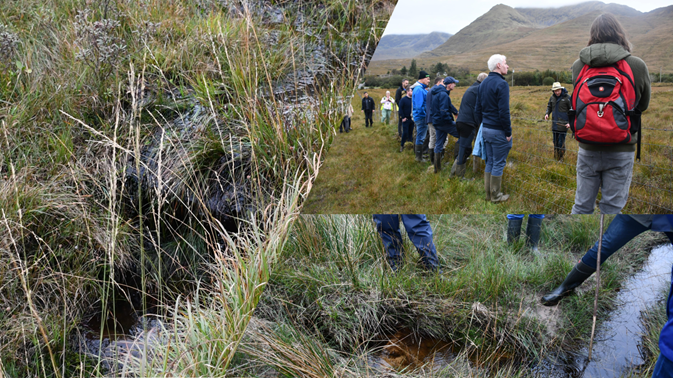
Colm Gavin explaining how drain blocking measures have reduced sediment from entering the Bundorragha river (Photo: Claudia Barry).
Many participants emphasised the need for further research into upland farming, noting that policy and research efforts in Ireland tend to focus disproportionately on lowland systems, leaving upland farmers underrepresented. Attendees also discussed the difficulties associated with organic farming and highlighted the importance of improving collaboration between different organic sectors, for example, aligning organic livestock production with organic cereal production to create more integrated and workable systems.
The aims of FarmBioNet
FarmBioNet aims to help farmers assess biodiversity on their farms and implement low-cost, practical actions to enhance biodiversity without negatively impacting production. The project will use a multi-actor approach to determine best practices.
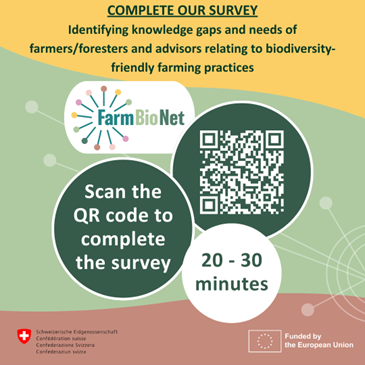
Our questionnaire on “Identifying the Knowledge Gaps and Needs of Farmers and Agricultural Advisors” is now live, and we need your input! If you haven’t taken the survey yet, now is the perfect time.
Your feedback would greatly help us advance our work. If you can spare a moment to share your thoughts, we would truly appreciate your time and effort.
To participate in the FarmBioNet Questionnaire, click here. Alternatively, scan the QR code below.
For further information or to join the National Network contact FarmBioNet@teagasc.ie
Learn more about FarmBioNet and sign up to the biannual newsletter.
You can find out more about helping pollinators on your farm here.