
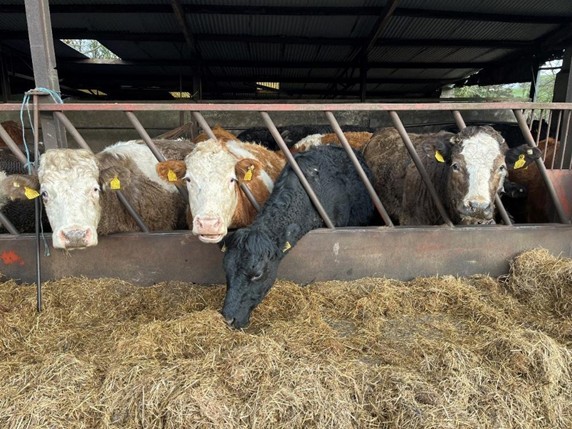
By taking actions on our farms now, we can reduce or eliminate issues in springtime. Marion Fox, Teagasc Advisor, Galway Clare Region, tells us more.
As we lead into the festive period, we can plan and organise the farm for the busy spring period. In this article, I am going to look at body condition scoring (BCS), silage testing, housing and preparing for calving.
Body Condition Scoring of Cows
Body Condition Score (BCS) is a vital tool used to assess the relative fatness or thinness of an animal by assessing the animal’s fat stores. The process of measuring body condition involves handling each of your cows and assessing how much fat cover they have in three particular body sites:
- Over the ribs
- Over the short ribs, transverse processes
- On the tail head, above the pin bones
The level of fat cover in these areas is scored on a point scale of 1 to 5. A score of 1 indicates a very thin, emaciated animal, while a score of 5 indicates an animal that is grossly overfat.
The scale should be used to group cows by condition:
- Thin cows (≤2.5): Prioritise these cows with the best quality silage and, if needed, offer a high energy nut until they reach target condition. First and second calvers may require additional feeding. Aim for calving at about BCS 3 for suckler cows. Cows may lose about 0.25 BCS from pre- to post-calving, so plan for a post-calving BCS of around 2.5.
- Adequate cows (BCS 3.0): Feeding 65 to 68 DMD silage ad lib during the dry period allows a slight draw on body reserves and helps achieve the target of BCS 3.0 at calving.
- Overfat cows (≥3.25 to 3.5): Start managing condition now, not close to calving. Restrict high DMD silage. Where possible, offer a medium quality silage with 15 to 25 percent straw or hay.
Body condition scoring is important because cows calving too thin can be slower to calve, will have poorer colostrum quality and will return to heat later. Overfat cows are at greater risk of difficult calvings. Most of the calf’s birth weight is gained in the last trimester, so December is the time to correct condition.
Silage Testing
Test silage now if this has not already been done. Silage analysis underpins every winter diet decision. Use proper sampling techniques: take multiple cores across the pit, or multiple bales per batch, exclude the top layer, mix thoroughly, place in a sealed plastic bag and send to an accredited laboratory for analysis.
It is vital that you know your DMD, crude protein, UFL and mineral profile. Once results are available:
- Match concentrates to forage quality for weanlings, stores and finishing cattle. A higher DMD reduces the need for meal, while a lower DMD requires increased supplementation.
- For cows in good condition, 65 to 68 DMD silage will suffice. If silage quality exceeds 70 DMD, restrict intakes or add straw or hay to avoid excess condition gain.
Housing
Ventilation and Space
Check air inlets and outlets, along with feed and lying space. Some farms have improved ventilation by increasing outlet space where ammonia odour lingered on calm days. Ensure that every cow can feed at the same time in restricted feeding systems.
Grouping and Scanning
Separate cows by calving date around Christmas. Scanning results can help identify empty cows early. Where fodder is tight, consider culling and allow targeted feeding for first and second calvers and thinner cows.
Prepare for the Calving Season
A tidy, well prepared setup saves time and reduces disease pressure.
Minerals
Start, or continue, a good quality pre-calving mineral for at least six weeks before calving. Prioritise high magnesium and minimal calcium to support calcium metabolism. Include phosphorus and sodium, along with vitamins A, D and E, and trace elements such as copper, selenium, iodine, cobalt, manganese and zinc. Mineral powders dusted on silage provide reliable daily intakes of macro minerals. Always check products against recommended intakes.
Shed
Have the calving shed power washed, disinfected and limed well in advance of cows calving.
Equipment Checklist
Ensure the following items are available and in good working order: calving gloves, lubricant, good quality ropes (red and blue), calving jack, thermometer, stomach tube and bottle, frozen colostrum backup, navel spray, electrolytes, and cow and calving gates. Test cameras, lights and alarms, and keep the vet’s number saved and easily accessible.
Work Organisation
Use December and January to service machinery, diet feeders and handling units. Check fences, roadways and water troughs. Many farmers find it helpful to keep a whiteboard list to track pre-calving jobs and supplies.
Read More: Body Condition Scoring Cows Factsheet
Watch: How to body condition score a suckler cow