

Starting out in farming is exciting. But you’ll need all the help you can get so make sure you take advantage of all available supports. James McDonnell, Farm Management Specialist, Teagasc outlines seven key supports farmers should avail of.
Farm succession planning can be tricky for both generations – the parents passing on the farm and the younger ones taking it over. There are tax issues, Department of Agriculture, Food and the Marine (DAFM) scheme rules and concerns about future care costs, including how the Fair Deal Scheme might affect the farm. Most supports are aimed at the successor, but poor timing can lead to big costs when taking over. The key is not to rush the plan just to meet a deadline. That can lead to missed opportunities or unnecessary expense. Careful planning pays off.
The following supports are available for farmers to avail of:
1. Getting advice
For many, it may begin with a chat to your spouse or partner, moving on to include the Teagasc advisor. Once a draft plan is put in place, you may need the advice of an accountant and solicitor. Advice can be expensive, especially if the plan is complex. No two families are the same. So it’s not a case of one size fits all, you have to figure out what works for your family. For more information on this see the article Pick your team for success, by Kevin Connolly.
Key support: There is a DAFM grant available. The Succession Planning Advice Grant (SPAG) is a 50% grant on a spend of up to €3,000 for farm succession advice.
2. DAFM Registered Farm Partnerships (RFPs)
For nearly 5,000 farming families, RFPs have become a stepping stone for a new generation of farmers who work with their parents in the farming business. With this option, a legal agreement is reached as to how the business is operated and profits divided. The ownership of the assets used in the business becomes a separate transaction.
Key support: DAFM Collaboration Grant will cover 50% of RFP set up costs up to €3,000.
3. Succession Farm Partnerships
Similar to RFPs but with these agreements: you are committing to transfer 80% of the farm between year three and year 10 of an RFP agreement. Note of caution: if you are interested in this step, the agreement needs to be entered into prior to age 32 or you may miss out on Young Trained Farmer Relief from Stamp Duty.
Key support: €5,000 tax credit per annum for five years, to be divided between the donor and successor based on the profit-sharing ratio in the partnership agreement.
4. Capital taxes
Three main capital taxes apply when a farm is transferred. It’s best to complete the transfer while everyone is still alive; once someone passes away, the valuation date is fixed and any tax due cannot be reduced or planned for. To maximise the benefit, timing is important. There are ceilings, age restrictions, thresholds and active farming conditions that need careful planning to maximise the benefits. For more information on capital taxes read an article Navigating the taxes and reliefs around farm transfer by Ruth Fennell. The relevant taxes are:
- Capital Gains Tax (CGT) rate 33%.
- Capital Acquisitions Tax (CAT) rate 33%.
- Stamp Duty (SD) rate 7.5%.
Key supports: Some tax reliefs potentially reduce the capital taxes to nil. The main ones used are Retirement Relief (CGT), Agricultural Relief (CAT), Young Trained Farmer Tax Relief and Consanguinity Relief (SD).
5. Income tax supports
One hundred per cent stock relief is a very important relief worth up to €100,000 for the first four years farming. Once the name is put on the herd number, the clock is ticking. This can be used to increase the stocking rate on a newly transferred farm, easing pressure on tax and cashflow. The normal rate is 25% for all farmers, but this rate is increased to 50% for those in RFPs. For example, a parent and child in an RFP can claim 50% and 100% respectively on their share of the profits. Previously mentioned at point 3 is the Succession Farm Partnership tax credit.
Key support: Stock relief, worth €100,000 in total and up to €40,000 in any one year to the young farmer.
6. CAP Supports
There are a number of EU supports aimed at young farmers. In EU schemes, a young farmer is defined as being under 40, and in their first five years farming; careful planning is required to ensure that you are in compliance with the requirements of each scheme, as there are different terms and conditions.
CISYF: The Complimentary Income Support for Young Farmers (CISYF) tops up the BISS payment (up to 50ha) each year for five years. The payment varies each year and is dependent on being rolled over in each CAP agreement. There is also a BISS top-up from the National Reserve where entitlement values are below the national average or an allocation if there is not one for each hectare on the BISS application (max 50). If the farm needs capital development, the TAMS grant rate is higher for young farmers (60%).
Key support: CISYF for young farmers, National Reserve allocation/ Top up and Higher TAMS Grant. These supports combined can be worth tens of thousands.
7. The Nursing Home Support Scheme (Fair Deal)
The Fair Deal Scheme is explained in an article by Hugh McEneaney: Essential steps when considering retirement.
Key support: The taxpayer contributes to your nursing home care instead of your successors if the farm and other assets are transferred more than five years ahead of making a Fair Deal Application.
Table 1: Summary of the main items to watch
| Key Items to keep an eye on | Deadline / time limits |
| Succession Advice Grant 50% | 50% of €3,000 max (succession advice costs) |
| Collaborative farming grant 50% | 50% of €3,000 max (RFP setup costs) |
| Succession Farm Partnership – Income tax credit (€5,000 per year for 5 years) | Apply before age 32 or you could miss out on full stamp duty relief on land transferred |
| Young Trained Farmer Stamp Duty Relief | Apply before Age 35 to avail of full stamp duty relief |
| CGT Retirement Relief commencement | > Age 55 (must own and farm for 10 years) |
| CGT Retirement Relief ceiling reduction | < Age 70 (€10m reduced to €3m for parent to child transfer) |
| 100% Stock Relief for young farmer | Use within first 4 years farming (€70,000 uplift in stock values) |
| CAP Direct Payment top-up payments (National reserve and CISYF) | Apply before age 40 and/or within 5 years of commencement in farming |
| TAMS: Higher Rate of aid (60%) for capital developments | Apply before age 40 and/ or within 5 years of commencement |
| Fair Deal Scheme | 5 Year “Look Back” on transfers completed |
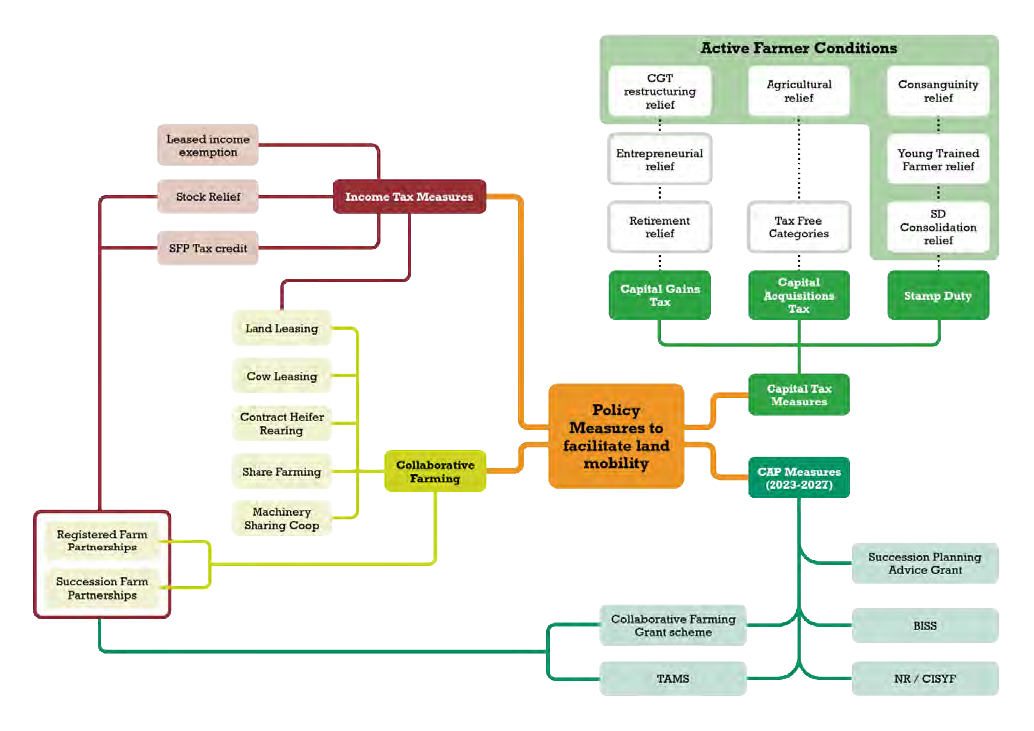
Figure 1: The below diagram shows the different policy measures that are available to support farming in Ireland. With so much complexity, it is important to meet your advisor soon to work on your farm plan.
This article first appeared in the November/December 2025 edition of Today’s Farm