
Potatoes are one of the world’s most popular foods, loved for their versatility. In Ireland, they hold a special place on the plate, and no Christmas dinner is complete without them. Rose Edwin, Food Programme Communications Officer, digs into the research to see how the way we cook potatoes affects what our bodies absorb.
Research from Teagasc shows that whether you boil or bake potatoes, can make a significant difference to how your body digests them and how quickly they release energy.
The study, led by Dr Daniela Freitas and Dr Andre Brodkorb, compared two types of potatoes: an Irish-grown, white-skinned variety (Maritiema) with a white flesh, and a popular sweet potato variety available in most Irish supermarkets. Using advanced microscopy and simulated digestion models, a lab-based system that mimics how food is broken down in the human gut, the team explored how different cooking processes change the structure of these potatoes and how that structure can influence how fast starch breaks down into sugar during digestion.
What happens when you cook potatoes?
For the Irish potatoes, the research showed that cooking method makes a clear difference. The reason for this lies in the cell structure. Each organism is made up of many cells stacked next to one another. Boiling tends to break down the cell walls in white potatoes more easily than baking, making the starch more accessible to the body’s digestive enzymes. In practical terms, baking white potatoes may be a better option if you are aiming for a slower, more gradual release of energy.
Under a microscope, you can see the following: the blue outlines show potato cell walls. In boiled white potatoes (left image below), you can see that the blue outlines are mostly broken and incomplete. In baked potatoes (right image below), the blue outlines are broken, but less so compared to the boiled potato.
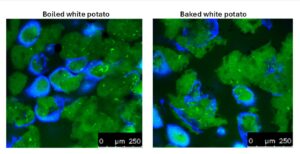
Sweet potatoes behave differently, regardless of how they are cooked. Whether boiled or baked, the sweet potatoes retain much more of their cell structure than white potatoes. This makes it harder for digestive enzymes to access the starch inside each cell, leading to a slower digestion.
Under the microscope, the cell walls in boiled and baked sweet potato remain well defined (clear blue outlines in the image below).
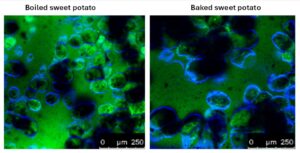
Overall, digestion occurs fastest with boiled white potatoes, followed by baked white potatoes. Baked sweet potatoes are digested more slowly, and boiled sweet potatoes take the longest to digest.
Why does this matter?
These findings align with observations in human studies: white potatoes tend to cause a quicker rise in blood sugar, while sweet potatoes provide a slower, more sustained release of energy. The rise in blood sugar is directly linked to the speed of digestion, which is affected by the food structure and the method of preparation.
Understanding how cooking methods can change how foods behave in our body can help us make better dietary decisions. For people managing blood sugar or looking for longer-lasting energy, sweet potatoes may be a healthier choice. If you want to support Irish potato growers or simply cannot live without ‘normal spuds’, then baking instead of boiling can slow down digestion and lower blood sugar. However, if you are a person with a high need of energy (endurance athlete, active teenager, manual labourer), then fast and easy digestion would be desirable and boiled potatoes would be the first choice.
This research reminds us that nutrition is not only influenced by what we eat but how we prepare our food.
Whether baked or boiled, no Irish Christmas roast is complete without potatoes – enjoy!
Funding: This study was funded by the European Union’s Horizon 2020 research and innovation program under the Marie Skłodowska-Curie grant agreement No 89801.
Technology highlight: All microscopy was conducted at the National Food Imaging Centre
Read the full scientific paper here