

Noel Kennedy, Teagasc Forestry Advisor, introduces us to Fergal Keaveney, who’s embarked on a forestry journey where trees will be a key component in the family’s farming future.
Forestry can do great things and bring many benefits – environmental, economic, social, practical – and beyond. However, the decision-making journey to plant is not to be taken lightly. Where this involves a family farm and the next generation, this process requires especially careful consideration, planning and foresight.
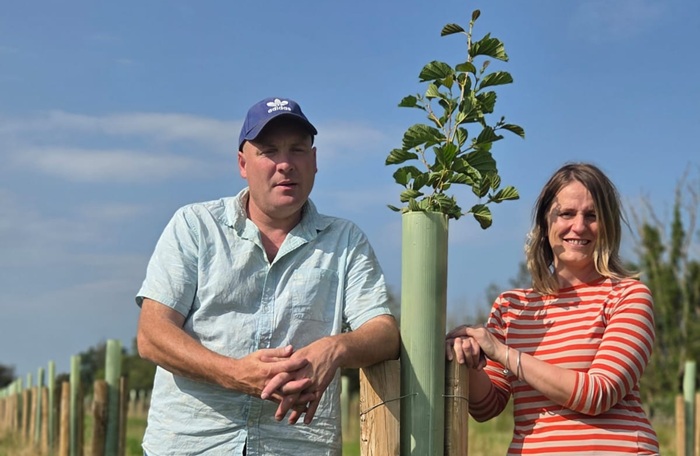
This is the journey that Fergal Keaveney and his wife Momo travelled in search of a more sustainable and diverse farming future – one that could offer a fulfilling and more secure lifestyle for them and their two young children.
The vision
Farming an organic herd of breeding cattle on 55 acres near Athenry, Fergal was dependent on off-farm work to keep the farm viable. He began looking at alternative approaches to farming and lifestyle, and with Momo, their initial ideas about the potential for forestry began to formulate and really began in earnest three years after the birth of their first child.
“We really believed that forestry could offer us a lot – a better work-life balance, lower input costs, income security, keeping the right balance and putting our stamp on the farm,” says Fergal.
Progressing the project
In 2023, the opening of a new Afforestation Grant and Premium Scheme prompted Fergal and Momo to move ahead with their forestry project.
They arranged for their local Teagasc forestry advisor to visit them and outline their options under the Afforestation Scheme. They saw that the scheme included a number of exciting forest types which they believed matched their vision for a multi-functional forest offering biodiversity, recreation, timber production and climate friendly opportunities within an organic farming environment.
The forestry advisor suggested they talk to other forest owners and, on his recommendation, they visited the forest of Ger Deegan in Mullingar – a previous winner of the RDS Teagasc Farm Forestry Award. They were inspired by Ger’s maturing forest and organic cattle farm and knew they were making the right decision.
Forest design
In accordance with the Afforestation Scheme, they engaged a registered forester to prepare their planting grant application. As they walked the farm and shared their ideas with their forester John Paul Fahy, they were delighted to learn he shared their enthusiasm for an ambitious approach to forest diversity and design.
With Fergal and Momo’s vision and determination coupled with John Paul’s experience and scheme insight, a forest design emerged blending five forest types – a mixture of broadleaf and conifer trees balancing biodiversity enhancement and timber and agricultural production combined with carefully chosen open spaces to facilitate access and recreation. The Afforestation grant application based on this design was submitted in early 2024.
Table 1: Planting details
| Forest type | Description | Area planted (ha) | Annual premium €/ha* |
| 1 | Native forests | 3.6 | 1,103 |
| 6 | Oak and Beech | 4.47 | 1,037 |
| 7 | Broadleaves excl. Oak and Beech | 1.59 | 973 |
| 8 | Agroforestry (trees and grass) | 1.33 | 975 |
| 19 | Continuous Cover Forestry | 2.33 | 912 |
| Total forest area and annual premium | 14.15 (35 acres) | €13,574 |
*Annual premium paid to farmers for 20 years and to non-farmers for 15 years. **Exempt of income tax. Liable for USC and PRSI.
Planting
Planting works began under John Paul’s supervision in winter 2024. Fergal and Momo were enthusiastic participants involved in various aspects of the project, which included planting trees and marking out the pathways that they hope will create an accessible and useable forest for the future.
24 species of both broadleaf and conifer trees were planted. In addition to the main species of Oak, Cherry, Birch, Beech, Sitka spruce and European larch, other species include Hazel, Sweet Chestnut, Red Oak, Douglas fir and Redwood to name a few! The agroforestry plot includes a number of fruit and nut species including Apple, Pear, Plum, Almond and Walnut. In time a forest feast by any other name!
The planting of approximately 25,000 trees and the and erection of a full new sheep-fence was completed within a few weeks and submitted for grant payment before Christmas 2024. The cost of purchasing the trees and all this work plus a four-year maintenance contract is 100% covered by the Afforestation grant. “An amazing service with no risk” is how Momo describes it.
Impact on farming
Practical
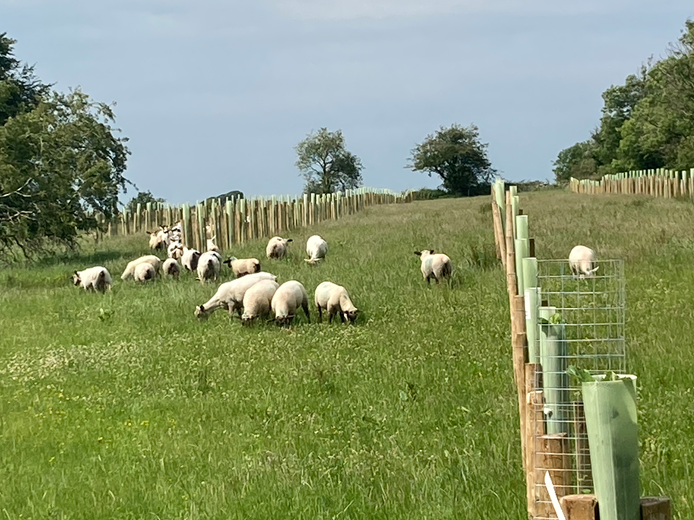
Fergal has retained 20 acres of grassland, enough to fulfil his love of organic breeding stock, which brings a welcome reduction in his workload especially as a parent of a young family. He has also entered into a short-term grazing agreement with a neighbouring organic sheep farmer to graze the new agroforestry plot.
The strategic location of the agroforestry plot beside the winter housing will, in time, allow the cattle to spend more time outdoors, with the agroforestry trees providing a dry lie and thus decreasing winter bedding costs. Fergal sees agroforestry as “a stepping stone for a farmer to start his forestry journey.”
Financial
Forestry and farming payments work well together, with Fergal retaining his full BISS, CRISS and Eco-scheme payments on the forestry area. In addition, as a participant in the Organic Farming Scheme, he also keeps his organic payment on the agroforestry plot as well the grassland.
With an annual income tax free forestry premium worth more than €250,000 over the next 20 years and decreased farming workload, Fergal says that the experience has put a spring in his step – and all the while a forest is growing and a new enterprise is evolving.
The future
Fergal and Momo are excited about what the future holds for their forest, farm and family. Over the next 4 to 5 years, the main task will be for John Paul to maintain the forest and help the trees grow strong so that Fergal and Momo can begin to realise their vision of a living and breathing forest for all to enjoy.
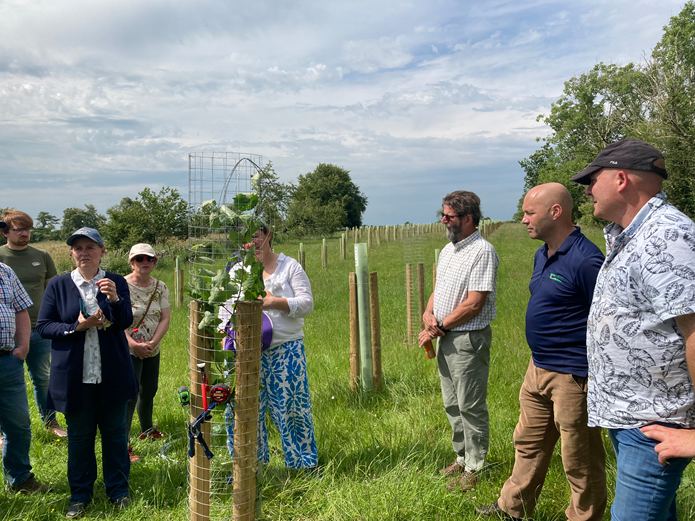
The forest has already hosted in-service training run by the Irish Agroforestry Forum and Fergal looks forward to future visits by farmers, foresters, schoolchildren and others.
They are also excited about opportunities for additional income through new developments in biodiversity credit trading and exploring many other forest related business ideas.
Turning back to the trees Fergal is delighted: “I am very happy with how things are going here and excited for what the future holds for me and my family and for other farmers who choose to plant some of their land.”
You can also sign up to the Teagasc Forestry enewsletter to keep up to date with forestry news and upcoming events.
This article has been adapted from that which first appeared in the September-October 2025 edition of Today’s Farm