
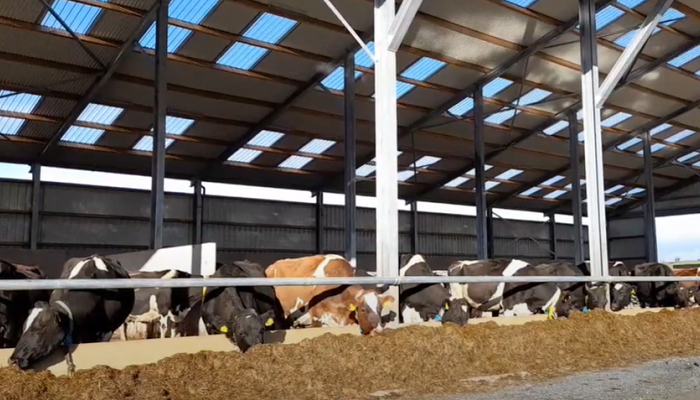
Around 70% of clinical health problems in dairy cows happen in the 2-3 weeks after calving. In this article, Head of Dairy Knowledge Transfer at Teagasc, Dr Joe Patton shares 10 tips for better transition cow nutrition and health.
Poor health outcomes at this time create cost, labour and welfare issues but also have knock-on effects on lactation milk yield, mastitis risk, and fertility. Prevention of metabolic problems is therefore time and money well spent. Some management tips for the upcoming calving period are:
1). Common disorders
Remember that the most common disorders – milk fever, displaced abomasum, ketosis, retained placenta – are interconnected and caused by much the same factors. Good practice on mineral nutrition, forage quality, intake management and cow comfort will help solve these problems all at once.
2) Good quality dry cow minerals
Good quality dry cow minerals should be fed from 6 weeks pre-calving. This gives adequate time to build up trace mineral supply. However, for milk fever prevention, it is the minerals fed in the last week before calving that will make the difference. Review amounts being fed daily and make sure the allocations are right from now on. The preference is for dusted minerals on silage in the days before calving.
3). Magnesium
Magnesium is a critically important mineral for milk fever prevention. Ensure the mineral fed has at least 22% Mag delivered for 100g feeding rate (or 20% at 120g feeding rates). Most high-quality minerals on the market meet this spec. Boluses alone will not cover Mag and P needs so a ‘bulky’ mineral needs to be offered.
4) Avoid overfeeding minerals
Do not overfeed minerals relative to the recommendation on the bag because this risks feeding minerals like P to excess. If extra magnesium is needed around calving, add some Cal Mag (20g per day) to silage or (or better still Mag chloride flakes) to water. Speak to you advisor on this if needed.
5). Vitamin D
Vitamin D (the sunshine vitamin) plays a very important role in milk fever prevention. It is recommended that cows are fed 14,000+ units per day (so a 100g per day mineral will have a spec of 140,000 units per kg). If possible, try to avoid feeding third cut silage to cows on the point of calving.
6). High forage potassium
High forage potassium (K) content (>2.5%) has a significant effect on milk fever risk. If you are having issues with milk fever, test forage and make sure cows are on lower K silage for at least 2-3 weeks before calving. Feeding higher K silage is not a problem for milking cows, youngstock or indeed dry cows that are more than three weeks from calving.
7). Body condition score
Cows in too high of Body Condition Score (BCS) of 3.5+ are much more likely to have health issues like milk fever, ketosis etc. Keep an eye on body condition gain in dry cows through January and February for later calving cows in particular – restrict silage or feed hay / poorest quality silage for a couple of weeks if needed – these cows do not need a full barrier of feed at all times.
8). Older cows and Jersey / Jersey crossbred cows
Older cows and Jersey / Jersey crossbred cows in particular are inherently more prone to milk fever issues, especially if they are in high BCS. Have a plan in place for these cows to treat (e.g. calcium bolus + Vit D) at point of calving, and make sure all staff know what to do. A good tip is to mark with blue paint etc. as they enter the maternity pen so that night calvers will know which animals to treat.
9). Concentrate feeding
There is no evidence that introducing concentrates pre-calving has any benefit to preventing displaced abomasum or ketosis. On the contrary, feeding too much concentrate for too long before calving may increase risk of sub clinical ketosis and BCS loss after calving. The one exception to this is if the silage fed to dry cows is particularly poor (<66 DMD for example). In that case, the cows may need some energy to correct BCS. Test colostrum as cows calve, if BRIX ratings are consistently low (<22) then feeding some soya (<0.3kg per cow per day) for a week pre-calving can help. If colostrum quality is on target, then this is not needed.
10). Grouping cows
As can been seen from tips 1-9, cow requirements will change a lot from far-off dry period to close up cows, through transition to milking. There is big benefit to grouping cows based on expected calving date as a result. In that way, later calving cows can be fed restricted diets, close-up cows can be offered low K silage with extra Mag and some extra protein if needed. After calving, it is highly recommended also that a colostrum group (cows <4 days calved) be run to allow cows recover after calving and also to simplify milking (milk this group last after the main group). Good planning and facilities are needed to achieve this.
For more insights on dairy cow nutrition, view the publication: Nutrition of the Spring calved dairy cow in the early lactation period.