
With growing interest in alternative management approaches, Dr. Ian Short and Dr. Grace Jones dig deeper into research on continuous cover forestry management systems.
About half of the Irish forest estate is Sitka spruce plantation, an exotic conifer species that has been the mainstay of the forest industry for the last century. These plantations are mainly managed with the clearfell rotation system (plantation is planted, managed, all trees felled at rotation end, replanted), a practice that has built the forest industry to what it is today – productive, multi-functional, sustainable. However, there is a growing interest in alternative management approaches, such as continuous cover forestry management systems.
Continuous Cover Forestry Research
Continuous cover forestry (CCF) management excludes clearfelling from the system, ensuring that there are always trees and a canopy remaining on the site. Research into CCF management in Ireland first began in 1998 with the UCD-led project “Alternatives to Clearfell”, funded by COFORD (part of the Forest Service) and in collaboration with Coillte. This project aimed to investigate site factors associated with successful natural regeneration of tree seedlings. It also carried out a trial in 42-year-old Sitka spruce where various thinning intensities (removing about 30% and 60% of the trees) were employed and then alternative tree species were planted under the remaining forest canopy. Unfortunately, the site subsequently suffered from significant windsnap, leading to the conclusion that thinning should not be so heavy.
This learning informed the subsequent project, again led by UCD and funded by COFORD. The CONTINUCOVER project underplanted 6 species into a 40-year-old Sitka spruce forest, and reduced the above canopy by about 15% and 30%. Whilst there was no damage from wind, the reduced amount of trees removed in the thinning created another issue: two years following the thinning there was significant seedling mortality from the light-demanding species (Sitka spruce and birch) because the canopy above closed very quickly. This led to the conclusion that there is a need to open the stand canopy more but without compromising stand stability. This learning was then employed in the LISS (Low Impact Silviculture Systems) project that followed, again led by UCD and funded by the COFORD.
CCF Research Sites’ Establishment
The LISS project started in 2010 and again initiated trials in Sitka spruce but this time in two young forests, aged 15 and 18 years old. Young forests tend to be more resistant to wind damage occurring. Three thinning treatments were applied. They were: Low thinning, Crown thinning, and Graduated Density thinning. More details on these thinning regimes are available here.
This time there was no underplanting of the plots. The plots have been continuously managed and monitored since 2010 under consecutive projects LISS, TranSSFor (2017-2021 – led and funded by Teagasc) and the ContinuFOR (UCD led, and Department of Agriculture, Food and the marine funded) project.
Since the start of the LISS project, researchers have tracked individual trees using ID numbers and 1.3 m diameter at breast height (DBH) marks to guarantee measurement accuracy over time. This data provides insights into individual tree growth, volume, and basal area (the tree’s cross-section at 1.3 m). Managing basal area is a key strategy in forest management, particularly for encouraging natural regeneration within CCF systems. We are fortunate to have access to these well-maintained, long-term trials and appreciate the ongoing support from the site owners.
Thinning Treatments
Much of the past research on the two sites has involved monitoring the growth of the standing trees as affected by the three different thinning regimes. An objective of Low thinning practice is to make the size structure of the stand to be quite even with little variation in tree size. This is generally done by removing the smallest trees and the largest malformed trees. An objective of the transformation process from rotational management to CCF management is to introduce variability in tree size, to increase the variability in canopy structure. After the second thinning, the GDT treatment follows the same process as the Crown thinning treatment. This entails the selection of several good quality trees (Q trees) and then the selection and removal of trees that are competing in the canopy with these Q trees. This results in there being generally above-average sized trees being removed in the crown thinnings and few small trees being removed. This then increases the variability in tree size of the remaining trees after the thinning.
Latest Data
The latest data from the two sites backs this up, with the stem diameter distributions of the Crown and GDT treatments becoming wider than that of the Low thinning treatment. For example, Figure 1 illustrates how the stem diameter distributions of the plots in Ballycullen have changed during the last 14 years. Notice that the stem diameter distribution of the Low thinning treatment has remained approx. 25 cm, whilst the distributions of the other two treatments has increased from approx. 25cm to 40 cm.
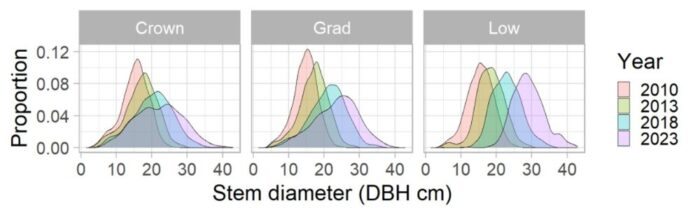
Figure 1: Stem diameter distributions of Sitka spruce following four thinning interventions of either Crown, Graduated Density, or Low thinning treatments at Ballycullen research site.
Impacts On Log Grades From Thinnings
The different thinning treatments not only result in disparate stem diameter distributions, but also disparate proportions of log grades of the trees being removed in the thinnings. Figure 2 illustrates the proportion of different log grades resulting from the third and fourth thinning operations in Ballycullen. There is a greater proportion of the lower grade pulp in the third Low thinning than from the Crown or GDT treatments, and that there is approx. double the proportion of higher-grade sawlog from the Crown and GDT thinnings as compared to the Low thinning. This higher grade of log attracts a greater product price. Using data generated from the two trial sites, and using a model produced as part of the project, an estimate will be made of the financial implications of transforming such a plantation as compared to managing it under the rotation management system.
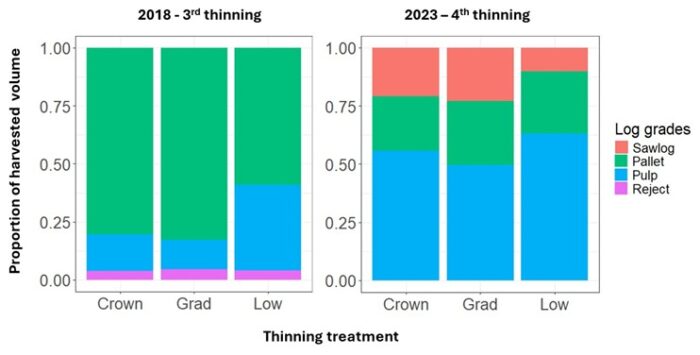
Figure 2: Proportions of log grades from the third (left) and fourth (right) thinnings of Sitka spruce in Ballycullen using three different thinning practices. Note: log grade value generally goes from low (Reject) to high (Sawlog).
The Future
The hope is that this long-term research may continue to attract research funding and produce data and evidence to help inform policy and management guidance. An additional site will be established this year to further strengthen the robustness of the conclusions and support further investigations into transformation to continuous cover forestry management.
Further Information
- Further information and related articles on the ContinuFOR project and Continuous Cover Forestry can be found here:
- Jones, G. (2024) ContinuFOR project highlighted at IUFRO 2024 Congress. Teagasc Daily article, 26-07-2024.
- Jones, G. and Short, I. (2023) Transformation of Sitka spruce stands to continuous cover forestry- ContinuFOR. Teagasc Daily article, 24-03-2023.
- Jones, G. and Short, I. (2023) ContinuFOR project update: four thinnings into our continuous cover trials. Teagasc Daily article, 24-11-2023.
- Schifferdecker, G., Hoeben, A., Spazzi, J. and Short, I. 2025. Adapting to Change: A guide for forest owners facing climate challenges. Forestry & Energy Review 15(1): 14-17.
- Short, I. (2025) Building resilience in Irish forestry: Learning from storms and adapting for the future. Teagasc Daily article, 26-09-2025
- Short, I. and Jones, G. 2023. Transformation of Sitka spruce stands to continuous cover forestry (CCF): Synergies and trade-off. Forestry & Energy Review 13(1): 14-16.
- Short, I., Spazzi, J. and Jones, G. 2024. Continuous cover forestry in Ireland – Informing through research and accessible Massive Open Online Courses. Forestry & Energy Review. 14(2): 46-49.
- Wilson, E., Ní Dhubháin, Á. and Short, I. 2020. Transforming Sitka spruce plantations. TResearch 15(1): 32-33.
- Wilson, E., Short, I., Ní Dhubháin, Á. and Purser, P. 2018. Continuous Cover Forestry: The rise of transformational silviculture. Forestry Journal 288: 38-40.
- Wilson, E., Short, I., Ní Dhubháin, Á. and Purser, P. 2018. Transforming Sitka spruce plantations to continuous cover forestry. Forestry & Energy Review 8(1):38-40.
Websites:
Acknowledgements
The authors wish to acknowledge the following:
- Coillte and the private owner of Ballycullen site for facilitating the research over the last 15 years;
- The Department of Agriculture, Food and the Marine (DAFM( and Teagasc for funding the research carried out on the sites since 2010;
- Past and present project staff, technical staff, students, project advisors and all those that have input into the research over the years.