
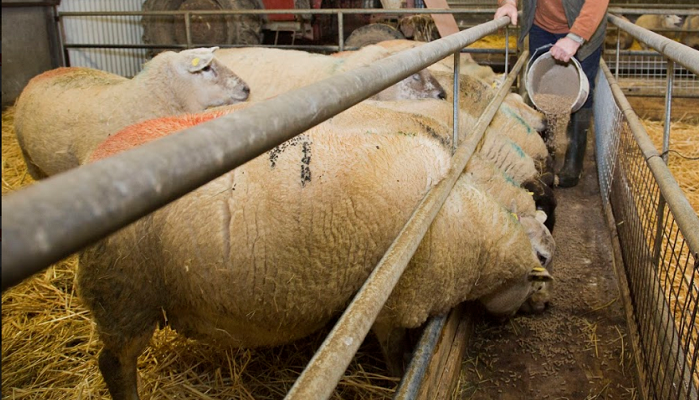
Late pregnancy feeding will have a big influence on flock performance at lambing time, including lamb birth weights and ewe colostrum production. Dr. Frank Campion, Teagasc Research Officer, shares some essential tips and guidance as the lambing season fast approaches.
From a ewe nutritional management point of view, late pregnancy tends to be the time that gets the most focus – and with good reason. The final eight weeks before lambing sees an increase in energy and protein requirements while at the same time the ewe’s feed intake potential is declining.
Late pregnancy feeding will have a big influence on flock performance at lambing time, including lamb birth weights and ewe colostrum production. Meeting this challenge requires good feed management, good quality forage and a good quality ration.
In terms of management getting the basics right and focusing on the elements within your control will bring the biggest benefits. The five key areas to make sure that are correctly managed are:
- Housed ewes need to have sufficient floor space
- Ewes being offered feed indoors or outdoors have sufficient trough space
- Refused forage from troughs/feeders is cleaned out regularly – at least weekly, ideally twice weekly
- Concentrate feeds are split into two separate feeds at least eight hours apart once feeding levels go above 500 g/head/day
- Ensure ewes always have continuous access to clean water
Feed and housing management
A lot of issues that can occur in the run up to lambing, including prolapses, acidosis and twin lamb disease, are linked to poor feed management. A 70kg ewe indoors on straw will require 1.2m2 floor space (1.1m2 on slats) and 600mm/ewe of concentrate feeding space. The space requirement for forage is only 200mm but this works under the assumption that sheep have continuous access to forage.
Splitting concentrate feeds into two feeds, eight hours apart once they go above 500g/head/day, will help avoid digestive upsets and allows the pH of the rumen to rise again following the drop which results from concentrate feeding.
Finally, water intake is linked to dry matter intake and particularly when concentrate feed is being offered ewes will require water, regardless of the dry matter of the forage available to them.
Forage quality
The quality of the forage we have is set at this stage, but it’s important to know how good (or bad!) our forage is. The higher the quality forage, the less concentrate feed required in the run up to lambing, and any concentrate feeding plan should be based around forage quality.
Forage nutrient analysis should also be combined with a forage budget and taking samples from a couple of different batches of silage/hay may be necessary. Experience from the Teagasc BETTER Sheep Farms has shown that there can be a wide range in quality between batches of silage within a farm. In practice, this means that while there may be some very high-quality silage on the farm there may not be enough of this for the full 6-8 weeks pre-lambing and the feeding plan would need to be adjusted once it’s used and a lower quality forage is being offered instead.
Pre-lambing concentrates
Pre-lambing concentrates need to have a high energy value (UFL of 1.1 /kg DM or a ME of 12.5 MJ/ME/kg DM), have a crude protein value of 18-20% and contain a suitable pre-lambing mineral. When considering the concentrate being used, the first step is to look at the ingredients list on the ration bag. The top three listed ingredients will usually make up much of the ration and within that there should be soya bean meal and two high quality energy ingredients such as cereal grains like barley or maize.
Beet pulp is also a comparatively high energy ingredient that can be included in rations. However, filler ingredients that are low quality, such as wheat feed and palm kernel should be avoided. It is also important to ensure that the ration has approximately 20% soya bean meal included. Soya bean meal is an excellent source of rumen undegradable protein which is essential for ewe colostrum production. Soya bean meal can be added to a concentrate for the final three weeks before lambing if the concentrate being used does not have sufficient amounts already within it. This option may be particularly useful for organic producers as organic soya can be expensive and not included in some readily available concentrate mixes.
More from Teagasc Daily: Taking stock: Ewe numbers, markets and the road ahead for sheep farming