
Reforestation following harvest
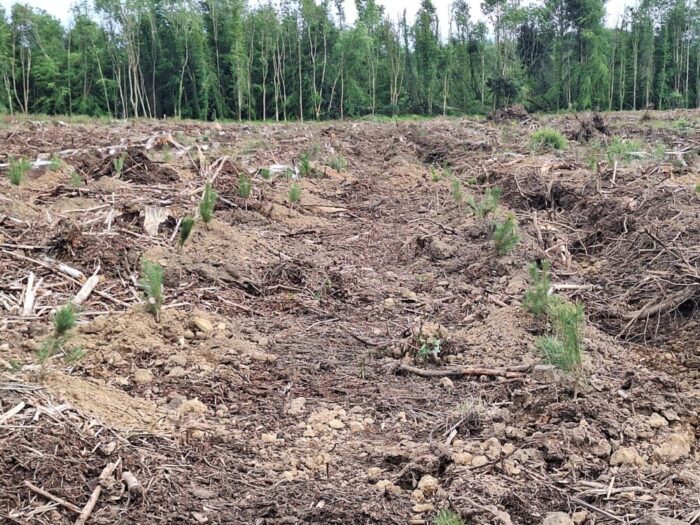
Once a forest has been clearfelled, the same area needs to be restocked with a new generation of trees. The focus of this reforestation is to provide an ideal planting environment, encourage strong growth of the most suitable tree species and minimise losses or growth delays. Teagasc Forestry Advisor Kevin O’Connell tells us more.
Based on previous COFORD studies, replanting sites, particularly those using improved planting stock, can be significantly more productive than the first rotation. Options for diversifying the species range for the next forest cycle can also be considered.
In Ireland, clearfelling and subsequent replanting are governed by the Forestry Act 2014. Applicants who receive a felling licence are legally obliged to replant the land after clearfelling unless an exemption is granted under specific scenarios, as outlined under section 5 of the Department of Agriculture, Food and the Marine’s Felling and Reforestation Policy. A felling licence, in conjunction with a replanting plan, will usually specify details of how and when replanting should occur. Generally replanting must be completed within 2 years of felling.
It can take up to 4 years to successfully re-establish a forest after clearfelling. Activities associated with reforestation can include:
- Ground preparation Mounding, Windrowing or Brash removal)
- Use of dipped trees (pre- treated with suitable insecticide)
- Planting and filling in (the replacement of failures)
- Fertiliser application )if needed)
- Fencing (if needed)
- Vegetation control
- Pine weevil control
Ground Preparation
The successful reforestation of a clearfelled site begins at the ground preparation stage. The type of ground preparation will be dependent on a range of site factors including soil type, slope and drainage status. Brash mats and post-harvest tops and branches are normally tidied up into windrows, typically 10 to 12 metres apart. This work is usually carried out by tracked excavator, with additional drainage or ground preparation such as mounding carried out between rows, according to assessment of the demands of the site.
Brash removal from the site may be an option, suited to better sites where existing site nutrition, ground conditions and environmental conditions allow. Nutrient loss can be reduced by leaving the brash on site until the needles turn brown and fall off. While brash bundling operations may be cost-neutral, the main benefit is the resultant tidier nature of the reforestation area, which may lead to lower site preparation costs.
On large sites, tracks for quad bikes should be planned and constructed to facilitate operations such as plant distribution, weed control and management of insect pests such as weevil.
Replanting Options
Replanting with the same tree species is a common choice with commercial plantations like Sitka spruce. This Conifer High Forest option will maintain a similar or improved timber yield, but owners may also wish to consider additional objectives for their new generation of trees. For example, to encourage biodiversity and resilience tree species, diversification can be an option.
The Climate Resilient Reforestation Scheme is a pilot initiative launched by the Department in July 2024. It has an annual current annual limit of 525ha, with a maximum 12 ha per application. This scheme and offers financial support to eligible forest owners who wish to reforest for a different purpose and to build resilience in response to the challenges that climate brings to Irish forests. The scheme can build capacity for more sustainable forests that can produce high quality timber products and deliver important ecosystem services, such as protecting and improving soil and water quality. Approved applicants can choose from three different elements in the Climate Resilient Reforestation Pilot Scheme: Reforestation for Continuous Cover Forestry (CCF), Reforestation for Native Forests and Reforestation for Biodiversity and Water.
The Department recently launched a Reconstitution Scheme for Windblow 2026 (RSW). This provides financial support for private forest owners with forest areas impacted by recent Storms Darragh and Éowyn. Support can be available to applicants with eligible areas in the form of fixed rate grants of between €3,858 and €6,744 per hectare, according to the Forest Type(s) appropriate for the reconstitution activities. The Department’s scheme document sets out details in terms of RSW qualifying criterial for windblow damaged forests and requirements for replanting. Applications for the RSW are made by Registered Foresters on behalf of eligible landowners via iNET, the Department’s online system for administering forestry schemes and licences. Queries can be directed to the Department of Agriculture, Food and the Marine, Johnstown Castle Estate, Co. Wexford. 053 9163400.
Plants and planting
In forestry terms, young trees are referred to as plants (transplants). The species of trees chosen will have been indicated in the felling licence application. Trees should only be bought from a registered forest nursery and should be ordered, where possible well in advance of planting. The plants should have a strong fibrous root system and a straight stem. Genetically improved planting stock have been proven to boost growth, stem form and wood properties and should be used where possible.
Planting and subsequent filling-in should take place between November and March depending on the weather, tree species and site type. The planting season may be extended by using either cold stored or containerised plants.
Fertiliser
Phosphorus is the most commonly applied fertiliser on newly planted trees to promote early tree growth, usually in the form of Ground Rock Phosphate (GRP). Each post-harvest site should be assessed on its merits in terms of soil types, drainage and nutrition status. Fertiliser, where needed, must be applied between the months of April and August. This is to maximise fertiliser uptake and to minimise the risk of loss from the site. It is highly unlikely that an application of Nitrogen will be needed on a site that formerly grew a successful forest crop, so overall nutrient requirements are likely to be very limited.
Fencing
Check fence line and repair or replace where necessary. Browsing animals can kill or severely damage young trees by bark stripping, eating shoots, trampling etc.
Vegetation Control
Vegetation such as bramble (briar), willow, gorse and willowherb can quickly colonise clearfelled sites and timely control of vegetation is critical to successful reforestation. Vegetation control can either be manual or chemical. To be most effective in terms of effort and cost, vegetation control should be carefully carried out at the start of the growing season.
Manual vegetation control may involve either trampling or cutting competing vegetation around newly planted trees. Chemical control involves the use of an appropriate herbicide as a directed spray around trees. The choice of herbicide depends on the type of weeds, the tree species and the time of year. A cowl or guard should be used to protect the trees when applying the herbicide. Any chemical application required should carried out in full adherence to the Sustainable Use Directive.
Large Pine Weevil Control
Felling a coniferous crop produces a lot of potential breeding material for large pine weevil. Trees used for restocking are liable to be heavily attacked by adult pine weevils, feeding on the stem from the root collar upwards. Heavy damage in the early years can completely girdle stems and cause tree losses. This will increase the re-establishment costs substantially through the cost of insecticide application, replacing plants and additional weeding.
With the Pine Weevil, there is a tendency for two peaks of damage to occur, one in spring before egg laying and the other in late summer before the adults hibernate. It is necessary to protect the plants directly through dipping and/or careful spraying with an insecticide like Acetamiprid. Trees can be purchased from the nursery dipped or herbicide can be sprayed on the planted young trees. It is important to note that the knapsack application of Acetamiprid is only effective for approx. 6 weeks, so predicting the optimum time of application is critical. When spraying for pine weevil two applications are generally necessary, one in March and again in July. Only one spraying may be required in the first year, if plants are dipped. Once trees are established, no further treatments are generally required over the rotation.
Integrated Pest Management (IPM) is a sustainable pest management approach that takes the ecology of the pest species into consideration and employs a variety of pest management methods which can be used singly or combined. IPM aims to take into account the costs and benefits of each method regarding its impact on producers, society and environment. For further information, please see the Teagasc publication on Managing Pine Weevil.
Time to Pause and Consider Options
Reforestation allows forest owners an opportunity to pause and consider their options before choosing the next forest rotation’s path. The owner’s objectives may have changed from their first crop of trees to reflect the multi-functional nature of forestry. It is advisable to have an intergenerational discussion on what way the family want to proceed with their forestry enterprise. For further information on reforestation and all aspects of forestry, contact your local Teagasc Forestry Advisor.