
Spring grass on sheep farms
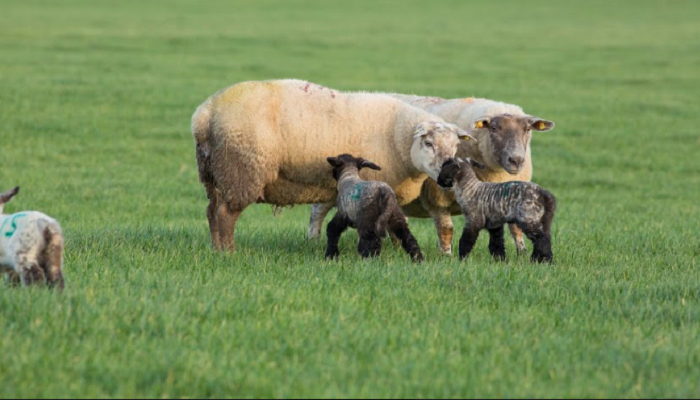
Although lambing accounts for 20-25% of the annual workload on sheep farms, Glen Corbett reminds us that attention should also be given to grassland management.
Attention should be given to grass on the farm to ensure its availability on turnout after lambing. If there is insufficient grass (less than 4cm) during early lactation, milk yield will be reduced and there will be no option but to supplement the ewe.
In consultation with your fertiliser recommendations, early nitrogen is important and a protected Urea product would be preferred. This will get grass started once soil temperatures rise later in the Spring. What I will cover next are some simple techniques/principles that will be relatively cheap and easy to implement that will increase volume of grass and improve its utilisation on grass farms.
Rotational Grazing
The goal is to provide a constant supply of high-quality grass to ewes and lambs throughout the grazing season. A useful rule of thumb to bear in mind is to grow the grass in three weeks and graze it in three days. The reason behind this is that the grass plant will only ever have 3 live leaves at any one time.
During the main grazing season, the grass plant will produce a new leaf every 5-7 days. Once the plant is grazed or cut, it will begin to form its first new leaf (fresh regrowth) after about 3 days with this leaf fully formed after 7 days. This process repeats itself for the second and third leaf.
If the plant is not grazed at this point (3 weeks/21 days), the first leaf that had been produced will die and the process begins again. This obviously wastes energy and nutrients and results in a drop in sward quality as there will be more dead material present in the sward.
In a rotational grazing system, the grass plant can fully express its natural growth cycle. By moving animals every 2-3 days you are protecting the regrowths (the first new leaf developing) and allowing the plant to maximise its growth potential. By grazing every 3 weeks, you are maximising the quality of the grass being grazed and grass utilisation as it is being grazed at the right growth stage which will also be most efficient in terms of nutrient use.
Field division/grazing groups
The grazing system it’s fair to say on Irish sheep farms traditionally was set stocking. This is where continuous grazing systems are operated, with sheep grazing the same grassland area throughout the grazing season.
Rotational grazing systems offer greater flexibility in grassland management by providing increased control over sward structure, grazing severity, regrowth periods and overall pasture supply. This involves dividing the grassland area into a number of paddocks, which are then grazed, fertilised and rested in turn and can allow greater levels of herbage utilisation be achieved.
A general recommendation with regard to paddock size taking an example of a farm with a flock of 100 ewes stocked at 10 ewes/ha would be a minimum of 5 paddocks of 2ha (5 ac) each per grazing group, which can then be further divided using temporary fencing as required.
By subdividing the paddocks, sheep are moving every 2-3 days. This keeps fresh grass in front of the sheep and allows the area to be grazed quickly to allow grass to begin growing again. This form of grassland management maximises grass growth and utilisation while maintaining animal performance as quality is more easily controlled.
Upcoming Workshops
The Teagasc Grass10 team, along with the Drystock team and Advisory Regions have organised a series of Drystock Early Spring Grass Workshops which are taking place throughout the country in February and March.
For further details, visit the Drystock Early Spring Grass Workshops events page.