
Progress on climate
Launched earlier this week, the Teagasc publication ‘Achievements 2025: Progress with Innovation, Sustainability and Technical Performance in the Agri Food sector’ brought together some of the key metrics of productivity in Irish agriculture and the levels of adoption of the new and innovative technologies by Irish farms.
A specific focus was placed on Progress on Climate, focusing on agricultural greenhouse gas emissions, input trends and MACC measures. Below is the extract:
Agricultural greenhouse gas emissions have declined annually since 2022, reaching a cumulative 4.6% reduction in 2024, relative to the 2018 baseline. Provisional EPA estimates indicate a further 0.6% decrease to the end of Q3 2025, mainly driven by lower cattle numbers and partly offset by increased nitrogen fertiliser use.
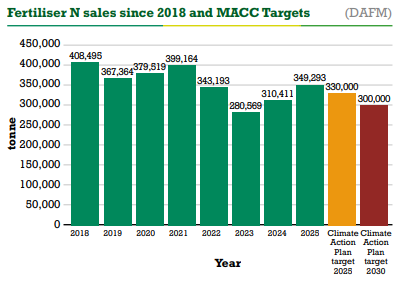
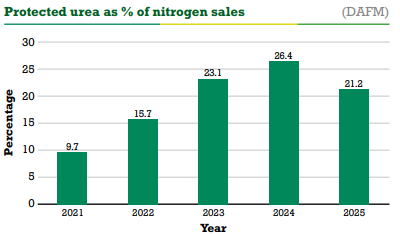
Input-use trends during 2025 were mixed: total nitrogen fertiliser sales increased, while the share of protected urea declined for the first time.
Figure 1: Fertiliser N sales since 2018 and MACC targets (DAFM)
Sales of phosphorus and potassium fertilisers rose, supporting soil fertility and productivity, although lime sales dropped by almost 90,000 tonnes to 930,000 tonnes, its lowest level in five years.
Figure 2: Protected urea as a percentage of nitrogen sales
Fertiliser report 2025 vs 2024 (DAFM)
- Total chemical N Use – 349,293 tonnes (+12.5%)
- Protected Urea – % of straight N as protected urea 21.2%
- 3% of total N in fertiliser compounds as Protected Urea
- Urea & Protected Urea – 45.7% of straight N market (Ordinary urea and Protected urea)
- Total Phosphorus – 32,556 tonnes (+13.3%)
- Total Potassium – 100,501 tonnes (+14.1%)
- Compound Fertiliser use – increased by 14.4%
- National lime requirement is 1.85m tonnes in 2026 (MACC)
- Lime 930,000 tonnes (DAFM)
Other MACC measures
- 5% of total land area farmed organically (Target 10%);
- Forestry planting increased in 2025 to 2,500 hectares (target 8,000 hectares/year);
- Reducing the age at finishing of beef animals has stalled, with no improvements seen in 2025.
Advisory engagement with farmers continued to expand. By the end of 2025, 58,000 farmers had access to AgNav, nearly 20,000 registered in the Signpost Advisory Programme and over 17,000 had a sustainability plan. The Signpost demonstration farmers showed strong uptake of Teagasc MACC measures, including increased usage of protected urea, reduced reliance of fertiliser nitrogen, achievement of age at finishing targets, and integration of cover crops and straw incorporation into tillage rotations.