
Climate Action on the Ground: What Irish Farmers Need to Know for 2026
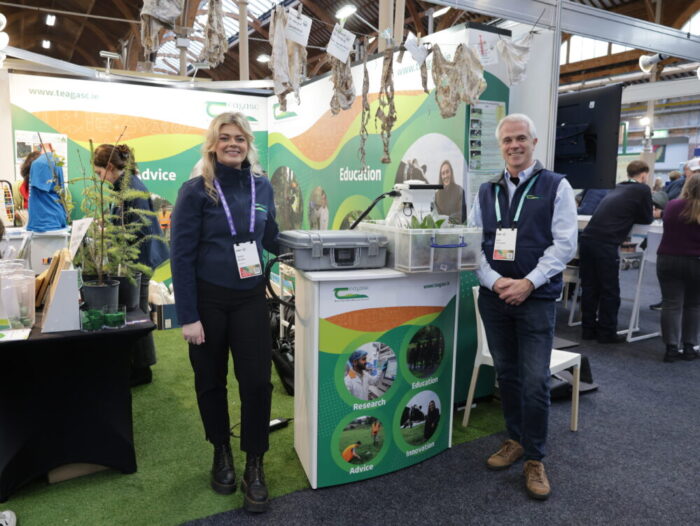
Dr Siobhán Kavanagh, Communications Specialist with the Signpost Programme interviews Dr Karl Richards, Head of the Teagasc Climate Centre on the progress being made to meet our emissions targets.
What progress have we made reducing emissions in Agriculture?
National emissions have reduced by 12.6% between 2018 and 2024. Agricultural emissions have reduced year on year since 2022 to date with a cumulative reduction in emissions of 4.6%.
How does that compare to other sectors?
Agriculture remains the largest single sector accounting for 38% of emissions. Agriculture and transport have both struggled to reduce emissions. Energy is the best performing sector in terms of emissions reduction, with emissions down over 30% to an all-time low. This has been due to significant investment in renewable energy sources – solar and wind. The national biomethane strategy will incentivise methane generation from agricultural sources both diversifying agriculture and providing renewable energy.
The MACC has been our bible for the past few years, how are we doing in terms of adopting the key technologies?
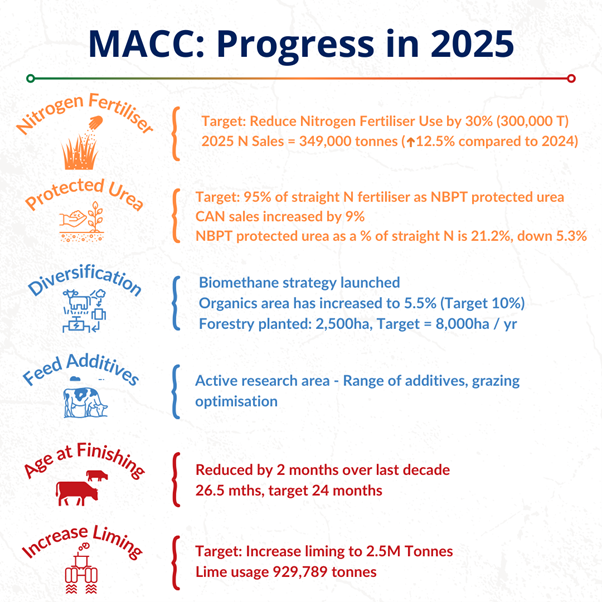
Areas that have been going well include low emissions slurry spreading (LESS), organic farming and dairy EBI. The area under organic farm was 5.5% for 2025, with a target of 10% by 2030. This has been helped considerably by the Organic Farming Scheme. We had been doing very well on fertiliser use and NBPT protected urea but in 2025 that started to change with fertiliser use up to 349kt or a 12.5% increase on 2024 usage. NBPT protected urea made up 21.2% of straight chemical N sales in 2025, a decrease of 5.2% compared to 2024. Soil fertility is still suboptimal on many of our farms. A recent DAFM report shows that lime usage was almost 1m tonnes in 2025, considerably below the target of 2.5million tonnes applied per year by 2030.
Age of finishing beef animals (average = 26.5 months in 2025) has not reduced in recent years and that needs to be addressed (target 24 months). Age at finish makes up over 15% of the emissions reduction achievable under MACC so it’s a significant technology. It will require a combination of the correct breeding policy, good grassland management, good herd health and overall management of the herd leading to an increase in lifetime performance of our beef animals.
Forestry plantings for 2025 were 2,500ha which is going in the right direction, this is an increase in afforestation from 1,573 ha in 2024. Progress has been slow in this area and will need to increase significantly if our target of 8,000ha planted per year is to be achieved. Forestry is a key land-use removing carbon form the atmosphere and is an important diversification measure on farms.
Is there any new technology on the immediate horizon?
Slurry additives are very close to being available on farms, but they will need incentives to encourage farmers to use them. Feed additives research is progressing with the evaluation of additives and slow-release technologies for the grazing situation. Feed supplements such as linseed and rapeseed offer the potential to reduce greenhouse gas emissions by close to 10% but again will need incentivisation. A national carbon farming framework is being developed to support reductions in soil emissions.
What do we need to achieve change?
We need policy, financial incentives and independent advice for farmers to adopt the MACC technologies on their farms and contribute to reducing emissions. We know from experience that once you have all these elements change is possible. The adoption of low emissions slurry spreading technology is a great example of this. Regulation was introduced that all derogation farmers had to use LESS. We have significant grants under TAMS for the investment in the equipment. And an independent science based advisory programme provided the advice to farmers to optimise the value of the technology on their farms. This will need to be done for many other technologies if we are to achieve the change required.
Where will this money come from?
A key challenge is how to fund mitigation of greenhouse gas emissions on Irish farms. The government are currently developing the carbon farming framework, and this is likely to be funded by a combination of public and private finance. Private finance could be investors purchasing carbon credits to asset their emissions or where the agri-food industry itself invests in the decarbonisation of their supply chains.
What is the advice to farmers facing into 2026?
Use AgNav to know your number and develop your farm action plan. Reducing chemical N can only be achieved once the foundations are strong. Soil test and use your nutrient management plan to improve soil fertility. Talk to your advisor about establishing clover and MSS on your farm and reduce your reliance on chemical N. Continue to use LESS to apply nitrogen to you grass and crops when they need the nitrogen. Reduce your chemical N use and use protected urea. If you are uncertain on what or how to do something then speak to your local Signpost advisor.
Is there anything new on the policy front?
We are currently awaiting the governments publication of the 2025 Climate Action Plan. The Climate Change Advisory Council has made its recommendations to government on the carbon budgets 3 and 4, for 2030 – 2035 and 2035-2040. We are currently waiting on government to issue the sectoral targets for these two carbon budget periods. The finalisation and publication of the new national carbon farming framework will provide guidance and certainty for farmers on carbon farming and what it means for farmers.