
Continuous progress is building this Cork business
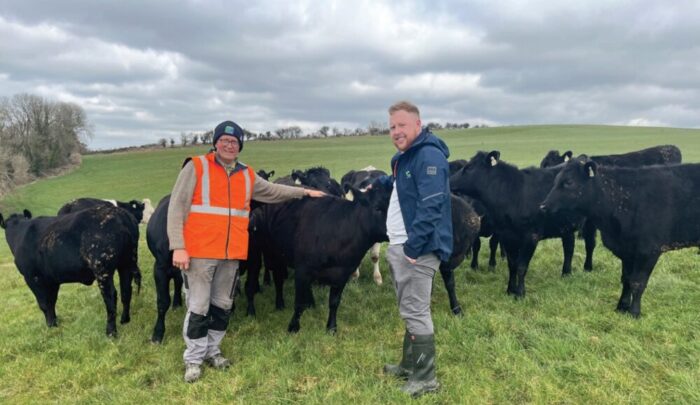
Farming outside Midleton in Cork, Denis Hickey buys and rears dairy calves on a 90-acre farm with his wife Aine and their four children. Gordon Peppard, Teagasc DairyBeef500 advisor, tells us about about the Hickey family farm.
Most of the Hickeys’ farm had been long term leased out for over 30 years until 2016. In recent years, Denis has taken back all the land to farm in his own right. Until 2020, the Hickeys bought yearling cattle or cull cows in the spring, grazed them for the summer months and sold them in the autumn/winter. In 2020 Denis changed their system. He started buying in calves from local dairy herds. He started by rearing 50 calves.
“Once we had the full farm back, I knew I wanted to put it to good use,” Denis explains. “But I didn’t want to dive into anything until I figured out what system would suit the land, the buildings, and the time I had.” In 2024 Denis joined a dairy calf to beef discussion group facilitated by local Teagasc dry stock enterprise advisor Alan Carey. Following discussions and having been made aware of the Dairybeef500 programme, Denis agreed to join the programme as a Monitor Farmer in late 2024 – a move that he said, “put structure on everything”.
A starting point
“Joining the programme was not about restarting from scratch. It was about refining what we were already doing and identifying where improvements could be made,” Denis said. “When you’re farming on your own, you can fall into habits. “The programme helped me to look at things with fresh eyes.”
By working with his local advisor Alan Carey, Teagasc DairyBeef500 programme advisor Gordon Peppard and other programme farmers, Denis said he gained useful insights which enabled him to benchmark his current performance, set realistic targets, and focus on changes that would deliver the biggest impact.
In 2025, the main changes centred on four key areas:
- Reseeding and improving grass quality.
- Increasing the number of calves reared.
- Developing a herd health plan.
- Planning new infrastructure to support future expansion.
Reseeding
“Grass has always been key to our farming systems,” said Denis. “But in 2025 we made a significant investment in renewing swards.” Twelve acres were reseeded in spring 2025; another four acres in the autumn. The spring reseed was completed in early May in good weather and ground conditions. “After sowing, no rain came and there was close to drought conditions for the next six to eight weeks,” said Denis. “The rain did eventually arrive, and the grass seeds germinated and today there is a great cover of new high quality grass/white clover sward.”
What are the benefits?
New reseeds are typically 20–30% more productive than older swards which means:
- More grass grown and better-quality grazing during the animal’s lifetime.
- Improved liveweight gain because cattle are consistently grazing better quality, higher-energy, leafy covers.
- Reduced reliance on meal as well-managed swards meet animal target weight requirements when grazing.
- Better soil structure and fertility, reseeding these paddocks allowed for the ground to be levelled, limed, chemical phosphorus and potassium applied. This supports root development and clover incorporation in the sward to allow nitrogen to be fixed naturally.
“It’s money well spent,” Denis said. “Once you see the difference a reseed makes, you realise you can’t afford not to do it.”
More calves reared
In spring 2025 Denis bought 47 heifer and 47 bull calves from local dairy farms. A big increase on previous years. Mortality on the farm is exceptionally low with only one calf death in August 2025. There are currently 93 weanlings in two groups – one of steers, the other heifers.
Benefits from the higher numbers:
- Higher output per hectare, improving the overall profitability of the farm.
- More consistent cashflow, as there are more animals moving through the system each year.
- Improved efficiency – labour and housing are used more effectively with larger, even, batches of stock.
- Better bargaining power when buying inputs and selling finished cattle.
“Once the routine is right, another 20 or 30 calves isn’t a huge extra workload,” Denis said. “It’s about having groups the same age and keeping everything simple.”
Developing a herd health plan
A structured herd health plan was another crucial improvement made in 2025. Denis worked with his vet and programme advisors to develop a clear, practical plan. It covers vaccination, parasite control, hygiene practices, and calf-rearing protocols. Most animal health issues occur in the first six months of a calf’s life.
Denis began by having the calf rearing shed cleaned out, well washed down, and disinfected, allowing enough time for it to dry out before use. All calves were given an intranasal shot for pneumonia after a few days on the farm. This was followed by a two-shot injection programme four weeks apart. A booster shot was given two to three weeks in advance of housing. All calves were also vaccinated for clostridial diseases with a two-shot programme four weeks apart.
How it improves performance:
- Healthier calves thrive better, achieving higher daily liveweight gains.
- Reduced stress and disease pressure results in fewer setbacks during early life.
- Lower mortality and morbidity save considerable time and money.
- More predictable performance, allowing Denis to plan housing, grazing, and finishing more accurately.
- Better welfare outcomes and stronger, more resilient stock.
“There’s no comparison to a few years ago,” said Denis. “Calves are stronger; losses are down; everything runs more smoothly.”
Planning further improvements
Denis knows that the next major step is improved infrastructure. With calf numbers rising and more cattle coming through the system each year, he is now planning a new finishing shed which will allow him to house all animals comfortably.
Benefits of the planned investment:
- Improved winter management, with stock grouped by age and weight.
- More controlled finishing, especially during the crucial last 60–90 days.
- Better animal comfort and welfare leading to improved performance.
- Greater labour efficiency through improved handling and feeding layout.
- Finishing cattle at the ideal time, rather than being restricted by space.
Denis has other clear goals for the next few years, including:
- Additional reseeding to keep grass quality improving year-on-year.
- Increasing calf numbers to over one hundred, further strengthening output and cashflow.
- Continuing to refine herd health protocols as new technologies and vaccines become available.
- Using performance data, such as weighing and grass measuring, to make more informed decisions.
“We don’t want to expand for the sake of it. It’s about creating a stable, well-run farm that supports our family now and in the future”
A system built on steady progress
The strength of Denis Hickey’s approach lies in steady, sensible improvements. He uses the resources available to him and focuses on doing the basics well, every day, with every group of stock.
His journey shows what is possible when a farmer decides to take control of his system, seek advice, and make changes one step at a time. Each improvement builds on the last.
In a sector where uncertainty is common, Denis’s approach shows that progress does not need to be complicated. It just needs to be continuous.
This article was first published in Today’s Farm