
Managing the bottleneck
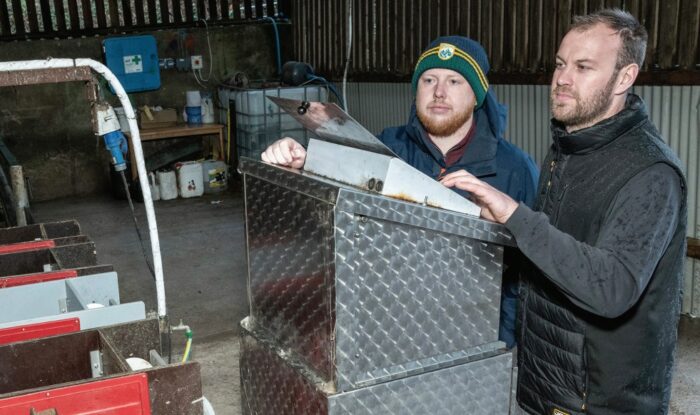
Niall Kerins, Teagasc Beef Specialist, and Alan Carey, Advisor, tell us how beef and tillage farmers found a solution to their spring workload.
Denise and her son Philip O’Neill farm in a Registered Farm Partnership near the village of Cloyne in east Cork. The farm consists of a calf-to-store enterprise and land in tillage. On the beef enterprise, 100 calves are bought early in the spring from two local dairy farmers and sold as steers at 18 months. The calves are primarily Friesian/Aberdeen Angus. The tillage rotation includes winter and spring cereals and maize for winter forage. The beef and crop enterprises complement each other. Straw is used for animal bedding and FYM/slurry is spread to help grow the crops.
Philip also works off farm, so labour efficiency is crucially important during busy periods. The question is, what have they done to keep things running smoothly particularly in spring when both enterprises demand attention? “We traditionally fed milk to calves in groups of 15 through a teat feeder,” said Philip. “This took 1.5 to 2 hours twice daily during the peak rearing stage. So, we set about looking at an automatic calf feeder to become more labour efficient.”
Philip and Denise visited farms with automatic calf feeders and researched different brands and systems. They learned about installing drainage channels, shed layout and maintenance required to run the machines efficiently. Denise and Philip settled on purchasing a second-hand Volac calf feeder. Spring 2026 will be their fourth year with the machine. “The first year was a steep learning curve on getting to know the feeder,” said Philip. “But since then with some tweaks, time spent on calf rearing has significantly reduced.”
The shed has two divisions and each group of 50 calves has access to two feeding stations. The shed is multipurpose, being used for machinery storage during the winter. As the shed is required to remain available for a few other functions year-round, careful consideration was given to where the calf feeder was to be located.
The shed is well ventilated, with space boarding along one side and Philip mentioned that they intend to put vented sheeting along the opposite side shed later in 2026.
Philip pointed out that since installing the automatic calf feeder he has seen several benefits.
“Calves are consistently fed the same amount of feed and at the same temperature every day. The machine monitors daily intake and at a quick glance at the computer screen,” he said. “Denise and I can easily see which calves have fed and identify calves that haven’t yet fed and may require attention.”
The machine is fitted with an adapter for feeding additional supplements through milk, should they be required. Calf performance and their feeding curve are closely monitored through the feeder. Calves behind target can remain on higher milk feeding rates while their comrades may be on a weaning program, all in the same shed.
Health
Upon arrival calves are vaccinated intranasally for respiratory diseases and receive their first vaccine for clostridial diseases. Calves will have their tag number programmed onto the feeder. Then, through the tag reader on the machine, it can pick up the calf number via the EID tag when the calf enters to be fed. After arrival calves take about 36-48 hours to adapt to the calf feeder. Denise and Philip monitor the performance of the machine closely during the calf rearing stage. Milk powder can vary slightly between batches, so calibrating the machine when a new batch arrives is vital to prevent digestive upsets.
Water temperature is checked daily on the machine with a thermometer, while the four teats on the feeder are also changed twice daily as a hygiene measure. The teats are placed in disinfectant when not in use. The stations and the machine are cleaned down with water and disinfectant once a week. This high level of attention to detail during calf rearing results in healthier calves and little time spent treating sick animals. During peak calf rearing the time spent feeding calves is about 30-40 minutes twice a day compared to 1.5-2 hours previously.
“There is very little manual labour required to operate the machine,” said Philip. “The pallet of milk powder is kept near the machine for easy access.”
Farmers who are in the business of rearing calves can, unfortunately, be aware of the significant amount of time spent treating sick calves should a disease outbreak occur. Disease outbreak coupled with poor animal thrive can significantly hamper margins that can be potentially made on dairy beef farms.
Prevention rather than cure is the strategy on the O’Neills’ farm. Careful calf purchase, biosecurity, implementing a health plan, hygiene and monitoring daily performance on the calf all lend themselves to a healthy batch of calves with low labour input. The beef and tillage enterprises on the farm have varying levels of labour required during the year. April usually signals the starting point for sowing spring crops and at the same time as Denise and Philip aim to have calves weaned off milk. For this to work – they purchase calves early in the spring, and have them reared and weaned before the heavy tillage workload kicks off. The concept works well but requires careful planning.
Denise and Philip have built a good working relationship with nearby dairy farms where they purchase calves directly. They usually source all of the calves from just two farms. Calves are bought in a tight time frame. This allows for calves to be at the same rearing stage and having them weaned again before the tillage work intensifies.
Looking ahead to calf purchase this spring, they will be in contact again with the same farmers.
Key jobs ahead of calf rearing on the O’Neill farm
- Before calves are purchased the calf feeder will be fully serviced and calibrated for the new batch of milk powder.
- Straw supply will be readily available for bedding and feeding the calves.
- The medicine cabinet in the calf shed will be fully stocked. Machine parts will be to hand if required.
- The backup generator will be serviced and ready to run the calf feeder should there be an interruption to power supply.
- Sick pens will be set up in a separate shed.
- The dairy farmers will have been contacted in order to purchase calves in a tight time frame.
- Milk replacer feeding guidelines will be reviewed.
This article was first published in Today’s Farm