
Ash dieback: Options and support for farmers
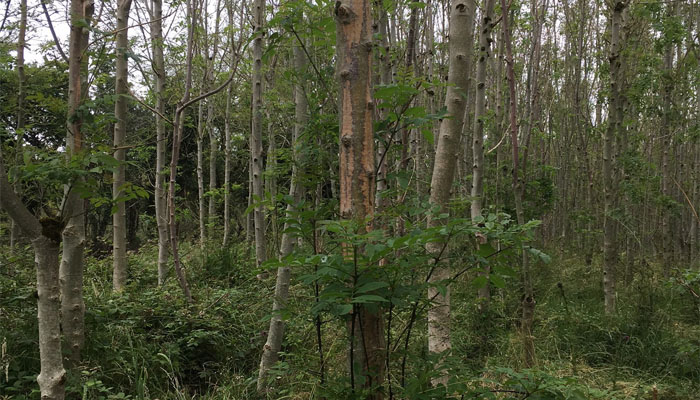
Farmers with ash plantations affected by ash dieback have access to a number of current options and supports. Some are even finding new opportunities. Padraic O’Leary & Jonathan Spazzi, Forestry Development Officers, tell us more.
Ash dieback was first detected here in October 2012. The disease is now widespread and is likely to cause the death of the majority of ash trees over the next two decades.
Case Study – Brian Nicholson
Brian Nicholson from Co Kilkenny farms just over 100 hectares of sheep, tillage and cattle. He had established an ash plantation with a grant from the Department of Agriculture, Food and the Marine (DAFM). When his trees succumbed to ash dieback, the DAFM Reconstitution Ash Dieback Scheme 2023-2027 offered supports for site clearance and reconstitution of the forest.
By selecting agroforestry as his replanting option, Brian has been able to re-establish tree cover, diversify tree species on the site and reduce future disease risk, all while integrating the land back into productive agricultural use.
“Once we made the decision to replant the ash site, we began to examine the larger role agroforestry could play across the farm,” said Brian. “Much of our land (about seventy hectares) is in conversion to organics, and the compatibility of agroforestry and the Organics Scheme encouraged us to look at establishing agroforestry on further suitable parcels.”
After assessing soil type, drainage and environmental factors, Brian identified approximately 19 additional hectares that could benefit from agroforestry. “The system appeals to us financially because we retain eligibility for key payments such as the Organic Farming Scheme and BISS on this land, alongside the annual agroforestry premium. Ultimately, I will have continued agricultural production along with future income from timber or tree-based products.”
Brian identifies a number of additional benefits from agroforestry. “There will be improved shade and shelter for livestock throughout the year and general enhancement of soil and pasture conditions.”
With increasing pressure to meet climate targets, agroforestry can offer a practical pathway for farmers to boost productivity through improved crop or grass yields especially in hot summers where the tree canopy can protect grass from high temperatures, reducing risk across the farm system.
From an animal welfare perspective, agroforestry can improve drainage, reduce waterlogging and consequently lower parasite burdens. Environmentally, agroforestry enhances soil health, reduces erosion, supports biodiversity, carbon capture and protects water quality. Brian’s experience demonstrates how the Reconstitution Ash Dieback Scheme can serve as a catalyst, not only for helping to address ash dieback, but for integrating innovative and sustainable land-use systems that strengthen the entire farm enterprise.
The Reconstitution Ash Dieback Scheme (RADS) 2023-2027
This scheme is available to forest owners with ash plantations affected by ash dieback disease and covers both site clearance and replanting operations. Site clearance involves the removal of affected ash trees and associated operations in order to prepare and present the site for replanting.
Reconstitution involves the replacement of the ash trees with alternative species following clearance. The following Forest Type (FT) options are available for replanting:
- FT 1 – native forests.
- FT 6 – broadleaf, mainly oak and beech.
- FT 7 – diverse broadleaf.
- FT 8 – agroforestry.
- FT 10 – continuous cover forestry.
- FT 11 – mixed high forests: Diverse Conifer.
- FT 12 – mixed high forests with Sitka Spruce and minimum 20% broadleaves.
Under the scheme, grant support will be paid to eligible applicants in three instalments:
- Application for the Site Clearance Grant.
- Application for the first Instalment Grant and top-up premium payment (where such top ups are applicable) may be made following the reconstitution of the treated area (75% of reconstitution grant).
- Application for the second Instalment Grant may be made four years after the site is successfully reconstituted (25% of reconstitution grant).
Current support for site clearance is €2,000/hectare cleared. Support for site reconstitution varies according to the Forest Type(s) selected – between €3,858/ha for Forest Type 12 (Mixed high forests with mainly spruce, with minimum 20% broadleaves) and €8,555/ha Forest Type 8 (Agroforestry).
The Climate Action Performance Payment (CAPP)
If you have already participated in the Reconstitution ash dieback scheme 2023-2027, or if you replanted your ash forest under one of the previous Department reconstitution schemes due to the impacts of ash dieback then you can be eligible for additional support (€5,000 per hectare) – under the Climate Action Performance Payment Scheme.
Landowners who have already cleared their ash dieback affected forest and received a payment for replanting their ash under the DAFM Reconstitution Scheme for Ash Dieback may apply for the first instalment of CAPP additional payment through www.agfood.ie.
The CAPP is paid in three instalments, totalling €5,000 per hectare.
CAPP support rates
The overall CAPP support rate is €5,000 per hectare, with one instalment of €2,500 and two payments of €1,250.
- An application for the first instalment of CAPP (€2,500 per hectare) can be made after an applicant receives payment of an Ash Dieback Reconstitution Scheme replanting first instalment grant.
- An application for the second instalment of CAPP (€1,250 per hectare) can be made the year after receipt of the first CAPP payment once an applicant has received payment of an Ash Dieback Reconstitution Scheme second instalment grant and has received all relevant premium payments on the related Afforestation contract. (The second instalment grant on an Ash Dieback Reconstitution Scheme can be applied for four years after the first instalment Ash Dieback Reconstitution Scheme grant has been paid.
- An application for the third instalment of CAPP (€1,250 per hectare) may be applied for the year after the second instalment of CAPP has been paid.
If you have not applied under any reconstitution scheme for ash dieback yet, then you should contact a registered forester and ask them to make an application on your behalf under the Reconstitution Ash Dieback Scheme 2023-2027.
Ongoing Teagasc support
Teagasc Forestry is carrying out extensive research to establish a gene bank composed of genotypes of ash tolerant to ash dieback with the aim to produce planting stock for forests and hedgerows in Ireland. Teagasc Forestry offers free and independent advice to forest owners affected by the disease. Further information on ash dieback and all forestry issues is available from your local Teagasc Forestry advisory staff.
This article was first published in Today’s Farm