
Signpost update: Refining a dairy-beef system in Cork
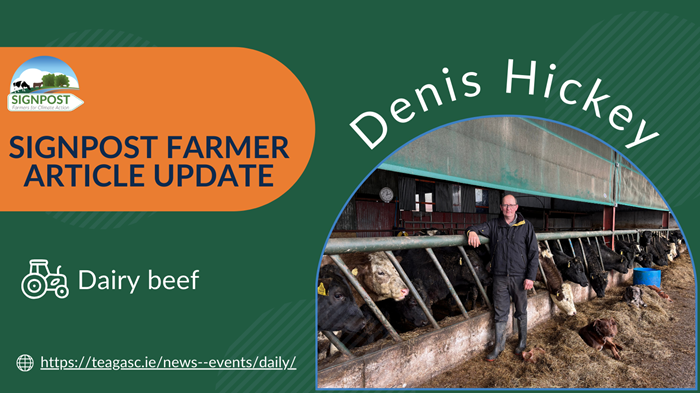
Participant in the Teagasc DairyBeef 500 and Signpost Programmes, Denis Hickey writes on putting structure on his dairy-beef enterprise in Co. Cork to deliver the biggest impact.
Located seven kilometres outside Midleton in Co. Cork, I farm just over 90ac with my wife Aine, and our four children. Most of the farm had been long-term leased out for over 30 years up until 2016.
In recent years, we decided to take back all the land to farm in our own right. Up until 2020, we didn’t really know what system to run, so we began by buying in yearling cattle in the spring, grazing them for the summer and then selling them again in the autumn/winter.
For a short time, we also contract reared dairy heifers for a local dairy farmer which allowed the opportunity to invest in our own stock. The production system changed from 2020 when I started buying in 50 calves from local dairy herds.
Once we had the full farm back, I knew I wanted to put it to good use, but I didn’t want to dive into anything until I figured out what system would suit the land, the buildings and the time I had.
In 2024, I completed a dairy calf to beef course over five days. While doing this course, I became aware of the DairyBeef 500 Programme and in late 2024, we made the decision to join the programme as a monitor farmer – a move that helped us put structure on everything.
Joining the DairyBeef500 programme: A starting point
For me, joining the programme was not about reinventing the wheel, it was about refining what I was already doing and identifying where improvements could be made that would give the best returns.
Working with my local Teagasc technical drystock advisor, Alan Carey, Teagasc DairyBeef 500 Programme Advisor, Gordon Peppard and gaining useful insights from the other programme farmers has allowed me to benchmark my current performance, set realistic targets, and focus on a small few changes that will deliver the biggest impact. As we stand, I have just completed my first year in the programme.
2025 – a good year for beef farmers
In terms of weather – for most of the past year- and with significantly improved beef prices by and large, 2025 was a year that beef farmers were waiting for, for a long time.
Yearling cattle were turned out to grass very early last spring on my farm here in Templenaccarriga. At the time, we had 40 steers and 24 heifers. These animals throve really well all spring and into the summer.
We did experience a slight drought and grass growth became restricted for a few weeks in May, June and July. During this time, I had 12 acres taken out for reseeding, there was silage ground closed up and with 94 reared calves now also at grass, I decided to sell some cattle live as the trade was very good at the time. To alleviate pressure on the system and leave adequate grass for the remaining stock, eight heifers and nine steers were sold in July and 11 steers sold in August.
The remaining 16 heifers were slaughtered in October at an average of 20.2 months of age and the remaining 21 steers were slaughtered in November at 22 months of age.
Current activities
We currently have 93 yearling animals on the farm (48 steers and 45 heifers) and were housed overwinter on good quality silage and 1.5kg of concentrate per day. The aim is to get these animals to grass as early as possible each spring and normally they would be out in early February. This year, the continuous rain has put the stop to that. Hopefully the weather will pick up soon, ground around here dries out quickly if given a chance and cattle will be out soon.
The calf house has been cleaned out, washed and disinfected and it has had time to dry out, leaving it ready for a new intake of calves. Hopefully in the next few weeks, we will have 60 – 70 calves in, to be reared on the blue teat feeders. The aim this year is to have approx. 100 calves. We are trying to up our stock numbers to maximise output from the farm. As the calf rearing shed is tight to rear 100 calves, we will get 30 – 40 calves reared and they will come to us weaned from milk.
The above first appeared in the Farming Examiner as part of a Signpost Programme update.