
Using lime to unlock soil fertility
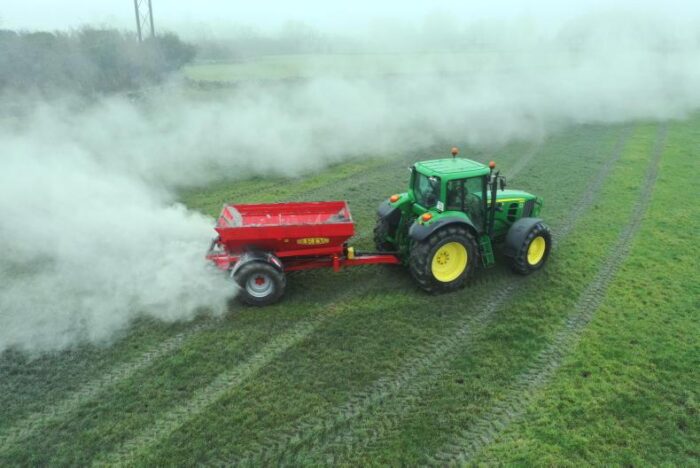
Oisin O’Connor, Walsh Scholar, Teagasc Westport, writes on the benefits of liming.
Lime is often called the forgotten fertiliser, yet it underpins soil fertility, grass and crop yield, nutrient efficiency and climate action on both organic and conventional farms. Maintaining soil pH in the optimum range transforms how soil biology and fertilisers work, unlocking more feed grown at lower cost.
Why does soil pH matter?
Soil pH governs the activity of microbes and the availability of nutrients like nitrogen (N), phosphorus (P), and potassium (K). When soil pH is low, P and K are locked up and the response to applied fertilisers is poor. Correcting acidity with ground limestone increases nutrient availability and recycling, improving the return from organic manures and any applied fertilisers.
Target pH:
- Grassland (mineral soils): 6.3 for grass-only; 6.3–6.7 where clover is a key component.
- Grassland (peat soils): 5.5–5.8.
- Cereals and maize: ≥6.5.
- Beet/beans/peas/oilseeds: 6.8–7.0.
- High molybdenum soils: aim 6.0–6.2 to limit Mo-induced copper issues in grazing animals.
More grass and crops – at lower cost
Research shows lime alone can deliver around 1.0–1.5 t DM/ha extra grass annually. On livestock farms, that is worth about €105/t DM on drystock units and ~€181/t DM on dairy farms. With typical maintenance costs of ~€25–€30/ha per year (averaged over a 5-year cycle), returns of €5–€10 for every €1 invested are achievable. In practical terms, raising pH can mean 5–10 extra bales/ha per year and stronger early growth from released soil N.
Lime releases soil N and boosts fertiliser efficiency
Correcting pH on mineral soils can release up to 70–80 kgs N/ha/year from soil organic matter, thus reducing chemical N needed with no loss of yield. Teagasc data shows N use efficiency can rise from ~35% on low-fertility fields to over 60% where pH, P and K are in the optimum range. On organic farms, released N supports clover and sward productivity; on non-organic farms, it cuts fertiliser bills and improves the response to applied fertilisers.
Phosphorus availability and soil test improvements
Teagasc trials at Johnstown Castle show that liming acidic soils increases soil P test results without even adding P, and combining lime with P delivers the biggest yield response. In a farm case study (Waterford), applying the recommended lime increased the area with pH >6.2 from 32% to 95% in roughly two years, doubled the proportion of ground at P Index 3–4 (38% to 79%), and lifted measured grass growth by 2.6 t DM/ha in one season. This translated into reduced summer feeding and stronger winter fodder reserves.
Lime supports climate action in two ways:
- Lower nitrous oxide (N2O): Raising soil pH reduced N2O emissions by up to 39% in Teagasc research when pH rose from ~5.0 to 6.9 under the same management.
- Less chemical N needed: By releasing soil N and improving efficiency, farms can cut chemical N. Teagasc’s MACC shows a 25% reduction in chemical N could deliver about 0.5 Mt of national abatement, aided by liming alongside better slurry use, clover and balanced P & K.
Practical application on organic and conventional farms
- Soil Test and plan: Sample soils every 3–5 years; build a liming plan targeting the biggest deficits first. Do not exceed 7.5 t/ha in one pass; on very acidic soils, apply half now and the balance in two years. A good rule is to aim to correct about 20% of the farm each year.
- Timing: Lime can be spread all year-round when ground conditions suit. Low covers after grazing or post-silage offer ideal windows. Allow up to three months between liming and closing for silage to avoid preservation issues. On wet-prone soils with an organic surface layer, use “little and often” to avoid short-term softening.
- Interactions with slurry and urea: To avoid N loss, apply slurry then lime 7–10 days later. If lime goes on first, allow roughly three months before slurry. Protected urea is considered safe on recently limed ground in early trials.
- High molybdenum (Mo) soils: Maintain pH around 6.0–6.2 to reduce Mo uptake and copper deficiency risk in grazing stock; alternatively, lime to target and supplement copper where needed.
At national level, Ireland currently applies less lime than needed. There is a big opportunity to increase annual lime use towards Teagasc MACC targets (up to 2.5 million tonnes/year by 2030) which would raise nutrient efficiency, reduce fertiliser dependence, increase homegrown feed, and cut agricultural emissions.
Across both organic and non-organic systems, getting soil pH right is the first, most cost-effective step to better yields, lower inputs and lower emissions.
Sources: Teagasc Signpost Programme factsheets and Today’s Farm articles on Advice on Liming, Soil pH & Liming, and How using lime can reduce Greenhouse Gas emissions (www.teagasc.ie).