

Edited By
Dr Joe Patton
Head of Dairy Knowledge Transfer
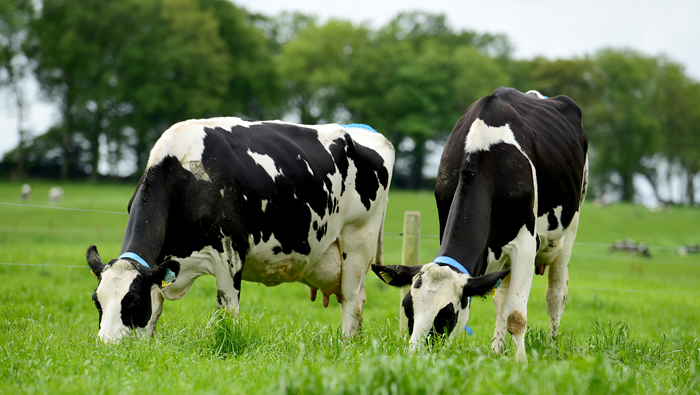
Welcome to the Teagasc April Dairy Advisory Newsletter. In this edition, Teagasc Head of Dairy Knowledge Transfer, Dr. Joe Patton shares practical advice on grazing management, concentrate supplementation and breeding tips ahead of the 2026 breeding season.
Grazing management
Commence second round grazing when there is sufficient cover on the first paddocks grazed (>1100kg DM per ha) to sustain herd demand and second rotation length can be supported by daily growth rates.
It is always the case that the farm will be/should be tight for grass in April for the last few days of the first rotation; however, running cover too low (<500kg DM per ha) can reduce daily growth rate and lead to underfed cows into May.
For some farms, it is worth asking the question: ‘Am I finishing my first rotation too nearly?’ This might be due to high stocking rates, higher feed demand due to better six-week calving rates, or due to location/grass growth patterns. It is too late for this year to make significant changes, but the question should be reviewed now to learn for the future.
Grass intake drives your margin
As your cows hit peak and move closer to the breeding season, ensure they are eating large quantities (18kg DM) of high-quality grass daily. This will drive profitable milk solids output while maintaining lower feed costs. An increase of 1 kg DM grass eaten per day over the grazing season can increase profit by €120/cow. Graze at the right quality (3-leaf stage, 1400kg DM per ha covers) to ensure quality and good utilisation to 4cm.
Invest in reseeding
Spending on reseeding recovered in 2025 after a number of years of decline (Profit Monitor data 2022-2025). This was due to a combination of good weather and positive margins.
Despite lower milk prices and higher machinery running costs this year, the return on investment in reseeding will still be very positive. A spend of about €50/cow is required to maintain a 10% reseeding rate. Reseeding done properly gives an excellent return on investment – make it a priority for 2026.
Mid-season concentrate supplementation
The economics of supplement feeding depends on milk price and concentrate price, but importantly the rate of milk response to concentrate is critical. Across a number of field studies, the average response to concentrate was approximately 0.8kg milk per kg milk DM in mid-season grazing cows. However, this rate declines sharply as rate of concentrate feeding rate increases from 1-3kg up to 6-7kg, down to 0.5 to 0.6kg approximately.
At this level of response and current milk price, the economic response to higher feeding rates in mid-season is quite negative. Also, feeding extra concentrate to ‘drive higher peak milk production’ will not result in extra milk production for the remainder of the lactation. Review meal feeding levels weekly and do not be chasing higher milk solids for the sake of it.
Silage
Spring 2026 showed the value of having higher quality silage in the yard. At least 50% of the silage for spring calving dairy herds should be >74% dry matter digestibility (DMD) to account for early and late lactation feeding, plus a reserve for drought situations. This means a mid-May date for first cuts.
Avoid the temptation to delay all first cut silage to later May / early June to bulk crops and cut silage making costs. This is a false economy in the longer term. Focus on quality for the first cut and the second cut can be bulked further to make enough silage for dry cows.
Lessons from national dairy breeding KPIs
Current breeding key performance indicators (KPIs) for dairy herds (Table 1) show that while steady progress is being made on calving interval and 6-week calving rates, there is plenty of scope for further gain.
Table 1: National dairy breeding key performance indicators 2021-2025
| Year | Calving interval (days) | 6-week calving rate (%) | Cows culled (%) | Recycled cows (%) | Heifers from AI (%) |
| 2021 | 388 | 67 | 20 | 13 | 59 |
| 2025 | 385 | 69 | 21 | 9 | 62 |
| Target | 365 | 85-90 | 18-20 | <5 | 100 |
Six-week calving rate
Six-week calving rate has a direct link to farm profit (€8.22 per cow for every 1% increase) so make sure to put management steps in place ahead of the breeding season. Six-week calving rates are a combination of submission rate (number of cows inseminated) and conception rate (percent per service round). Some farms tend to focus only on conception rate when reviewing fertility figures; however, submission rate is even more important to drive high 6-week in-calf rates. Some actions are:
- Examine all cows >40 days and not observed in heat. Pre-breeding tail paint or examination of auto-heat detection device records is essential.
- Treat any non-cycling cows to ensure they are eligible for service on day 1 of breeding. Vet-check any cows with a health issue in spring also (milk fever, retained afterbirths etc) and treat as needed.
- Assess body condition – have cows ‘turned the corner’ by mid-April? Ensure cows are on a rising plane of nutrition by offering enough daily dry matter as grass and supplement. Check grass allowances and residuals in tandem.
- Identify very thin cows (<2.5 pre-breeding) and check they are cycling- milk once a day for 4 weeks pre-breeding if needed.
- Ensure mineral supplementation is adequate for at least a few weeks pre-breeding. Watch out for signs of deficiency (e.g. pica for Phosphorus) and adjust supplementation if needed
- Plan your breeding of heifers carefully – if using synchrony programmes, make sure they match the type of insemination used e.g. sexed v conventional AI.
Heifers and culling
Data show that while the culling rate is relatively steady, the number of recycled (carryover) cows is declining which is a positive for profitability. It is important to look at the culls plus recycled numbers together when assessing heifer numbers required, if carryover cows are to be eliminated.
For example, herds with >30% culling plus recycling need to have at least 35% dairy heifers born in the short term to have sufficient replacements to tidy up the herd. Herds with a stable 20% cull rate and 0% recycling can aim for 25% dairy heifers born. Finally, in 2025, only 62% of dairy heifers born were AI-bred. A big factor in this is using dairy stock bulls on maiden heifers – it is recommended to switch to a least 1 round of dairy AI on heifers with easy calving beef bulls to finish up.
Heifer synchrony protocols
Synchronising heat is a good option to maximise submission rate to AI in maiden heifers. Below is the protocol for use with sexed semen, where timing of AI is very important to success. Other protocols are available for conventional AI usage. Speak to your vet and advisor on the options available. It is important to follow the steps and timings precisely in order to achieve a good conception rate so pick a protocol and follow exactly.
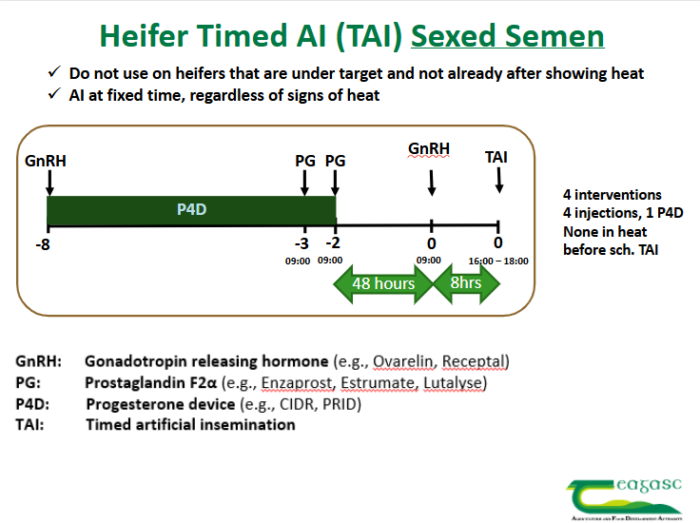
For further practice tips and advice on breeding, visit the Teagasc Breed Week 2026 webpage here.
The Dairy Edge Podcast
The Dairy Edge is Teagasc’s weekly dairy podcast for farmers. Presented by James Dunne and Stuart Childs, Teagasc Dairy Specialists, the podcasts will cover the latest information, insights and opinion to improve your dairy farm performance.
Listen to recent shows from the Dairy Edge podcast below:
For more from Teagasc Dairy, visit here.
Keep up to date with Teagasc
Teagasc offers a suite of digital products – ranging from insightful podcasts, trusted eNewsletters, social media, website and mobile app channels – to provide you with the latest news, information and knowledge.