
Yellow rust increasing in winter wheat
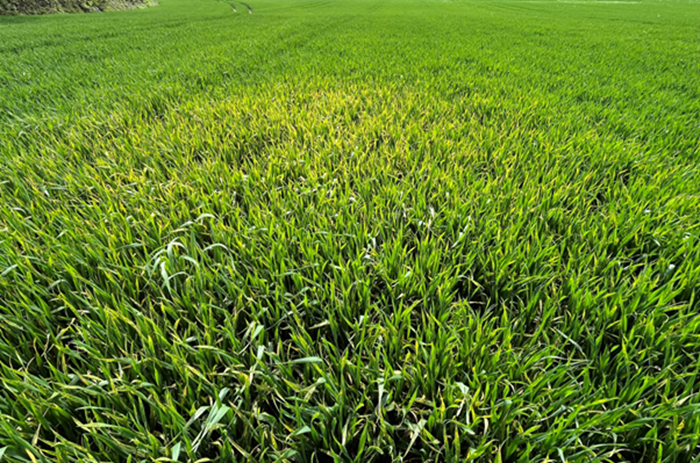
As temperatures increased during the middle of this week, so too has the risk of yellow rust in winter wheat. Ciaran Collins, Teagasc Crops Specialist, reminds us that early action is best for control.
Up to now, reports were limited to low levels of infection, but there has been a noticeable increase in activity over recent days. This change is closely linked to weather conditions that favour the disease.
While all varieties are now considered at risk, the majority of early reports have been in varieties such as Champion and KWS Scope. Where susceptible crops are left untreated, yield losses of 40–50% are possible, highlighting the importance of early intervention.
Recognising yellow rust
Yellow rust is relatively easy to identify in the field. The key symptoms include:
- Distinct parallel rows of yellow to orange pustules on leaves
- Rapid yellowing (chlorosis) of infected leaf tissue
- Progression to dead (necrotic) tissue in severe cases
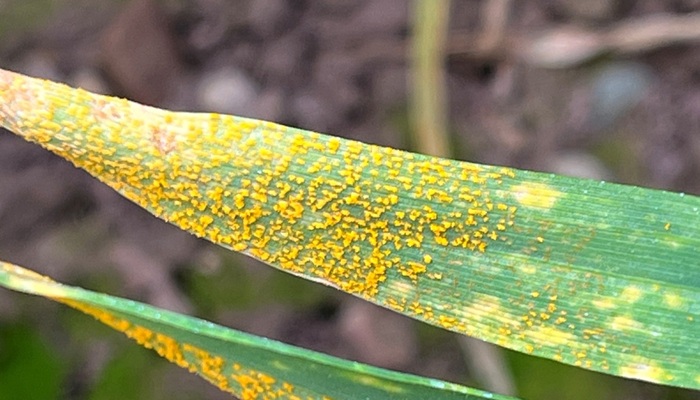
Infections often start in small patches but can spread quickly across a crop under favourable conditions.
Weather conditions this week favoured yellow rust where it can develop very rapidly once conditions are suitable. Optimum temperatures of 10–15°C and high humidity or prolonged leaf wetness are the key drivers.
Under these conditions, the disease cycle from initial infection to the production of new spores can be completed in as little as 10 days. This short cycle means infection levels can escalate quickly if not controlled early.
Act early for best control
The current situation means all winter wheat crops should now be considered at risk, and a preventative approach is essential.
1). Timing is critical
- Target leaf 4 fully emerged (T0 timing) as the key timing but,
- Act immediately if rust is already visible.
2). Preventative fungicide options
- Pyraclostrobin (e.g. Comet, Modem, LSPyrac) is the preferred strobilurin
- Apply at 0.5–0.6 L/ha
- This is protectant only, so it must be applied before infection establishes
3). If rust is present (curative approach)
- Include an azole for knockdown. Tebuconazole (Tebulink/Tebucur) or Prothioconazole (e.g. Proline)
- Where tebuconazole is scarce, Teagasc trials have shown prothioconazole is effective for knockdown.
4). Mixing partners
Pyraclostrobin should not be applied on its own.
- Where no rust is present include a partner such as Folpet or Sulphur (products with fungicidal activity i.e. products that have a PCS number e.g. Thiopron or Vertipin).
- These will not control yellow rust, but will help protect against septoria, particularly in high pressure scenarios.
For resistance management and the control of septoria where an azole is used for knockdown at T0 timing rotate to a different azole at the next timing (leaf 3). This is important to protect chemistry and maintain long-term efficacy. It is important to keep the focus on septoria. While yellow rust requires immediate attention, septoria remains the key yield limiting disease in winter wheat so do not compromise your main fungicide programme, leaf 3 (T1) and leaf 1 (T2) where timings will still be critical.
Key take-home messages
- Yellow rust risk has increased with recent weather
- All varieties should now be treated as susceptible
- The disease cycle is short, therefore early action is essential
- Use pyraclostrobin preventatively, and include an azole if infection is present
- Keep a clear focus on septoria control at later timings.