
Synchronising sucklers for AI
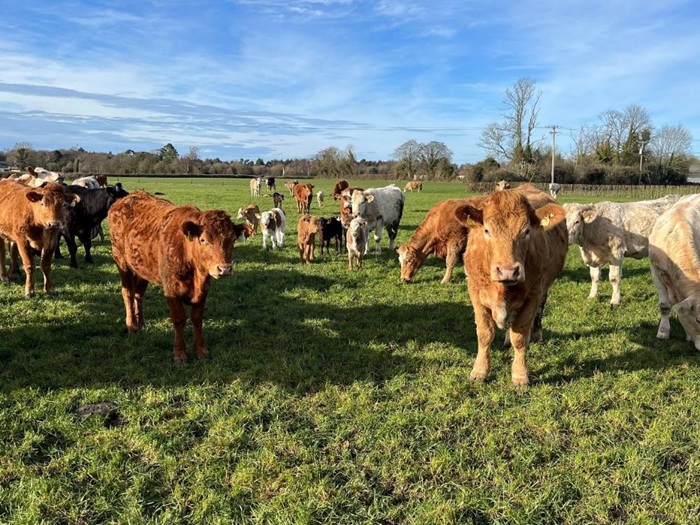
In a recent Today's Farm article, Aisling Molloy, Teagasc Future Beef Programme Advisor, visited John and James Dunne in Co. Offaly to see how they are making the best use of synchronisation when breeding their 80-cow suckler here.
John Dunne farms with his son James in Co Offaly just over the River Barrow from Portarlington in Co Laois. This spring they are calving over 80 suckler cows in a system where all the progeny are sold around 24 months as forward stores to the mart or finished for factory sale. They also rear over 140 dairy bred calves per year and will be growing over 15ha of spring barley which is fed back on the farm.
“Over the last five years we have had difficulties with stock bulls due to sub-fertility and an unexpected mortality in the middle of the breeding season,” says John. “This had a cumulative effect on our herd with cows not in calf, buying in replacement heifers that had low/poor milk yield when trying to keep to keep up cow numbers and subsequently trying to rebuild the maternal traits in the cows and heifers.”
This year they are finally back to the cow numbers and are very focused on improving the herd quality. They are taking a structured approach towards this through:
1. What to improve?
Milk Yield and Carcass Weight
Milk yield is a core focus for John and James. The herd average is 4kg and they would like to increase this to over 6kg. Carcass weight is moderate at 16kg and they are targeting 18–20kg. Fertility is okay in the herd at 0.82 days and docility is good at 0.03 so their aim is to maintain these.
“We would also like to improve the Eurostar index from €99 to over €110 (4 stars),” adds James.
2. How to improve genetics?
Artificial insemination opens up a new opportunity to select bulls and match them directly to the most maternal cows in the herd for breeding replacements. Last year they chose three Simmental bulls; Lisnacrann Fifty Cent (SI2469), Lis-Na-Ri-Gucci (SI4250) and Rubyjen Here’s Johnny (SI4350).
The bulls have the following key traits:
- 14–25kg on carcass weight
- 8.1–10.1 kg on daughter milk
- <5% cow calving difficulty at >90% reliability
- €165–171 on the replacement index
“We matched the sire to each cow based on her milk and carcass weight figures,” says John. “The lighter carcass weight cows got the higher carcass weight bull and vice versa.”
John and James looked for an easy calving AI bull for the heifers but found none that matched their own Angus stock bull. He is 6.5% for heifer calving difficulty at 80% reliability, 10.8kg for carcass weight and 6.1kg for daughter milk.
“Our priority is to get live calves from the heifers so that they go back in calf again, but this bull has also produced potential replacement heifers this year too,” says John.
The rest of the cows were bred to the Charolais stock bull who is sired by Voimo (VMO). He is 32.4kg for carcass weight and 2.31 for carcass conformation and his progeny have performed well over the last few years.
The poorest cows for milk were culled and John and James will have the opportunity to do the same this year.
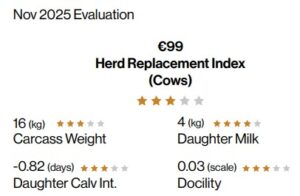
November 2025 Evaluation
€99 Herd Replacement Index (Cows)
16 kg Carcass Weight. 4 kg Daughter Milk. 0.03 scale Docility. -0.82 days Daughter Calving Interval.
3. Where does synchronisation fit in?
Labour is a key restraint on the Dunne farm and synchronisation of breeding cycles is a key technology used to help with AI. Synchronisation allows cows and heifers to be brought into heat at the same time. By tightening the window of reproductive activity, John and James are significantly reducing the day-to-day hands-on time normally required for heat detection, artificial insemination, and calving management.
“What was once a constant round of individual animal checks has been replaced with a more predictable, efficient schedule,” says John. “That frees up time for other critical tasks on farm.”
Last year John and James employed this simple protocol:
- Day 0 – Progesterone device (P4) inserted + GnRH injection
- Day 7 – P4 device removed + prostaglandin & ecG injection
- Day 10 – Fixed Time AI
This means that the cows are handled three times on pre-selected days when James was available to help.
“We made sure to confirm with the AI technician that he was available on day 10 for AI,” says James.
Last year 45 cows were fixed-time inseminated and 35 of these were scanned in calf after one serve (78% conception rate) which was exceptional. The target was over 70% so John and James were delighted.
“Synchronisation isn’t a silver bullet, however,” John says. “Cows have to be right – good nutrition, good health, and cycling naturally. If the basics aren’t in place, it won’t deliver.”
4. How does artificial insemination of 45 cows on one day help workload this year?
While the thought of 45 cows calving on one day would send shivers down anyone’s spine, it is important to note that they tend to calve over a 10 day period. “Cows are not machines and they will naturally vary in their gestation period,” says John. This year John and James calved the cows over a spread of 12 days and took it all in their stride.
The benefit of synchronisation is that the need for calving supervision is more predictable. Batches of calves can be tagged, vaccinated, and weighed together. Instead of constantly switching tasks, work flows in organised phases.
For a family-run farm balancing multiple enterprises and responsibilities, that structure is invaluable. “The tight calving spread suits us as we can really focus on it and are around the yard to supervise cows calving,” say John. “It gets more difficult with the later calved cows as there are lots of other jobs going on at the same time and the same focus isn’t there.”
5. Tracking KPIs
As part of the Future Beef programme, John and James regularly track key performance metrics which are linked to their profit, see Table 1.
The calving interval and spring six week calving rate in the herd are well on target. Reducing mortality will help to increase the calves per cow per year.
John and James’s biggest focus area will be reducing the age at first calving. In order to build the herd numbers they were selecting two year old heifers to breed from instead of buying in animals. “From next year we expect to be in a position where a higher percentage of the heifers will be bred at 15 months of age for calving at 24 months,” says James.
Good weaning weights and maternal genetics are central to selecting these, while also matching them to an easy calving bull.
Key breeding metrics on the farm
| KPI | John & James’ Herd 2025 | Target |
| Calving interval (days) | 366 | <365 |
| Mortality at 28 days | 6.3% | <5% |
| Calves per COW per year | 0.89 | 0.95 |
| Heifers calved at 22-26 months (%) | 45% | 100% |
| Spring 6 week calving rate | 70% | >70% |
Future plans
Looking ahead, John and James see synchronisation as part of a broader shift towards precision management. Compact calving improves grassland utilisation, aligns peak milk demand with peak grass growth for suckler cows, and produces more uniform cattle for sale. Each element feeds into the next, creating a cohesive system built around efficiency.
In an industry where time is as valuable as output, the Dunnes’ synchronised approach shows that smarter breeding may well be the key to a more resilient and sustainable beef enterprise.
Date for your diary
John and James are hosting a Future Beef farm walk on Friday 5th June 2026. All are welcome to attend.