
Getting ready for the breeding season
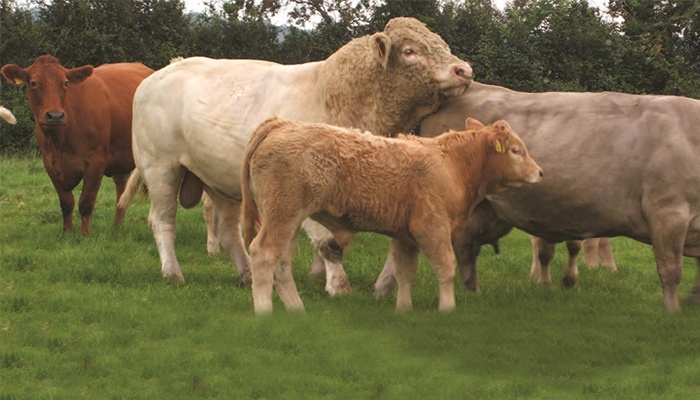
As calving season winds down, it’s time to shift your attention to breeding. Some preparation now can make all the difference later. Sarah Lily James tells us more.
Bull
Your bull significantly impacts the genetic make-up of your herd. Look for good legs and feet with no sign of lameness. He should also have a strong drive to mate and be producing enough healthy sperm. If you had any problems last year, it’s worth getting a fertility test done – it’s a small cost compared to carrying empty cows through the winter.
Cows
Ensure cows receive adequate mineral supplementation before breeding commences. If problems have occurred in the past, consult with your vet and blood test 6-8% of cows at least three weeks before breeding and take corrective action as needed.
Cow condition is another vital factor – cows should be at a BCS of 2.5 at breeding for both spring and autumn calving herds. Cows in good condition conceive faster and calve down easier next year.
Heifers
Replacement heifers are the future of your herd. Breeding your own replacements reduces disease and if done well, improves genetics and saves money. Look for good feet and legs – you can often get a sense of this by looking at her dam. The dam is also a useful guide for milk production, temperament, and fertility. For the sire, look for positive figures for daughter milk and negative figures for daughter calving interval.
Good body shape without excess muscle on a small animal helps reduce calving difficulty. Weight for age also matters – aim for 1.1 kg per day from birth, achieving a pre-breeding target of 60% of their mature live weight. A Eurostar rating of 4 or 5 stars is recommended, with positive figures for milk and temperament, and negative figures for calving interval to keep calving compact.
Getting the bulls, cows and replacement heifers right sets you up for a smooth breeding season, and a successful calving season next year.
Watch out for grass tetany
With most herds now out grazing, keep a close eye out for grass tetany, also known as staggers. This is caused by a magnesium deficiency and tends to happen when animals graze heavy, lush paddocks that are high in potassium and phosphorus but low in fibre and magnesium.
Signs to watch for include muscle twitching, staggering, and nervousness.
For prevention, consider:
- Adding CalMag to meal
- High-mag buckets or blocks
- Magnesium boluses
- Dusting pasture with CalMag powder
Making the most of your first silage cut
Cutting silage removes far more nutrients from the soil than grazing. For every tonne of grass per hectare, 3.2 units of phosphorus (P) and 24 units of potassium (K) is removed. When land is grazed however, around 60% of the P and 90% of the K is returned to the soil through animal dung. Aim to cut in May to hit a dry matter digestibility (DMD) of 75%. Teagasc research shows that leaving cutting beyond late May can reduce DMD by 2–3% per week.
To get the best from your first cut, slurry should be used as efficiently as possible. Unfortunately, the wet conditions this year may have made grazing silage ground difficult, leaving heavy covers of 1,000–1,200 kg DM/ha that are unsuitable for slurry application. In that case, a good compound fertiliser high in P, K, and sulphur is your best option, something like 13-6-20+S or 12-8-20+S at 3 bags per acre. Top this up with protected urea and sulphur (e.g. 38+7 or 40+7) at 1.5–2 bags per acre. Sulphur can help plants to use nitrogen more efficiently and supports higher yields. Of course, nutrient application should always be dictated by the result of your soil samples.
Some useful information to note is that a typical first cut of 5 T DM/ha (or 10 T fresh grass per acre) needs approximately 80 -100 units of nitrogen, 16 units of phosphorus, 100 units of potassium, and 15 units of sulphur.
BISS – don’t miss the deadline
Make sure your BISS application is submitted before 15th May.
You can make changes to your application, such as correcting your claimed area or adding new land parcels, up until 31st May without any penalty. Late applications and changes are accepted until 9th June 2026, but a penalty of 1% per working day late will apply for each day beyond the deadline.