
Windthrow and what we can do to build resilience
Niall Farrelly and John Casey, Teagasc Forestry Department, look at factors linked to windthrow in Irish forests and if opportunities exist to increase resilience in our forests through smart silviculture which can make forests more wind resistant.
Many private forest owners have experienced windblow in their forests – a result of Storm Eowyn, which occurred on the 24th of January 2025. Some growers may ask the question why replant with spruce, if the species is going to be blown down again in 10, 20 or 30 years? The research and data suggest that while Sitka spruce does not blow down at 10 years, and rarely blows down at 20 years, it can be vulnerable after 20 years of age given the high growth rates experienced on Irish soils.
Since Storm Eowyn, the question arises: Is there a timber tree out there that can withstand the impact of storms? Such a tree would need to produce deep, stable root system, be capable of performing and developing on poorly drained and impermeable soils and withstand blowing over once it reaches maturity. This gives rise to a further question: Are there ways to reduce the risk of storm damage to our forests?
While such disturbance events can teach us valuable lessons that a wider range of species can and should be considered for Irish forestry, it perhaps points to the need to design our forests to be more resilient to wind damage. However, an appropriate tree for many sites depends on the objective of the landowner and its ability to survive and prosper.
The planting of trees in a forest requires appropriate silviculture knowledge and an objective of management are the trees to be utilised to produce a valuable crop for the farmer or used provide ecosystem services or biodiversity. Whatever the objective, these trees require to be capable of withstanding windy environments and storm events.
In this article we will look at factors linked to windthrow in Irish forests and if opportunities exist to increase resilience in our forests through smart silviculture which can make forests more wind resistant.
Wind climate
For the most part of Ireland, our mean wind climate ranges between 7 to 25 km/hr (kilometres per hour). The literature suggests that sustained mean wind speeds of approximately 80–105 km/hour can cause trees to be uprooted, especially where rooting is restricted.
Wind gusts are perhaps more relevant for forestry. Sustained wind gusts in Storm Eowyn reached 142 km/hr. In storm Darwin in 2014, the storm had sustained wind speeds up to 120 km/hr and gusts reaching 160 km/hr.
In both storms, the gusts were far more than those required (e.g. 80–105 km/hr) to cause significant damage, including the uprooting of trees. In the case of these almost unprecedented winds, we have limited opportunities to prevent damage to forests, especially where forests are at a critical development stage.
Probability of windblow
What is the probability of windblow to a given forest in Ireland? To determine this, we need to determine the likelihood that two independent events occur simultaneously in the same year – the occurrence of a storm and that the fast-growing forest is in a vulnerable development state.
We can estimate the probability of a storm occurring once every 10 to 15 years from historical data on windblow in Irish Forests. Therefore, the probability of a storm in any single year is 12.5 percent (%). The forest is vulnerable for 10 years out of every 30 years (at age 20 and beyond) or for 33% of its lifetime.
For damage to occur, a storm must happen and the forest must be at the vulnerable developmental stage. Assuming these events are interdependent, the probability of damage occurring in any given year is 3%. However not all storms occur at the same location and other factors predispose a forest to windblow, including:
Site topography:
The shape of the land (e.g., hills, valleys) can accelerate the wind. Sites in exposed locations and those that face the prevailing wind direction (i.e. the south-west in Ireland) are more vulnerable. While sites that are in sheltered valleys are more secure, flat sites and sites located on westerly slopes are more vulnerable to windthrow. Forests on wet mineral lowlands are particularly vulnerable as they are often fully exposed to the force of the wind and act like a windbreak, initially they withstand the wind up to a certain point after which the trees begin to fail and blow over, whereas deep rooted trees tend to snap or break.
Soil conditions and drainage:
The rooting system which provides stability to the tree is governed by soil type in which it is planted. Soils with a high percentage of clay particles are very fertile, but some also tend to have restricted drainage, they tend to hold water at or near the surface.
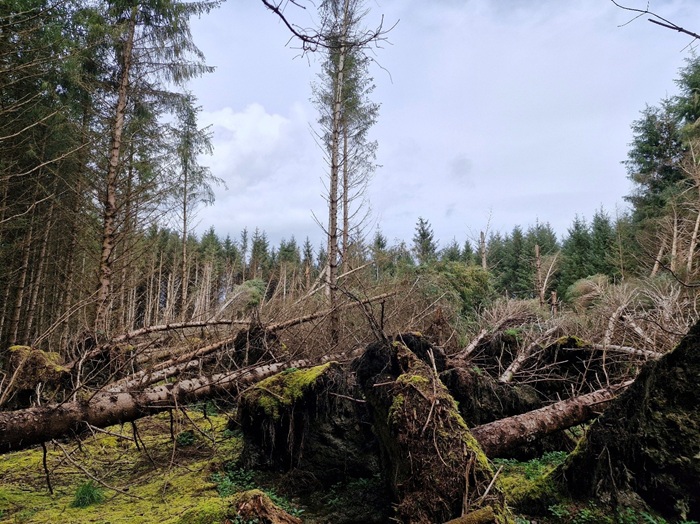
On these soils, tree root systems are restricted in growth by cold and wet conditions and high-water tables and often develop into a flat, plate-like structure, restricted in depth owing to anaerobic conditions reducing tree anchorage (Picture 1). Normally, stability is maintained through the lateral roots and by the support of neighbouring trees, which happens in the upper canopy, when trees are intermeshed with each other, once the canopy is disturbed, trees are forced to withstand the force of the wind on their own merits.
Drainage is a key factor influencing tree stability. Research shows that trees on more poorly drained sites (Gley soils), have a much higher probability of windblow compared to very well-drained sites. And many trees blew over in Storm Éowyn were associated with restricted drainage, however the force of the wind was enough to topple mature broadleaved trees on well drained soils. The provision of drainage is essential to maintaining stability as excess water on sites increases the risk of windthrow.
Site cultivation practices such as ploughing and mounding can show higher windthrow incidence. Mound drains serve to remove surface water but may act to reduce radial root development for trees planted on mounds closest to the mound drain. Roots can be confined to the mound and can be limited in growth by the presence of a drain. The direction of mounding can also influence windblow, with drains perpendicular to the prevailing wind often more vulnerable, trees are often blown across the mound drain which provides an entry point for instability in the forest for windblow (Picture 1).
Picture 1: Windblow in Co. Roscommon, trees blown in Storm Eowyn, and blown from south westerly winds.
Stand characteristics and management
When trees reach maturity, their exposure to the wind increases, taller trees stand up over the surrounding landscape and the wind force increases exponentially with elevation, thus taller trees are more vulnerable. Therefore, at age 20 to 30 years where trees at 20 to 25 m in height they are at increased risk of windthrow due to increased mechanical loading by the wind than smaller trees 10 to 15 m.
Thinning and mechanical stability
Thinning serves to break the canopy and allow an entry point for wind into a forest. Unthinned forests have intact canopy’s which deflect the wind, whereas thinned forests create conditions where individual trees, lack the mutual support of neighbouring trees and the ability to offset the wind along the canopy chain – and each tree is forced to withstand the force of the wind on its own. Thinning increases short-term vulnerability, especially until up until a time that the trees can adapt to their new conditions. Poor timing and heavy thinning increase vulnerability, especially when trees are suddenly exposed to unexpected high winds. Thus, if a thinning takes place a year before a storm events, the tree has had little time to recover and adapt to the new growing space.
Thinning if practiced should be early or on time, early thinning fosters gradual adaptation of the tree to its environment with better root and stem development. While heavy thinning increases short-term exposure to windblow, it can promote the development of trees which can reach final harvest earlier, producing the economic return before windthrow becomes a significant issue, but should be practiced early to encourage adaptation. In such cases where windblow is a concern, light and moderate thinning are less risky as they limit the disturbance to the canopy, while providing much of the benefits of thinning.
Implications for forest management
A review of research offers critical advice for forest managers in high-wind regions:
1). Site selection and planning is crucial:
Examine the soil type, remove surface water and maintain drains and plan the direction of mound drains with knowledge of the prevailing wind. Consider increasing the distance between mound drains, where appropriate, to encourage lateral root development.
2). Use early, moderate or limited thinning:
This promotes adaptation to the wind environment and the development of stronger root/stem structures. In certain cases, options include no thinning on poorly drained soils or limiting thinning to light thinning facilitated by two thin operations. In these cases, early thinning should be favoured with earlier preparation for final harvest once a desired tree size is attained.
3). Minimise edge exposure:
Avoid abrupt creation of forest edges or gaps by introducing forest roads and creating brown edges in forests, as these edge trees are not acclimatised to the wind and create entry points for windthrow (Picture 2). The possibility of using mixed-tree species buffers which occur naturally in the landscape should be considered.
4). Avoid ploughing where possible:
Consider pit planting or practice mounding with the aim to preserve rooting integrity. The placement of mounds in the vicinity of mound drains needs to be considered, since this location can negatively impact on 360-degree rooting of trees.
5). Integrate topographic and wind data:
While not significant in all cases, topographic exposure remains a practical planning tool. A windthrow risk assessment performed as part of the overall management planning process will help to evaluate and identify risks, and to identify possible improvements to minimise damage.
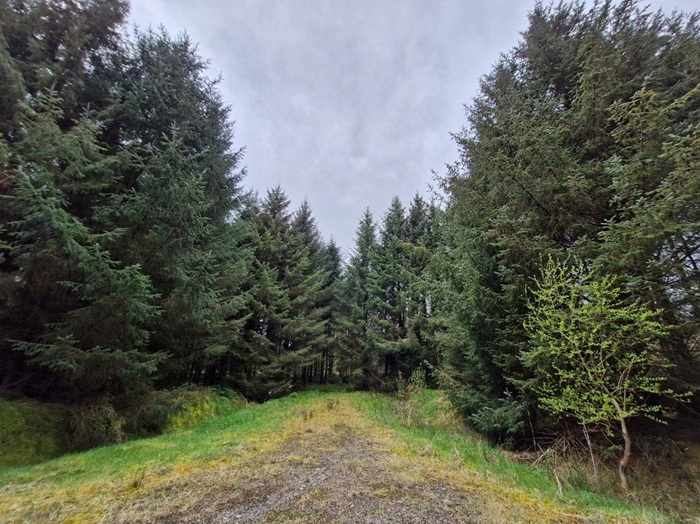
Picture 2: An unplanted area serving as a road turntable, trees have full green canopy to the ground level, becoming fully acclimatised to the wind climate.
Conclusion
Windthrow is a complex, multifactorial risk shaped by interactions among wind dynamics, site characteristics, stand structure, and management history. Catastrophic wind damage which occurs during major storm events is strongly associated with tree height and poor drainage. Thinning can influence long-term forest structure and wind resistance, though its short-term destabilising effects must be managed carefully. Research underscores the need for integrated risk-based forest planning that balances productivity with resilience – particularly as climate change may increase storm frequency and intensity in Ireland and beyond.
Refor Event
Forest owners who have had forests that have experienced storm damage are encouraged to attend a Reforestation after Storm Damage on Thursday, 30th April in Castlerea, Co. Roscommon. The meeting point is St. Kevin’s GAA, O’Rourke Park, Castlerea, Co. Roscommon, Eircode – F45 K500. Attendees are encouraged to arrive between 10:30am and 12pm and will be bussed to a local forest site.
Further details on the Reforestation after Storm Damage event are available here.