
Understanding the seasonal milk fat reduction
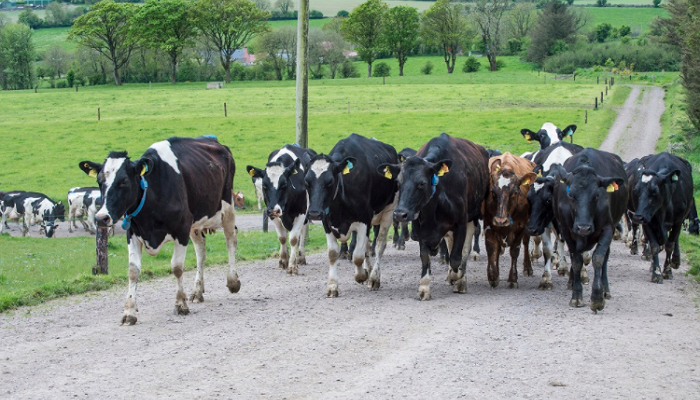
Nationally, milk fat percentage consistently declines from spring to summer in Irish dairy systems.
As part of the Moorepark Open Day, Christopher Heffernan and Michael Dineen examined some of the possible causes, read their full paper below:
Milk fat contributes to the economic value of milk, as it can be processed into various food ingredients, including butter, cheese, cream, and whole milk powder. Milk fat is the most variable component of milk, with fluctuations driven by nutritional, environmental, and genetic factors.
In Ireland, there is a consistent annual reduction in milk fat percentage from spring (i.e. February/March) to summer (i.e. May/June), with a 0.44% reduction observed nationally during 2023 (CSO, 2024; Figure 1). The predominantly spring-calving system employed in Ireland likely contributes to a proportion of the annual reduction as it coincides with peak lactation.
However, previous research suggests that the reduction occurs typically in May for both spring- and autumn-calving cows, suggesting that the time of year may influence milk fat more than the stage of lactation. Therefore, this seasonal decline in milk fat percentage may be associated with dietary factors (e.g. pasture fibre concentration) or environmental influences (e.g. day length) during this high-risk period.
Nutritional impacts
During the high-risk period (i.e. April/May/June), reductions in milk fat production have been suggested to be driven by nutritional factors such as low fibre and high fat concentrations in pasture.
Fibre digestion provides building blocks for milk fat production while also maintaining stable rumen conditions. If rumen conditions are unfavourable and too much unsaturated fatty acids are consumed, compounds can be formed in the rumen that reduce milk fat production.
Two recent observational experiments conducted on commercial Irish dairy farms did not find evidence linking these factors to reduced milk fat percentage. In both experiments, pasture fibre and fat were maintained at satisfactory concentrations across the high-risk period to maintain milk fat production.
It is possible that milk fat percentage is reduced when this pasture nutritive value interacts with concentrate supplementation. However, the impact of concentrate supplementation on milk fat in pasture-based systems remains inconsistent, with substantial effects likely requiring high levels of concentrate supplementation (e.g. > 5 kg/day) or significant changes in concentrate formulation (e.g. high starch content).
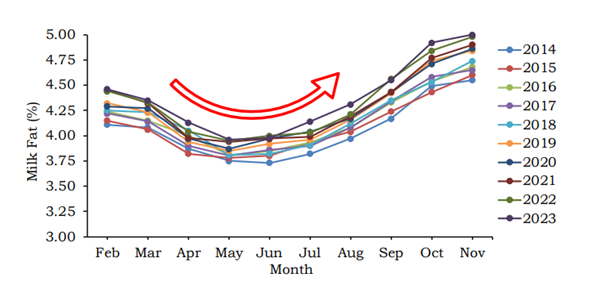
Figure 1. Fat percentage of milk supplied to Irish milk processors each month from 2014 to 2023 (CSO, 2024)
Genetic factors
Selection for high milk fat percentage predicted transmitting ability (PTA) has proven effective in increasing average milk fat percentage. Experiments have demonstrated that for every 0.1% increase in PTA, there is an associated 0.25–0.29% increase in actual milk fat percentage. However, it appears that the reduction in milk fat percentage during late spring to early summer may still occur in herds with high milk fat percentage PTA, suggesting that genetics can raise the baseline but may not prevent the observed decline.
Environmental factors
Recent studies from Penn State University suggest that milk fat fluctuations across the year may be influenced by natural biological rhythms within cows, specifically circannual rhythms, which can be regulated by changes in photoperiod (i.e. day length). These rhythms appear to operate independently of feed quality or heat stress and could explain a considerable proportion of the seasonal variation in milk fat. Furthermore, the magnitude of the effect is possibly influenced by latitude and hence its connection with a change in day length. Interestingly, countries in the southern hemisphere appear to experience an inversed annual rhythm to Ireland. Though the mechanisms are not fully understood, these biological cycles may be important contributors to milk fat fluctuations and could be an important factor to take into account when making management decisions on farms.
Conclusion
The decline in milk fat from spring to early summer presents a substantial economic concern for producers and processors. While genetics and nutrition both influence overall milk fat, they do not seem to explain or resolve the seasonal milk fat reduction. Emerging evidence points towards a consistent annual biological rhythm as a key factor which may be largely outside the control of management.
Acknowledgements
We thank the participating commercial farmers and acknowledge the research funding by the Irish Dairy Levy via Dairy Research Ireland.
For more insights, view the full Moorepark Open Day book here (PDF).