



Breeding
This year’s calving season started on 12th February. Up until mid-April Wesley had 76 cows and heifers calved, with 2 live sets of twins. 12 are left to calve and he is looking forward to being finished. Weather aside, this year’s calving season proved tough. There were 6 caesarean sections and a high number of heifers needed assistance at calving. They were bred to the Angus bull and Wesley has decided to sell him this spring due to the calving difficulty with the heifers. There was also a case of e.coli mastitis in one cow after calving which Wesley has not had before.
On top of that, he lost 3 cows; one from internal bleeding and one from sepsis. While he does not typically sell stock live in spring, the herd is still restricted with TB with the next test due after 29th April.
The breeding season will start on 7th May, although Wesley is considering delaying it by a week after the poor weather this spring. While he succeeded in getting calved cows out to grass with their calves within a few days of birth, grass growth was slow in spring and not enough was carried over from the autumn.
Wesley’s breeding plan for this spring is as follows:
- SimmentalX heifers will be bred to the old Limousin bull
- Third calvers plus will be bred to the new Limousin bull
- A Saler bull will be bought for the heifers
- The Simmental bull will run with the remainder of the herd
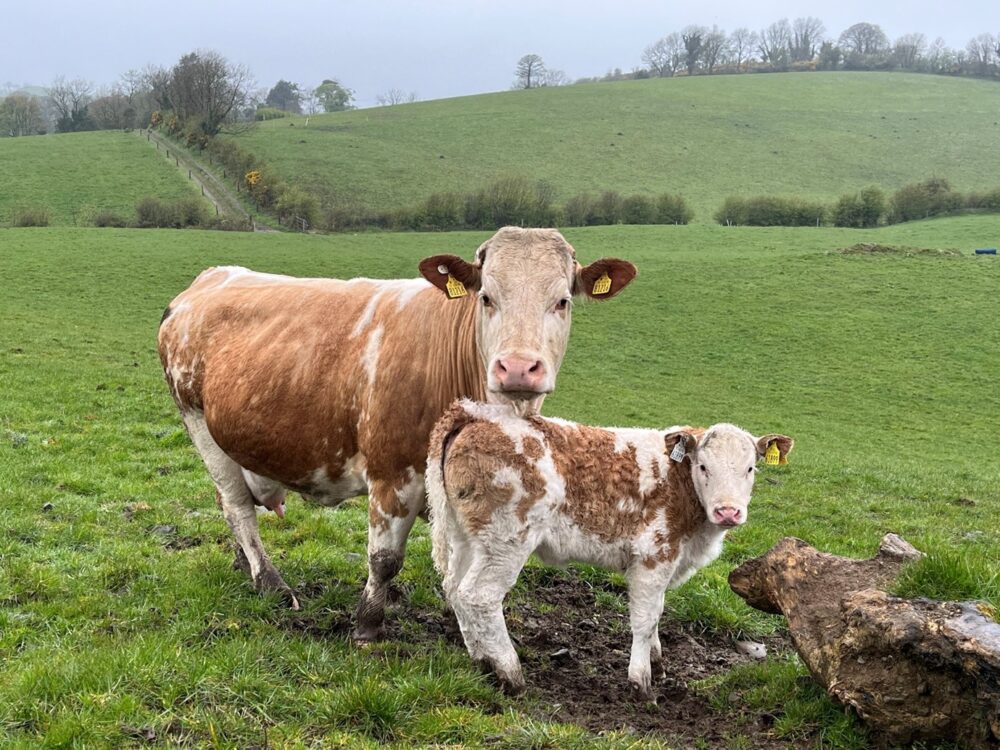
Figure 1: A February 2026 born heifer calf from the Simmental stock bull
All cows and heifers have got their first vaccination against bluetongue. The booster shot will be given 3 weeks later at the herd test to reduce labour and immunity will develop ~3 weeks after the second dose which will coincide with the start of breeding. While there are fewer clinical signs in cattle in Ireland to date than in Europe, infertility remains the biggest concern if there is an outbreak in the herd. It can be transferred 3 different ways:
- Midge transmission – the main route of infection. A midge bites an infected animal and the virus replicated. After 4-20 days the midge can infect another animal.
- Semen transmission – infected bulls can spread the virus through semen.
- Transplacental transmission – the virus can pass from the dam to the foetus.
Grassland – Clover
Wesley is considering how to establish more clover on the farm to reduce chemical nitrogen usage. Some considerations include:
- Soil Fertility
Clover requires fertile soils for establishment and persistence, with a soil pH 6.5, and > index 3 for P and K. Rhizobia bacteria that fix N in association with clover are more productive in soils with a pH of 6.5. 56% of the farm has a soil pH over 6.2, 95% is in index 3 or higher for P and 84% of the farm is in index 3 or higher for K. As soil pH is the most limiting factor, this can be corrected by spreading lime at 2t/acre on the lower pH paddocks which are coloured in blue in Figure 3 below.
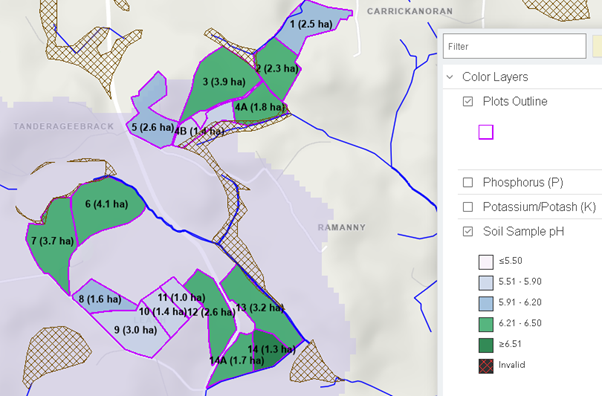
Figure 2: Soil pH on the home paddocks
- How: White clover establishment blueprint
A targeted multi-year approach should be used in establishing a white clover system – a combination of reseeding and over-sowing:
- Reseed approx. 10% per year.
- Over sow approx. 15% per year.
- Year 1 – reseed 10% and over sow 15% = 25%;
- Year 2- reseed 10% and over sow 15% = 25% (50%);
- Year 3 – reseed 10% and over sow 15% = 25% (75%);
- Year 4 – reseed 10% and over sow 15% = 25% (100%) – on going there after.
- Paddocks for a full reseed should be identified as early as possible in the process to avoid over-sowing clover on these (poor performing, age of sward, weed content etc.).
- Seed choice & sowing date
Small and medium-leaved cultivars are best suited to intensive grazing systems, with large leaf clovers more suited to silage-based systems. Varieties used should be from the DAFM recommended list. Clover should be sown ideally when soils are warm and moist – ideally in late April / May. Sowing in the autumn can reduce chances of a successful establishment, as soil temperatures decline so it is more difficult for clover to compete with the grass. White clover can be established on your farm using two methods: 1) direct reseeding; 2) over-sowing.
- Sowing method
Direct reseeding – key steps involved in a full reseed
- Aim to reseed as early in the year as possible (April, May, June), when soil temperatures are high and increasing, and there is adequate opportunity for weed control.
- Soil sample for P, K and pH.
- Spray off the old pasture with a minimum of 5L/ha of glyphosate; allow a minimum of 7 to 10 days after spraying before cultivating.
- Prepare a fine, firm seedbed.
- Use grass and white clover varieties from the Irish Recommended List.
- Cattle sowing rate – 28-30kg/ha of grass plus 3.5-5.0kg of medium leaved clover.
- Avoid sowing white clover seed too deep – sowing depth approx. 10mm.
- Apply 40kg N/ha (30 units N/acre) at reseeding.
- Apply P and K fertiliser as required.
- Roll well to ensure good contact between the seed and the soil.
- Apply 25kg N/ha (20 units N/acre) 4-6 weeks post sowing.
Over-sowing – key steps involved with over-sowing white clover:
- Do not over-sow old ‘butty’ swards with a low content of perennial ryegrass – white clover will not establish well in these.
- Control weeds before over-sowing white clover as weed control options afterwards are more limited. Some herbicides have a residue of up to four months – always check the residual time on the label of the product or seek advice on a suitable weed control product.
- Take a representative soil sample for P, K and pH analysis and correct soil fertility prior to over-sowing. Optimum soil fertility when over-sowing will help increase the chances of success.
- White clover seed can be broadcast onto the sward or stitched in using a suitable machine.
- If broadcasting with a fertiliser spreader: Mix clover seed with 0:7:30 or muriate of potash fertiliser and only add white clover to the spreader when you are in the field to avoid white clover settling at the base of the spreader, with a max of 1ha at a time.
- Stitching in white clover seed with a drill/harrow ensures better seed to soil contact. Stitching can be used for oversowing denser swards.
- Over-sow directly after grazing (≤ 4cm post-grazing sward height) or after cutting the paddock for surplus bales – ideally only over-sow three to four paddocks at a time.
- Sow at a rate of 5.0-6.0kg of white clover seed/ha (2-3 kg/acre).
- Soil contact post over-sowing is one of the most crucial factors affecting germination.
- Reduce N fertiliser post over-sowing to 15kg N/ha per month (12 units N/acre) for two months.
- Select paddocks for over sowing to give the best chance of establishment:
- Optimal soil fertility (index 3 or > for P and K, soil pH 6.5);
- High perennial ryegrass content;
- Open/low density swards – dense swards prevent light getting to new clover plant, hindering establishment;
- Low weed content.
- Any paddocks that are not suited for over-sowing in the first year (but not ear marked for reseeding) should have any issues corrected and over sown the following year. These include the correction of soil fertility issues and the spraying of any weeds well in advance of over-sowing to allow for residual time frame.
- Management of grass-clover swards after over-sowing
Poor establishment results have been obtained where grass gets too strong after over-sowing. Swards need to be grazed tight after over-sowing clover, for the first three grazings post sowing, both for direct reseeding and over-sowing (<1,200kg DM and grazing to ≤ 4 cm). By doing this, it allows light to penetrate to the base of the sward which is essential for clover establishment.
Weed control is an essential element in both direct reseeding and over-sowing. Weeds in new reseeds are best controlled when grass is at the 2-3 leaf stage and clover is at the first trifoliate stage, with a clover-safe herbicide. When over-sowing clover into existing grass swards, it may be better to control more established weeds before over-sowing white clover into the sward.
Performance
The bulls are still on 9kg of ration/head/day, in combination with excellent quality silage which is fed through the diet feeder. They were weighed on 18th April (36) and averaged 561kg after gaining 1.51 kg/day since the last weighing. In their lifetime they have averaged 1.33 kg/day. The weights ranged from 401kg to 674kg and Wesley expects to start drafting them for the factory in May.
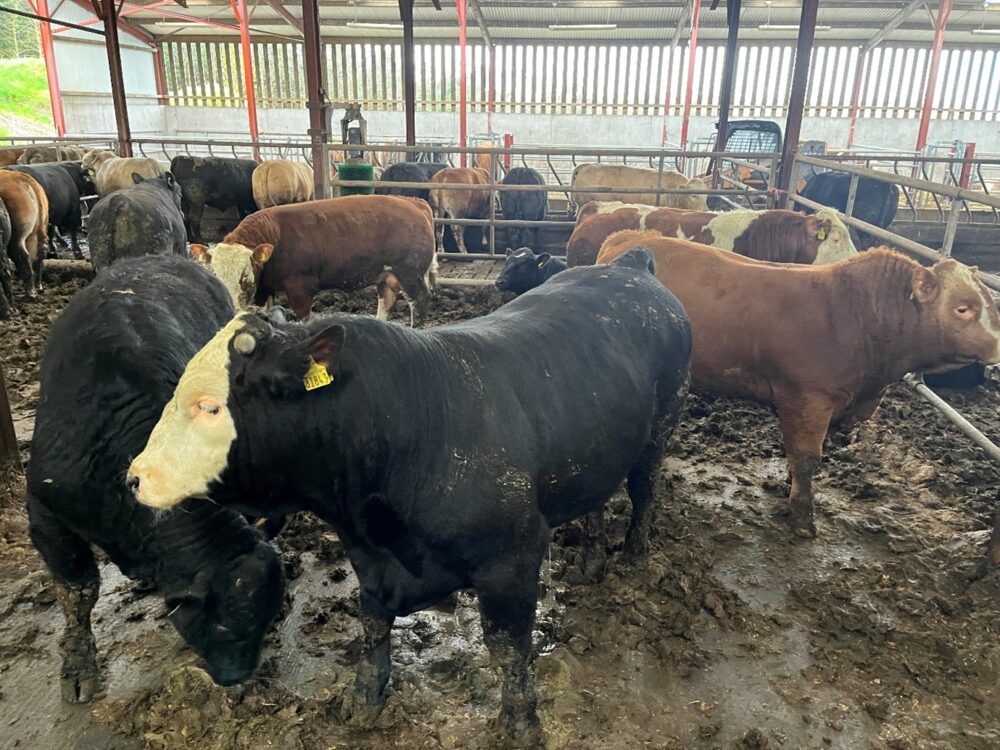
Figure 3: Finishing bulls averaged 561kg on 18th April