
Deadline approaching for National Sheep Welfare Scheme
Along with outlining the key actions, Anne O’ Malley, Teagasc Mayo, reminds sheep farmers that the deadline for the National Sheep Welfare Scheme is fast approaching.
Targeting practical actions to enhance animal health and welfare on sheep farms, application for the 2026 National Sheep Welfare Scheme (NSWS) is open online and will close on the 15th of May 2026.
Completion of three chosen actions are mandatory for full payment of up to €13. When combined with the Sheep Improvement Scheme, total payments of €25 per ewe are delivered.
Actions undertaken are in respect of the payable number of eligible ewes selected at application, which is determined on previous years (2023-2025) census numbers.
Farmers must complete actions by the chosen date of either the 13th of October 2026 or the later date of 24th of November 2026. Applicants should note that this later date will result in later processing of payment. Complete actions in full, retain all dockets or receipts, Scheme Action Record Sheet, and all supporting documentation for the one-year duration of the scheme plus one additional year.
Scheme actions
There are five actions in the scheme and farmers must complete two actions from Category A, which are mandatory, and one action from Category B which is voluntary. If a farmer does not wish to undertake a voluntary or optional action, they can still apply by selecting and completing two mandatory actions, in which case they receive a lower payment of €8 per ewe.
| Category A (Mandatory) | Category B (Optional) |
| 1). Shearing | 1). Foot bathing |
| 2). Body condition scoring ewes and appropriate follow-on management | 2). Plunge dipping to control external parasites |
| 3). Vaccination of ewes |
Farmers opting for the Shearing Action must complete in full by completion date chosen at application stage and provide documentary evidence of its completion, including completion of the Scheme Actions Record Sheet provided.
Body Condition Scoring (BCS) of breeding ewes has a significant effect on performance and productivity and farmers who choose this action must conduct scoring on all ewes twice, with an interval of eight weeks between assessments. Complete the first BCS between 15th of April and 15th of July 2026 and the second BCS between 1st of August 2026 and completion date chosen at application stage. BCS identifies ewes that are thin and not thriving and these ewes can receive preferential treatment, including housing, access to better quality grass, forage and/or supplementation.
Applicants to the NSWS 2026 can choose to complete either Clostridial or Bluetongue vaccination in consultation with their vet. Clostridial diseases affect sheep of all ages depending on the strain and vaccination will help protect from potentially fatal bacterial infections. Farmers must complete action by the selected date chosen at application stage. If breeding ewes are not in receipt of a clostridial vaccination, you may vaccinate lambs as an alternative, from 3 weeks of age and a second booster no later than 4-6 weeks after the first vaccination.
Bluetongue is a viral disease transmitted by biting midges and can cause significant economic losses, particularly in sheep and vaccination reduces severity and virus levels but may not give complete protection. Vaccinations that are currently available for purchase in Ireland will only be effective against bluetongue serotype-3 (BTV-3) and there are three BTV-3 vaccines authorised for use in Ireland under licence. Farmers may obtain BTV vaccines from their veterinary practitioner, under licence from the Department.
Foot bathing and Plunge Dipping to control external parasites are optional Category B actions. Complete Foot bathing action at least twice over the period from 1st April 2026 to completion date chosen at application stage and leave a two-week interval between events. The updated 2026 NSWS Terms and Conditions allows the use of Copper Sulphate or Zinc Sulphate to improve overall hoof health and thus reduce lameness in sheep. Where the primary purpose of the footbath is to control harmful organisms and prevent infection spreading, it must contain an appropriate registered biocidal product. Details of registered biocidal products for NSWS are available here.
Follow all label instructions and precautions when using biocidal products to protect human, animal health and the environment.
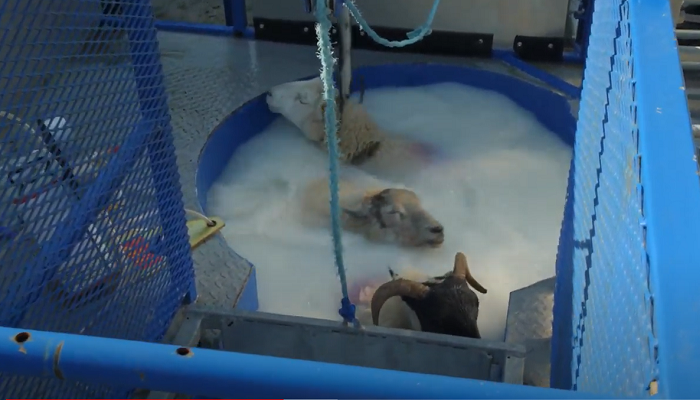
Plunge dipping can be carried out on farm where the flock owner has their own plunge dip or by a mobile plunge dipping service operator. Plunge showering will not be acceptable as an alternative to Plunge Dipping. Check out best practice sheep dipping guidelines under Sustainable Use Directive (SUD), DAFM Cross Compliance requirements and Health and Safety Authority (HSA) well in advance of operation. Follow all label instructions and precautions when using sheep dip products to protect human, animal health and the environment.
Applications can only be made online at www.agfood.ie either by the applicant or their FAS advisor by 15th May 2026 and any queries regarding the National Sheep Welfare Scheme please contact your local Teagasc office.