
Current status of broadleaf weed resistance
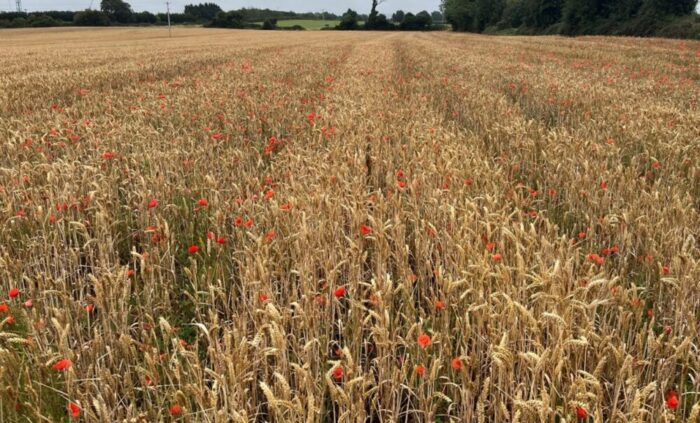
Effective broad-leaved weed control, especially in spring crops, has become a growing challenge. Vijaya Bhaskar, Teagasc Research Officer, gives an update.
Monitoring of herbicide resistance in broadleaf weeds has been ongoing since 2022. To date, 19 populations have been confirmed as ALS-resistant (Figure 1), showing resistance to sulfonylurea (eg. Cameo Max, Pacifica) and triazolopyrimidine (eg. Boxer, Broadway Star) herbicides (Figure 2).
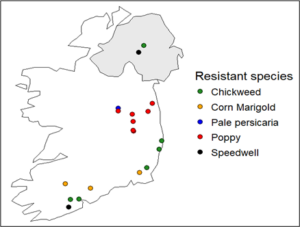
Figure 1. Maps showing the known prevalence of ALS-resistant broadleaf weed populations, with marker colours indicating each species.
- Chickweed: Six populations collected in Cork, Wicklow, Wexford and Northern Ireland were resistant to both ALS sulfonylurea and triazolopyrimidine All populations carried the Trp-574-Leu mutation, with three also possessing the Pro-197-Ser mutation. Previous research from Oak Park has confirmed several cases of ALS resistance in this species.
- Poppy: Seven populations from Kildare and Meath were confirmed as ALS-resistant. All populations possessed a diversity of amino acid substitutions at the Pro-197 position (Leu, His, Arg, Thr) conferring resistance primarily to ALS sulfonylurea Two populations also carried the Trp-574-Leu mutation, which confers additional tolerance to ALS triazolopyrimidine herbicides. Some strains also showed reduced sensitivity to hormone-type herbicides (Figure 3).
- Common field-speedwell: Two populations from Cork and Northern Ireland were resistant to both ALS sulfonylurea and triazolopyrimidine herbicides due to Trp-574-Leu mutations.
- Corn marigold: Three populations from Cork and Wexford were resistant to ALS sulfonylurea herbicides due to multiple substitutions at the Pro-197 position (Leu, Thr, Gln, Ser).
- Pale persicaria: A population from Westmeath, received from the 2025 harvest, was confirmed resistant to both ALS sulfonylurea and triazolopyrimidine herbicides due to a Trp-574-Leu mutation.
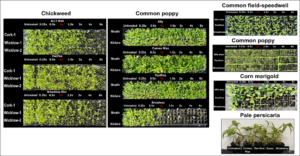
Figure 2. Ineffective weed control in suspect resistant broad-leaved weed populations following application of ALS herbicides.
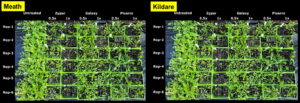
Figure 3: Response of ALS-resistant poppy populations from Meath and Kildare following application of half and full label rates of the ALS + hormone herbicides Zypar (1x = 0.75 L/ha) and Galaxy (1x = 1 L/ha) and the hormone-type Pixarro (1x = 0.5 L/ha). Each product was tested in six replicates (Rep).
Weed resistance is becoming an increasing challenge in Irish tillage crops, with 11 species now confirmed as resistant: 6 grasses (blackgrass, Italian ryegrass, wild oats, annual meadow grass, rough-stalked meadow grass, and rye brome) and 5 broad-leaved weeds (common poppy, common chickweed, corn marigold, common field-speedwell and pale persicaria).