
Don’t let scald be a gateway to more costly lameness issues
Sheep farmers have been urged to act on scald early, rather than delaying treatment and facing the prospect of more costly infectious lameness control strategies.
That messaging came from Jake Delaney, Walsh Scholar at Teagasc, who joined Ciaran Lynch on a recent episode of the OviCast podcast.
Caused by an abrasion in the foot which permits bacteria ingress, Delaney noted: “Scald is a painful condition which causes severe lameness very quickly that can spread between ewes and lambs.”
Where treatment is delayed, the condition worsens, with farmers advised to “act early when you see these first few cases and treat them”.
Jake Delaney’s research focuses on the causes of lameness on Irish sheep farms, finding that the majority of lameness cases are caused by infectious conditions such as scald, footrot of contagious ovine digital dermatitis (CODD). Interestingly, Delaney highlighted that scald is often the starting point for more for the more severe causes of lameness.
“If we get on top of scald early, we are minimising the impact on performance on lambs and ewes. We are saving ourselves treatment costs as well; we are not going to have to use antibiotic treatments that are necessary to treat footrot and CODD. Conditions like scald are highly treatable with just footbaths or topical sprays and they are going to be easy get on top of to prevent cases going into the future.”
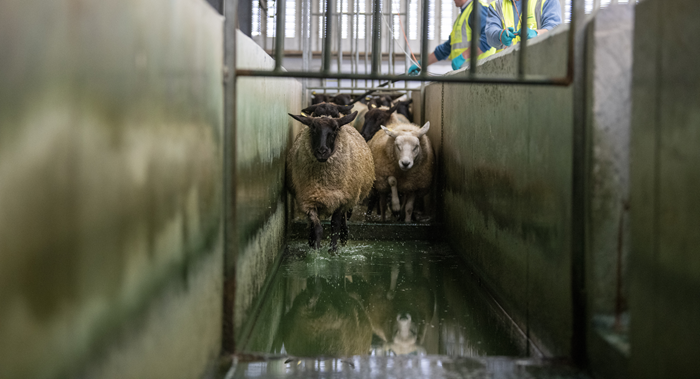
As for treatment options, Jake Delaney noted that a whole flock approach using zinc of copper sulphate filled footbathing is preferred as the bacteria responsible for scald spreads quickest before causes of infection become evident. Footbathing also reduces the bacterial load present within the flock through the disinfection of hooves. If only lame sheep were treated using topical sprays, there’s a risk of non-lame sheep exhibiting the condition in the days post handling.
Along with the bacteria being present within the flock and on pasture, Delaney noted that gathering sheep is a high-risk period for scald spread. Therefore, tasks such as dosing should be coupled with a footbathing event.
As regards footbathing practice, Jake Delaney said that batch footbaths are preferred, adding:
“Contact time or standing time is probably one of the most important things when you are using zinc or copper sulphate. A minimum of 15 minutes is required to allow the solution to disinfect and kill that bacteria present and to penetrate the hoof.”
Once finished within the batch footbath, he encouraged farmers to make use of a dry, hardstanding area to allow the solution to dry and to prevent it being wiped of the sheep’s feet when returning to pasture.
For full insights, listen to the full episode of the OviCast podcast below: