
African Swine Fever in Spain – Industry growth meets emerging disease risk
Spain’s pig industry faces a serious challenge from African Swine Fever. Michael McKeon, Teagasc Pig & Poultry Specialist, tells us more.
Over the past two decades, Spain has transformed its pig industry into one of the most dominant forces in global pigmeat production and export. In 2010, Spain’s pigmeat exports to destinations outside the EU were comparable to those of Ireland, now they are one of the biggest exporters in the world. Despite this remarkable growth, the recent emergence of African Swine Fever (ASF), a disease similar in impact to ‘foot & mouth’, presents a significant threat to this success story, raising concerns for producers and exporters, not only in Spain but across the wider EU.
Expansion of the Spanish Pig Industry
Since the early 2000s, Spain’s pig sector has undergone rapid expansion, driven by a combination of efficiency gains, integration, and strong international demand. The country is now the largest pig producer in Europe, with a highly modernised and export-oriented industry.
The rapid growth of their export pigmeat market has been particularly striking. In 2005 they exported 160,000 tonnes and twenty years later they now export 1.34 million tonnes, an increase of approximately 800% in 20 years. Today, Spanish pigmeat exports account for aboutn32% of total EU pigmeat exports, which stands at approximately 4.2 million tonnes.
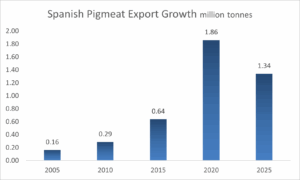
Spanish Pigmeat Export Growth 2005-2025 (Eurostat 2026)
However, the size of the Spanish herd, and more importantly the importance of its export market to provide product demand, means that any disruption, particularly from disease, can have far-reaching consequences for the whole of the EU market.
Current ASF Situation in Spain
African Swine Fever is a highly contagious viral disease affecting pigs and wild boar and has become one of the most serious threats to global pig production. While it poses no risk to human health, its economic impact is severe due to high mortality rates and strict trade restrictions imposed on affected regions.
Spain experienced its first outbreak of ASF in November 2025. Since then, they have implemented geographical zonal control measures to restrict disease spread. To-date they have experienced:
- 232 total positive ASF cases
- 40 different confirmed outbreaks
- cases spread across 10 municipalities
- 5 new cases reported in recent weeks
Encouragingly, all recent cases have been detected within the restricted area and have been found in wild boars rather than commercial pig units. This suggests that the containment measures are having some effect and that the disease has not yet spread beyond the initial control zone. Maintaining this containment will be critical in preventing wider dissemination across the country. However, the presence of ASF in wild boar populations adds complexity to containment efforts. Wild boars act as a natural reservoir for the virus, making eradication significantly more difficult. The high density of pig farms in nearby regions further compounds the risk. This underscores the importance of strict on-farm controls and monitoring.
Implications for the EU pigmeat trade
The detection of ASF cases in Spain had immediate implications for its export-driven pig industry. Many countries impose strict import bans on pork from regions affected by ASF, even if outbreaks are regionalised. Given the sheer scale of Spain’s exports, any disruption to trade flows have significant economic consequences for the whole EU pigmeat sector.
The EU sow herd declined between 2020 and 2025 by 13%, equivalent to around one million sows. This resulted in a downward trend in EU pigmeat self-sufficiency, which was forecast to have declined from a peak of 126% in 2021 to a low of 115% in 2026 (Eurostat). The expectation for the sector was that pig supply would remain quite tight and therefore pig price would remain relatively stable. However, the Spanish ASF outbreak caused an 18% year-on-year contraction in Spanish pigmeat exports outside the EU. For the months of December and January alone, this has resulted in an extra 38,000 tonnes of pigmeat (Eurostat) remaining within the EU market, thereby depressing the average EU pig price. In today’s world, a disease outbreak in Barcelona can have a direct effect on the Ballyjamesduff pig price!
Looking forward it is important that the Spanish ASF cases are eliminated and the country regains its ‘ASF free’ status. However, this can only be declared 12 months after the last ASF case is reported, so unfortunately, we will be waiting a bit longer for this to happen. The Spanish case also re-emphasis the important of keeping Ireland ‘ASF-free’ through continued stringent national bio-security measures.
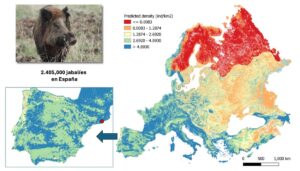
Wild boar concentration (boars/km2) (Institute for Game and Wildlife Research)